
Hand Tool Headlines
The Woodworking Blogs Aggregator
“Glory to God in the highest heaven, and on earth peace to those on whom his favor rests.” - Luke 2:14
Be sure to visit the Hand Tool Headlines section - scores of my favorite woodworking blogs in one place.
Norse Woodsmith Blog Feeds
Wax Processing II
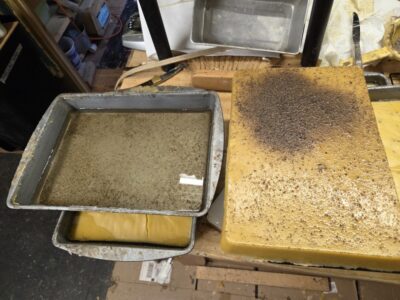
Once the molten beeswax cools in the cake pan after filtering for gross contaminates, the next day I pry out the now-solid blocks from the pan. The contents of the pan are in two phases, the water and the block of wax that forms on top of the water. By not disturbing the molten concoction once it is poured, the contents settle into their respective layers. That which is compatible with water goes into the water. That which is not water compatible remains in the wax block after having settled to the bottom of that fraction.
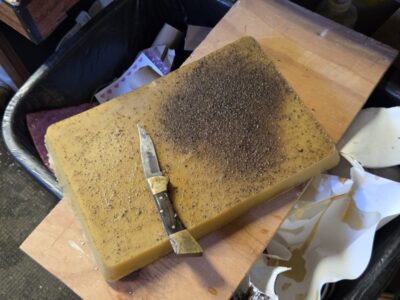
Flipping the now-solid block gives access to the contaminates that aggregate along the interface at the bottom of the wax.
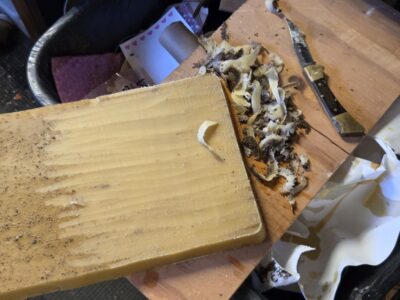
These contaminates are easily removed by ultra low tech methods; I simply scrape away and discard the bottom layer of the wax block that contains the particulate contaminate.
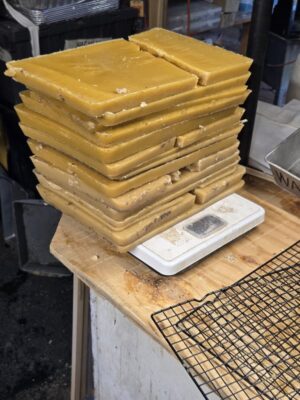
Behold, the almost thirty pounds of partly purified beeswax. At that point the material has had perhaps 75% of the particulates removed and is ready for the next step.
Stay tuned.
hardware/screw mini dresser.......
I wasn't going to start anything today but it just fell into place. Started it and fingers crossed, I'll be finishing it sometime next week.
 |
| hmm.... |
I have 39 of these plastic containers. They are phillips head wood screws, sheet metal screws, and machine bolts along with picture hanging do dads. Way too much crappola to put into the mini 3 drawer dresser from yesterday's post.
 |
| story stick |
Initially I thought I would keep everything in the plastic containers but nixed it. Zoomed past that idea and settled on individual compartments. This story pole is for a 9 compartment drawer, with 5 drawers total. The number of drawers is subject to change, up or down.
 |
| rough sketches |
Thinking ahead, I really don't have a hole for this (when finished) but I'll find one. Rough measurements are 12" across, 12" deep, and about 14" high.
 |
| sigh |
I missed it again. I should have sawn the two long edges parallel before squaring the end grain ends. Fixing that boo boo cost me a little more then a 1/4" lost between the end grain ends.
 |
| couldn't avoid it |
I had to glue on a 2nd board to get the length I needed. I'll put that small glue on towards the back.
 |
| made a Lowes run |
The 1x12's at Lowes were complete garbage. I found some decent 1x8's that I'll use for the top and bottom. Snagged ten 1/4" poplar slats that I'll use for the dividers. I might need to get more because I'll need 3 per drawer and I'm short for two drawers.
 |
| cooking away |
That is the dresser carcass - two sides, a top and bottom.
 |
| hmm....... |
Got 3 boards left over, not that they will go to waste in my shop. The heat wave must have scrambled the synapses firing in the brain bucket.
 |
| yikes |
That is my bandaged right thumb. I got careless clearing a scrap of wood from the saw blade. The blade grazed the inside edge of it - a superficial wound that the ER took care of lickety split. I was in and out of the ER in less then 30 minutes and back in the shop.
 |
| drawer cross rails |
Mr Thumb shook hands with Mr Saw Blade while I was sawing these out. I had to saw one more - incident free.
 |
| hmm....... |
The R/L opening is about 12 1/4" and these are 24" long. I will only be able to get one front or back from these. I'll have to rethink the drawer stock. I could use 3/4" pine and thin it down to a 1/2". I'll start with the three 1x8's from above.
 |
| checking for twist |
The first one I checked was twist free but the next two had a wee bit that I see sawed knocking out.
 |
| needed a couple of more |
These will be used for the drawer runners. That don't have to be 12 plus inches. I think they will be about 11".
 |
| stickered |
The thinner ones will be the drawer runners and the wider ones are the front cross rails. I will put only two rails on the back. All of these will get thinned down to a 1/2".
 |
| hmm...... |
A little awkward but no headaches using the #3 to flush and smooth the glue joints on the sides, top, and bottom. This is where I left off for the day. No idea when I'll get back to this. The doc said I can work in the shop once I'm home but I shouldn't exert myself for at least a couple of weeks. And I can't lift anything weighing more than 9 lbs.
accidental woodworker
Getting ready for the exhibition
So, the exhibition will be taking place at Birdwood House, Totnes 12th-18th July. These geese will be winging their way there, so time for an oiling.

There will be woodworking demonstrations and stuff for sale, big and small. Drop in and say hello.
one day and counting........
Didn't get much shop time today. Spent most of it nodding out at my desk and watching You Tube vids. I don't get this way often but with what is looming on the horizon....
 |
| it is 13 years old |
This is something my wife kept in her office that is now an orphan. I used it at the VA for to keep my binder clips in them. My wife used it for the same purpose and now it is back in my care. The finish is a little worn but the drawers still work silky smooth.
This was my project for the day. Sanded, scraped it, and applied 3 coats of shellac to it over a period of 7-8 hours. I am thinking of using it to hold specialty hardware items or screws, etc etc.
After I had made this I had to fix a couple of stupid wood tricks it threw at me. The right side had cupped and the top right and bottom drawers were binding. I shaved the inside of the right side with a chisel and eliminated that headache. In the time since then it hasn't come back.
The 2nd headache was the middle rail came loose at the ends. I know I had nailed each end through the outside into the rail but not if I glued it again. It doesn't matter as the repair has held up but I never set and filled the nail holes. I did that today with wood putty.
 |
| see the white dot? |
Got two coats on the body and the wood putty filled nail hole popped like a neon sign. Normally this would send my OCD into overdrive but this is a shop piece of furniture. I can deal with it. This will be done definitely by tomorrow. I don't expect to burn up the shop on sunday doing much of anything beyond sweeping and cleaning things up a bit.
accidental woodworker
Busy Week in the Waxerie
I spent a good deal of time and effort this past week processing beeswax and shellac wax in preparation for the upcoming Handworks 2026 in Amana IA over Labor Day Weekend. My polissoir inventory is lacking and my broom maker is struggling with some health issues so I do not know exactly how that will be resolved.
Since the shellac wax arrives already purified straight from the factory in India, all it needs is to be melted and cast in the silicone molds I made for this purpose.
The beeswax is a different story as it is the opposite of purified when it arrives. My end product is something that is purified using essentially old-fashioned technology.
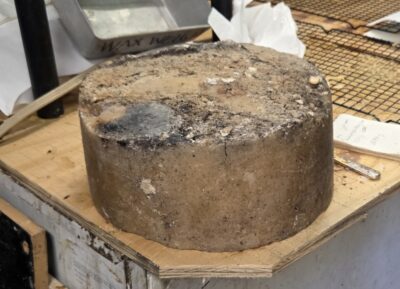
I start with a block of raw beeswax, straight from the honey processing plant. As I recall, the slang of the bee/honey trade is to call this mass of by-product “slum gum.” It’s got residues of honey, lotta dirt and bee body parts.
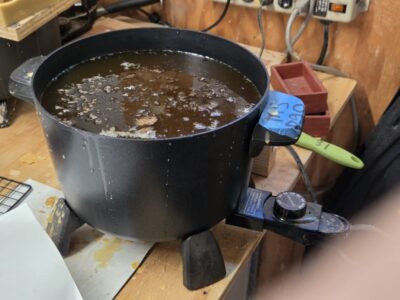
My first step is to break up the blocks of slum gum and melt the mass 50/50 in a water bath in my largest cooking pot.
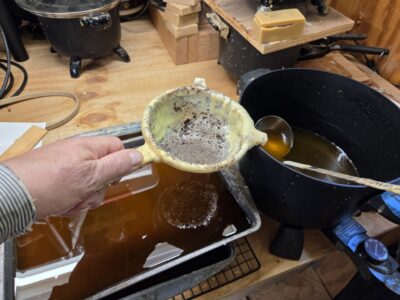

I then pour the molten mass through a kitchen strainer to get the larger particles and body parts out. Downstream from the strainer is a cake pan, into which the remainder goes to cool.

A day of work yields a stack of cake pans that cool over night.
Stay tuned for the second day.
in between.........
I just finished the miniature cherry chest and the cherry bench/plant stand. BTW, daughter #2 said yes, I'll take it. Getting back on track, finished two and there is no project on the horizon at the moment. I have to take a step back and wait until I see what this coming monday says to me.
I have surgery scheduled at the Roxbury VA on monday at 0600. The CT guided biopsy last month confirmed that I have lung cancer in my left upper lobe. Before the surgery they will take a sample of my lymph nodes to confirm that they are cancer free. If they are they will remove the cancerous portion of my left lung. If the lymph nodes are cancerous, it is toast for me and there will be no surgery.
Either way the wind blows this, all I am really concerned with is being able to continue to work in the the shop. Fingers crossed that the lymph nodes come out negative, the cancer is removed, and I'll be able to figure out what the next project from Ralphie's shop is.
I would have started something now but I would only have two days to work on it. I also don't know if the blog will continue after monday - my wife will be posting while I'm in the hospital. I'll make that call after I get back to barn, hopefully on thursday at the latest.
 |
| hmm........ |
The blackening solution worked. The directions were straight forward and the screws matched the color of the hinges. This solution has scary chemicals and I took a lot of precautions using it. If push comes to shove I'll try to get steel next time and use heat to blacken the screws.
 |
| happy with this |
There were a few spots of shiny brass peeking through that I dabbed with a cotton swab to darken them.
 |
| the honey do project |
The back was a plywood wanna be thing secured with staples, no glue. It came off easily and I had no problems pulling out all 23 bazillion of them.
 |
| 1/4" staples |
These staples barely held the plywood back on the bookcase. Just about everyone of them remained on in the bookcase.
 |
| hmm....... |
I had to cut off 15" according to my wife. That went off without a hitch. The bottom and the center shelf were still attached keeping the bookcase reasonably square and together.
 |
| hmm....... |
I got lucky that the rabbet was in the top and not the sides. The joint came apart cleanly and the glue residue scraped off with no headaches.
 |
| sigh |
Glued and nailed the top back on with the 5 penny nails through the sides and the top. It should be ok because it was only previously held together with 3 staples and a bit of glue.
 |
| top on and cooking |
I stapled the back on and nada. The plywood was thin and the staples blew right through them like I was stapling paper. I had to attach the back with 3/4" brads.
 |
| done |
This bookcase is going here in the boneyard. This is the space my wife has decided to turn into a reading room. The left wall has all of my crappola that is facing eviction. Some hard choices coming.
 |
| 100% done |
I mixed up a fresh quart of shellac and put two coats on the bench/plant stand. My wife will be bringing this to daughter #2 in august. On monday the movers are coming to pick up the desks and the dresser to ship them to her. That is the downside of living so many states away from daughter #2.
 |
| experiment time |
I've noticed lately that a lot of the You Tube woodworkers I watch use this saw to rip and crosscut. I am in between so I ripped this piece of pine off following a groove I had plowed in it.
 |
| hmm...... |
Cross cut #1 and it ain't pretty. It is square across but wee bit out to lunch on the plumb cut.
 |
| 2nd crosscut |
Cross cut #2 and it wasn't any better neither. It was square across (no problems there) but still off on the plumb cut.
 |
| 3rd cross cut |
No problems sawing it square across the face. It doesn't matter if I use the japanese or western saw. The problems come when sawing the plumb part. The plumb pencil line helped a lot.
 |
| square |
The easy part of the sawing for me. All of the crosscuts I did were all square.
 |
| better |
The plumb line helps me a lot to saw plumb. I did 8 crosscuts total and went 8 for 8 with square crosscuts and 5 for 8 with square plumb cuts.
 |
| hmm....... |
I bought these clamps a couple of years ago specifically made for using with these machinist's blocks. Today was the first time I used these. Made a cross cut and edge plumb cut with it. Both of them came out dead square. The 2nd set up was making a practice tenon.
 |
| hmm...... |
This is my preferred way to make tenons. Saw the shoulders and split off the cheeks.
 |
| done |
After splitting off the cheeks I use my LN rabbeting blockplane to get down to the knife lines. I should have made a mortise to test fit this but I didn't. Maybe I'll do that in the AM because there is nothing else on the hit parade.
My sister and brother in law stopped in again today for another visit before they head back to Indiana. I'm thinking of driving out there because once you get past New York it is basically a straight shot to where they live in Indiana. Maybe, that is what I told my sister.
The weather lately has been out of sorts. There was a mini heat wave and then it got cold, the kind of cold where I had to turn the heat back on. Now we are back to a mini heat wave. I went to Wally World and bought an AC. The temp at the house hit 93F 34C at 1430. I got the AC now because I will have a weight limitation after monday if the surgery goes through. Got it installed and it is working good - the bedroom temp is down to 70F from 88F.
accidental woodworker
Some sample transcription from that 19th-century door
A follow-up to the previous post about that 19th-century door. One reader, Dennis Santella, was able to create very clear images from some of my photos. How he did it is hocus-pocus to me – all that matters is he did it. I’ll post a few of them here with some partial transcriptions. Thank you to Dennis – and if anyone can fill in my blanks, I’d love to hear from you. The transcription I put in italics, to distinguish from my comments.
 #5814 top batten, left
 #5815 top batten 2nd photo from left
Across part of this batten I can make out the following:
First real snow of the season Dec 4, 1886
First white frost season Sept 21, 1886
Heavy freeze Oct 4, 1886
—————————————————————-
1891 Robins and blue birds Mar 15
Frogs Mar 20
Crickets [evening of?] Oct 2? [7?]
“ “ “ 14
“ “ “ 18
“ “ “ 20
Crickets heard first time on Aug 9
First frost of the season Oct 2,
Total eclipse of the moon Nov 15, 1891 [illegible beyond date]
Dennis showed me the part about the eclipse. I looked it up & there was an eclipse then visible in Massachusetts – over night on Nov 15/16. The next photo of that batten shows a small area blocked off in 2 squares:
 #5816
#5816
June 15, 1887
White frost this AM. No damage to Garden
First frost of the Season Sept 16, 1887
No damage to Garden
I’m pretty sure that first date is 1887. One pass through I recorded it as 1889, but that doesn’t make sense. The last photo of that batten has a few entries on it –
 #5817
#5817
Crickets distinctly [heard?] for first time Aug 5 [?] 1887
Crickets on Oct, 8, 1887
“ “ 17 “
“ “ 18 “
The last part of that batten has records from two different years, much of it I can’t make out.
The worst and longest ____ ____
Of the year with ____ _____ ___ in the
Night of Nov 7, 188_
Thunder Storm & very heavy rain Nov 18, 1886
First Snow of the season Nov 13, 1886
Heavy [thunder?] & ____
Feb 18, 1887 ____ ____
[bottom bevel on right-hand end of batten:]
Bad NE Snow Storms _____
April] 13, 1887 4 or 5 inches _____
____ to 9 PM _________
Some of that beveled section shows up better in a later photo – I cropped it & insert it here:

Westone Thunder I Bass Restoration
As you’ll know, once in a while, I like to do resto project: just for fun really! I’d been hankering for a Westone bass made in the legendary Matsumoku factory and I finally managed to get my hands on one. So, this series of videos is all about bring a 44 year old bass back to life!
Part 1
miniature chest & bench/plant stand are done.........
 |
| squirrely grain |
The grain on two of the faces of the legs have an interesting grain that I like. A downside to it is that it is full of shallow tear out pockets. It is/was very difficult to remove it. Sanding did diddly squat and scraping was the only thing working. Even that wasn't nice sailing trying to remove and smooth it out. Wiped it with alcohol to show me where it was still and how well I was doing removing it.
 |
| bottom is done |
I got three coats on the underside of the top and I'm calling it done. There isn't any need to put anymore on it.
 |
| stretcher |
Got three coats on the bottom and sides of the stretcher. After I install it I'll finish the top of it.
 |
| sigh |
I thought I was done with scraping the base but it ain't so boys and girls. I was getting ready to shellac this when I caught several spots of tear out in raking light. Spent another hour and a pound of calories dealing with it.
 |
| oops |
I forgot to or rather I thought I didn't have to sand the ends of the stretcher. The angled saw cut was pretty smooth but this piece of end grain was raw and rough. Sanded it and the saw cut up to 220.
 |
| not waiting |
The last screw for the hinges. This chest had been done except for this for a couple of days. The back stop on the lid increased the real estate for driving screws on the lid. I'll deal with replacing the phillips head screws after my #4 screws come in.
 |
| lid stay |
I have several bent arm lid stays but nixed using them. My track record for installing them is dismal. Chain stays are very forgiving and almost impossible for me to screw up.
 |
| eyeball is off |
Got the upper part of the chain on the lid a wee bit too far over to the right. I'm leaving this as is because I don't want to fill in any errant screw holes.
 |
| extremely happy with this |
The front of the chest had the most work fixing the gaps on the pins/tails. From a foot away I had to stare and concentrate to pick out the shims and hide glue/sawdust filler. The latter blended in seamlessly too. From 3 feet or more away the pins/tails look flawlessly tight.
 |
| lead off glamour pic #1 |
I absolutely love these handles. This chest is heavy (due to being made from 3/4" thick cherry) so handles of some sort were necessary.
 |
| glamour pic #2 |
Don't know if the back will be visible but it is finished so it can be viewed. The tails/pins look good here too.
 |
| left side glamour pic #3 |
I prefer the larger handle but the price of them is prohibitive IMO. One handle is about $70. These two are 4 1/2" and cost me $21 each including S/H.
 |
| left side pins/tails |
Up close and personal and almost nothing to pick out. I had my doubts about the pins/tails being presentable after what I had to do to close/fill all the ugly gaps I had. Couldn't be happier with this. I have no issues with giving this away as a present.
 |
| final glamour pic |
I like the top of this chest. It has cathedral graining, sapwood, and black gum streaks that matches the rest of the chest.
 |
| bench/plant stand |
Glued the stretcher to the end rail and I'm adding screws to give me a warm and fuzzy.
 |
| ran out of shellac |
The can is bone dry but I have two spray cans of shellac. This one is about a 1/3 full and the other is full to the brim. More then enough to finish the bench/plant stand.
 |
| calling this done |
The top of the stretcher is all that needs to have some shellac slapped on it. I will do that with spray shellac and it will probably take 6 or so light coats.
 |
| bench/plant stand glamour pic #1 |
This looks better than I expected. The top of it is 15 5/8" up from the deck.
 |
| side view glamour pic #2 |
I think not putting a bottom shelf on this was a good call to make. The size of this would be perfect for the grandsons to use as bench.
 |
| glamour pic #3 |
It is hard to pick out the double bung holes I did on this side and the opposite one. At first glance I didn't notice them.
 |
| glamour pic #4 |
The top has some interesting grain and my first attempt at a butterfly tie (also called a bow tie). In hindsight I should have used walnut rather then cherry.
 |
| hmm...... |
There is a slight bit of rocking which I wasn't expecting. When I checked this yesterday there was none.
 |
| high spots |
I put a piece of blue tape on the high legs. After the shellac is done I'll trim these two down until the rocking goes bye bye.
 |
| sigh |
My #4 screws and shellac flakes were waiting on my desk when I killed the lights for the day. When I put the #4 screws away I found that I already had 50 #4 x 5/8", flat head screws and now I have a 100. A little later on the Birchwood Brass Black came in early. When I had checked it at lunch it was scheduled to come tomorrow.
I'll check it out in the AM and see how well it works on turning my brass #4 screws black.
 |
| a honey do quickie project |
My wife wants this bookcase shortened by 16". I'll be taking it off at the top and she knows that she will be losing at least one shelf position. She said she didn't even care what it looks like but of course I will give it my best shot.
accidental woodworker
Why Woodworkers Dull Their Chisels on Purpose
There are a few well known tricks in woodworking, such as using a deliberately blunt chisel as a scraper, using a slightly dulled chisel for hinge mortises to reduce tear out, the old cabinetmaker’s trick of burnishing end grain with the back of a chisel, and various tricks popularised by people like Paul Sellers and Rex Krueger.
But the one I’m particularly thinking of is one nobody really knows who invented.
Using a chisel sharpened to a square 90 degree edge so it acts as a scraper rather than a cutting tool is an old workshop technique. It appears to have been known by toolmakers and cabinetmakers long before it became popular on YouTube. There is no documented inventor that historians attribute it to. I actually wrote about it extensively in the magazine on planemaking and demonstrated it on YouTube eight years ago before my account was hacked.
The person I learned it from, and most responsible for popularising it among modern hand tool woodworkers, is probably Bill Carter. He demonstrated grinding a chisel square and using it as a scraper, particularly for planemaking and fine fitting work. Modern references to the blunt chisel technique often trace back to him.

Bill Carter is a British hand tool woodworker and master planemaker who builds traditional wooden and metal hand planes by hand.
The idea itself is not unique to woodworking. Metalworkers have used scraping tools with blunt cutting angles for centuries to remove tiny amounts of material with great control.

At first glance it sounds ridiculous. Why would anyone intentionally ruin a perfectly good edge? The answer becomes obvious the first time you use one. A sharp chisel wants to dig. Even with careful control it can suddenly follow the grain and remove more material than intended, which can be a costly mistake. A blunt chisel behaves differently. Because it cannot slice into the wood, it removes material slowly and predictably. Instead of taking shavings, it scrapes away fine dust and tiny fragments. You can work right up to a line with a level of control that is difficult to achieve with a sharp edge.
This makes the technique especially useful for planemakers. Bill Carter used blunt chisels when fitting plane beds and mouths where removing even a fraction too much material could ruin the geometry of the tool. The technique also works well for cleaning up difficult grain, removing small high spots, and fitting parts that require absolute precision.
If you want to try it yourself, take an old chisel that is no longer your favourite. Grind the bevel away until the edge is square to the back. There is no need to hone it. Hold it almost upright and push it forward like a scraper. You’ll notice immediately that it behaves very differently from a normal chisel.
If you’re not sure what I mean, I’ll leave some video links below. Bill demonstrates his quick method of blunting the edge and raising a burr, and Richard Maguire from the English Woodworker goes into considerable detail about it, though in good jest I’d say he does somewhat overcomplicate the sharpening side of things. Richard is one of the most knowledgeable and pleasingly pedantic woodworkers I watch, and I trust that what he tells you is accurate and properly researched. That matters more than it might seem. Far too many content creators have jumped on YouTube hoping to make money without giving much thought to the misinformation they spread, particularly around history. The claim that carrots were purple and genetically modified in the 16th century to become orange springs to mind.
made some progress.......
Today was an interrupted one. I had an appointment with my new PCP at 1000 and at 1200 my sister and brother in law stopped in for a visit. We went out to grab lunch. Three of us got fish 'n chips and the wife got a patty melt, well done. The only seafood I have seen go into her pie hole in 27 years is a fish sandwich from McDonald's. Needless to say not much time in the shop but I did manage to squeeze in a few things. Still not done with either the cherry chest or the cherry bench/stool/plant stand. Maybe tomorrow I'll knock out both or maybe at least one of them.
 |
| bottom stretcher |
Settled on how I want the bottom stretcher to be attached to the bottom end rails. The notch in the end rails is half the width of them. The 1/2 lap notch on the stretcher is 3/16". It will sit proud of the end rails.
 |
| hmm...... |
The ends of the stretcher will extend past the outside face of the end rails 1". I thought of putting the stretcher flush and putting a shelf on it but nixed it. With it being proud it says that this was intentional.
 |
| clipped the ends |
I didn't like the look of the ends being squared so I clipped them This cut isn't 45° neither but something shallower - 5/8" in from end and 3/8" down. I liked how smooth the cut face was off the saw - no need to play with it anymore.
 |
| sneak peek |
This definitely has the look of a bench but it could be used as a plant stand. The bench is roughly 16" off the deck which, IMO, is as low as seat height should be. The fit of notches on the stretchers/rails is spot on.
 |
| not easy |
I was able to chop down but angling the chisel to remove/pop out the
waste wasn't happening. Not enough room to leverage the chisel to do
that.
 |
| surprise |
I got my heaviest picks to pry out the waste but the exacto knife is what I used to remove it. It outclassed the picks by a mile which surprised me to no end at all.
 |
| step one fixing the errant drilled holes |
Positioned the drill block on the center of the leg and drilled two teeny depressions on it.
 |
| hmm...... |
These could be a decorative item, I'll have to keep this in mind. I did this only on the outside faces of the long side legs.
 |
| step two |
Used my Fuller countersink to drill in the depressions I did with step one.
 |
| step three |
Make more bungs then needed to fill in the countersinks.
 |
| first one done |
This is what I repeated on all four legs. They will all look the same, with two cherry plugs. I orientated the grain on the bungs to align with the grain on the legs. Normally I would put the grain of the bung at 90° to the leg grain.
This is as far as I got. Stopped here and went to the VA for my PCP appointment.
 |
| blast from the past |
The wife is rearranging her office and this got demoted to the boneyard. It is a revolving bookcase I made for her 14 years ago (?). She still wants it which surprised me because she uses something and then discards it without another thought. This she likes and wants to keep.
 |
| hiding the me-steak |
I got enough of these thin strips of cherry to apply to the tops of all four rails.
 |
| covering the notch |
I covered the notch in the end rails so I don't get any shellac on it. I learned the hard way that you can't glue over shellac.
 |
| happy face on |
It isn't shaking or rocking in any direction. This is/was almost ready for shellac. I don't have enough to finish this but I have a 1/2 pound of flakes on order.
 |
| sigh |
Got a divot on this end from the router. I brain farted and forgot to tighten the collet on the bit. Too big to ignore or sand and blend out.
 |
| fixed |
I had to saw off a 1/8" to remove the boo boo divot. After that I had to smooth the end grain with my sanding sticks.
 |
| nope |
I thought I could sand the top and be done with it. I was wrong because the butterfly developed some gaps I didn't like. Mixed up some cherry sawdust and hide glue and filled it in. I'll have to wait until the AM before I can sand this smooth and stop slapping some shellac on it.
accidental woodworker
June Bird Bowl and Bowl-Blank News
Lowest of Low-Tech
I’ve got a 12-inch radial arm saw down on the first floor of the barn, but it has not seen one second of activity since it was moved here thirteen years ago. I’m just not doing anything that makes it necessary. However, on the second (main) floor I’ve got a 10″ chop saw that gets used regularly to make long boards shorter for whatever reason. For some tasks I use the cross-feed sled on the table saw but far more frequently I’m just chopping something up.
One of the great features of the chop saw is that it is quick and easy. One of the lousy features is that it made a huge mess even when I hooked up the “dust collector” outlet to the shop vac. Even when everything was hooked up properly sawdust went all over the place and it required a local cleanup with every use.
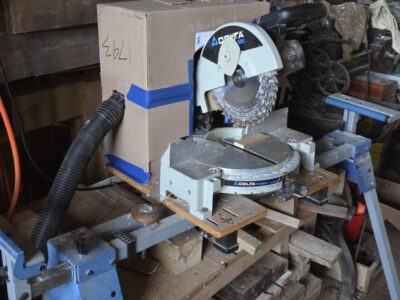
I finally got tired of this nuisance and made and installed the lowest possible tech solution, which reduces the sawdust cloud by about 99%. I looked through my mountain of boxes piled up on the third floor and found one that fit my needs. Equipped with a utility knife and a roll of masking tape I fabricated a box shroud to fit over the back side of the saw, complete with a port for the shop vac hose. At this point the only thing missing is a fitting to glue to the portal for plugging in the hose, but even with just a rough hole cut in the side of the box the collection is magnificent.
Where Is Dickens When You Need Him? Hand or Simple Turning by John Jacob Holtzapffel - Chapter 7

The five volume compendium "Turning and Mechanical Manipulation" by Charles and John Holzapffel started with Volume 1 in 1846 and ended with Volume Five in 1884. A planned sixth volume was never completed. The series is a treasure trove of hand tool technology. Volume Four, on Plain Turning, and Volume Five on Ornamental turning are the bibles of their field.
Unfortunately the Holtzapffels, both father and son, may have been great tool makers but they were crappy writers of how-to books. In the time between their era and ours, "how to" instructional books have become more engaging and and much more than just a recital of facts. And of course, the act of writing a book - whether in the 19th century or today - doesn't of itself confer an engaging writing style. As a matter of fact, most Victorian books I have plowed through are pretty turgid. I can claim the honor of having read all six volumes of "The Morning Chronicle Survey of Labour and the Poor" a a groundbreaking 18491850 newspaper investigation into the living and working conditions of the British working class mostly written by the crusading Morning Chronicle journalist Henry Mayhew. I found the section on Billingsgate Fish Market to be particularly evocative and engaging - nearly two hundred years later, you can still smell the fish. Later in that section Mayhew notes that the description of the fish market section was contributed by his colleague at the Morning Chronicle: Charles Dickens.
But back to Holzapffel. I realized that in order for me to understand treadle lathes, I would need to plow though Holzapffel's description of using a treadle lathe - possibly the only instruction on using a treadle lathe specifically with hints on treadle speed, how to stand, and other treadle specific info - however turgid I found his prose.
I found it tough going. Too much of my time was spent getting lost in the text (in a bad way). And then I had a brainwave: what would happen if I took the important bits of the text and fed it into the AI chatbot Claude? I asked Claude to take the text and turn it into modern English. And it did - and wow, what a massive improvement. So here ya go. I don't have the time to do the entire book - you can if you want to; it's pretty easy - but here is what I hope is the first section of something useful. The PDF is also posted on the Gramercy Tools Treadle Lathe product page.
One important point. I look at this modernized version as a inexpensive translation. One wonderful feature of the modern internet is that Google and many services will do an instant language translation for you. The translations are rarely perfect and may miss the nuance and discernment that a real translator can provide. However, it's hard to imagine how a niche project like modernizing inaccessible language in a classic woodturning text could ever be economically viable, so having a starting point is great.
A note on the text: As I wrote in a previous blog, "softwood" in this time period included all the furniture woods, including oak. "Hardwood" referred to like Ivory, Rosewood, Ebony, and Boxwood. Meanwhile, a lot of modern forms such as roughing gouges hadn't been invented or named yet and so are not mentioned in the tools section.
Here is the link to the modern version of chapter seven.
and here is a link to the entire volume four in all its glory.
PS We used to stock reprints of all five volumes of Holzapffel but slowly they have gone out of print. We do have a single copy available of Volume Two which covers construction, action, and application of cutting tools and the machines derived from hand tools.
they're both cherry.......
The miniature cherry chest isn't done. I'm waiting on the screws which are coming friday, but I'm still applying shellac too. In between doing that I started and almost finished the cherry bench/stool/plant stand. Came close but no cigar but I am so awfully close to being done with it. I have already started looking ahead to what will be coming out of my shop next.
 |
| rearranging the shop |
I needed the workbench to be cleared off so I can work on the bench/stool/plant stand. I need the bench to plane and clean up the rails and legs.
 |
| cleaned up |
All the rails had burn marks that cleaned up easily. The legs were mostly burn free but had saw marks to plane smooth.
 |
| hmm...... |
Legs and rails sawn to length and dry fitted. The stretcher I'm leaving over length because I haven't decided how I'm going to use it. This gives a peek at what it will look like which IMO ain't too bad.
 |
| swapped out |
Removed the 1/4" drill block and installed the 6mm drill block. Looking at my stock of dowels, 99% of them are 2" and 1 1/2" 6mm pins. I have about 40-50 1/4" diameter, 1 1/2" spiral dowels.
 |
| 6mm dowel in a 6mm drilled hole |
The dowel fits snug and I mean snug. I can't push the dowel into the hole with my hands. No probably driving it home with a hammer. As an aside the 6mm dowels fall straight through the 1/4" diameter drill block bushings.
 |
| oops |
Got ahead of myself and drilled a hole I shouldn't have. The rail will cover about half of it but not all.
 |
| scratched off the bucket list |
I have wanted to put a butterfly on a split/crack for a bazillion years. The split/crack here doesn't extend straight through to the other face. It only goes less then half way.
 |
| hmm...... |
This came out better than I expected. I have a gap here at this end but the rest of the butterfly is gap free. This is going to be the up face of the top. If this butterfly had come out crappy I would of placed this face down.
The depth of the mortise is about 5/16" deep and I sized it so that I could use my small Stanley router to get the depth consistent.
 |
| stretcher |
Still figuring out how to do this. Overall I want the stretcher to keep the bottom of the ends from moving in/out. I kinda have an idea but that won't happen until after it is glued and cooked.
 |
| panic time |
The glue up plan was to do the ends first and then the two long rails. Things went south on me first when I couldn't align the 2nd bottom rail with the top one. The top rail fit on both ends but the bottom one was off.
I thought it was me not drilling the holes correctly so I drilled one more. That did diddly squat and left me with a hole I had to plug.
 |
| the problem |
When I drilled the dowel holes I did them opposite of each other. The holes on this end should have had the closest dowel to the edge on the right and not the left. The other end of this rail I drilled correctly. Drilled the holes again in the right orientation this time.
 |
| another me-steak |
After the screw up from above, I was checking the holes lining up and they do. However, I saw another misalignment that I'll deal with after this has cooked.
 |
| 2nd _*&%@)(@*_)(_#@ me-steak |
When I put this rail in I thought I had done it right - making sure the slot for the table clip was facing the inside of the base. Missed that by a mile. I had remembered to do the table clip slots with my plunge router but I'll have to chop this one by hand on the other side of this rail.
I made this same brain fart on Miles's desk and the fix to hide the me-steak is I'll cover it with a thin slat of cherry.
 |
| hidden brain fart |
While I was trying to figure out why the bottom rail holes didn't align, I drilled two holes on this face that I'll have to hide somehow. These won't be partly hidden though but will be staring right back at me.
 |
| one more |
I had a couple of drips and runs that I had to card scrape away. It is going to take a couple of covering coats of shellac to blend them in. I should be done with the shellac tomorrow. Before glamour pics I'll have to wait for the screws to come in.
 |
| hmm..... |
Clamped and cooking away until the AM. I have been thinking of the stretcher and I think I have decided how to do it. I will notch the ends to go over the rails - not a full half lap joint but a 1/4 one. We'll see how that shakes out in the AM.
accidental woodworker
Furniture Maker Floater Frames Revisited
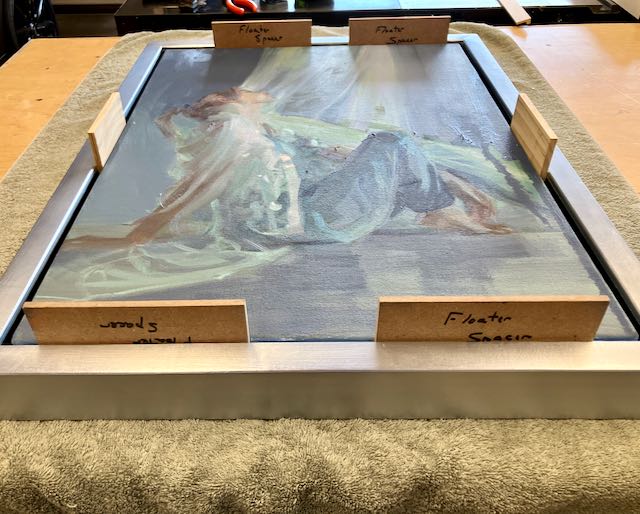
Quite a few years ago I began making floater style frames for my wife’s work and wrote this blog post. Since then, I’ve made a number of them and my methods are different from most of the commercial floater frames available. My goal is to elevate the floater frame from its origin of lattice strips tacked to the sides of canvas to one that has more of a presence. Granted, as a furniture maker I tend to overbuild everything and at this point in my life I have the time to do that. The Picture Framers Grumble has been a place where I can have interactions with other frame makers and I really enjoy that. Unfortunately, here in Las Vegas there isn’t a thriving art scene. This painting is one Diane recently completed, it measures 18″ x 24″ and the frame is about 1″ wide and 2″ deep. The finish is imitation silver leaf which has been sealed Platinum shellac which was toned with French Ultramarine blue powdered pigments.

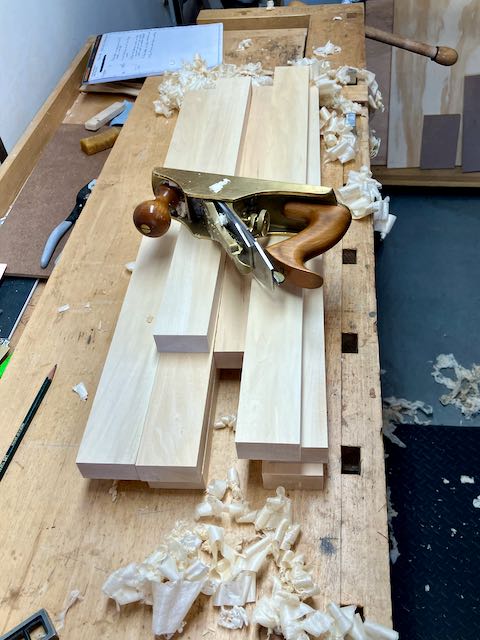
I’d like to share my process with a series of pictures to illustrate the process. I’d be interested in hearing from other framers who make their own frames and moldings. Basswood begins with 5/4 stock which I try to get at least 7″ wide. A combination of hand planes and a power planer will yield material that is about 1 1/16″ to 1 1/8″ in thickness. I hand plane every surface of the boards after cutting them to rough length and finished width. For this profile I wanted a slight chamfer on the edge which was cut with a low angle block plane.
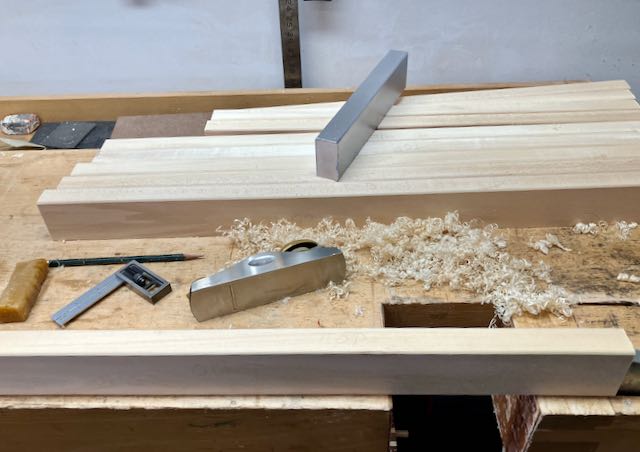
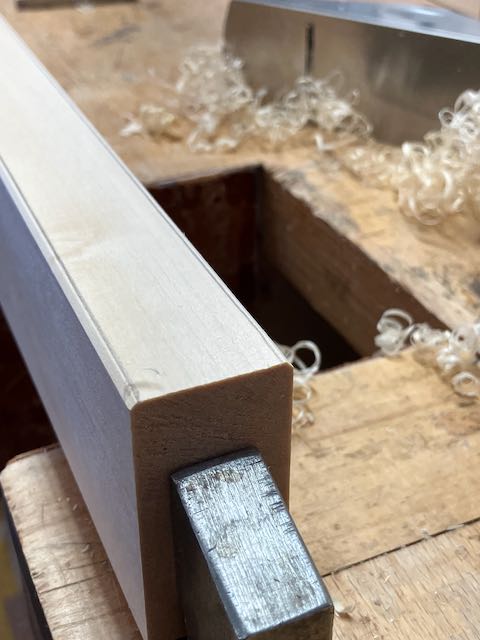
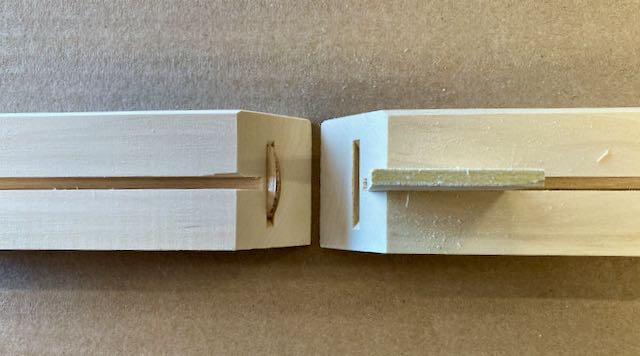
To support the painting I cut a 1/4″ groove on the inside of the piece about 1″ from the top surface. Plywood (1/4″ thick) is eventually glued into it to support the painting and strengthen the corners. The corners are strengthened further with a face frame sized biscuit. Miters are cut using my shop made jig on the tablesaw and the frame is glued and clamped overnight. In the clamped picture you’ll notice a spring clamp in each corner; there is another piece of plywood on the backside to strengthen that — I know: overkill!
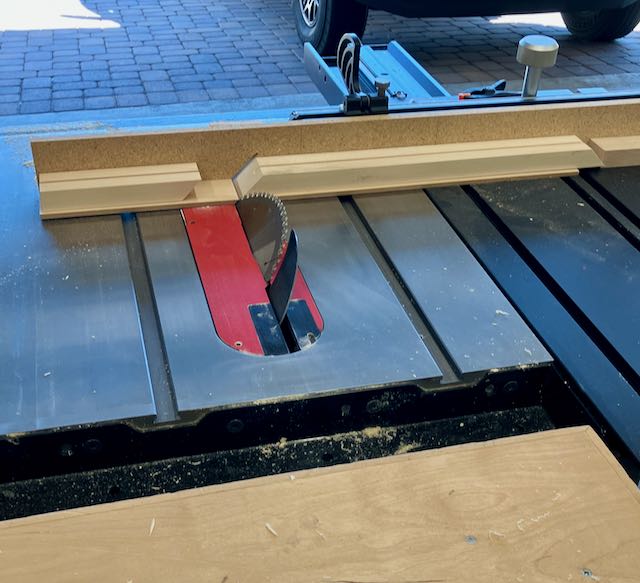
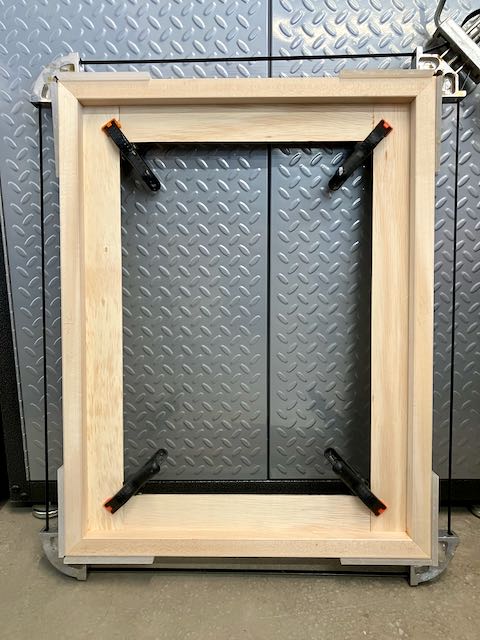
I keep projects glued up over night and check for any misalignment, glue, scratches, etc. before starting the finish process — it is so easy to miss them; don’t ask me how I know!
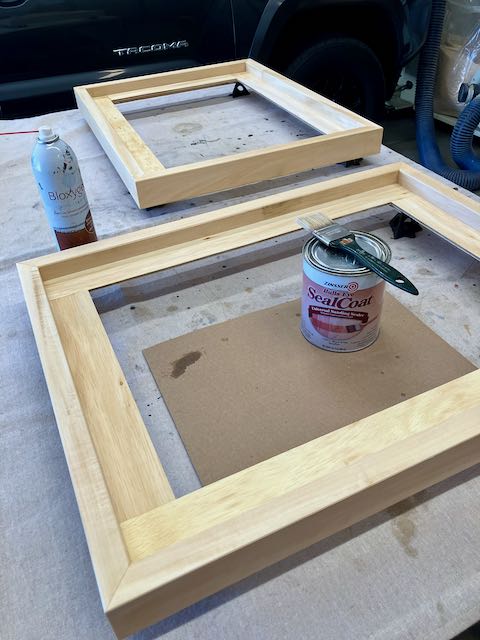
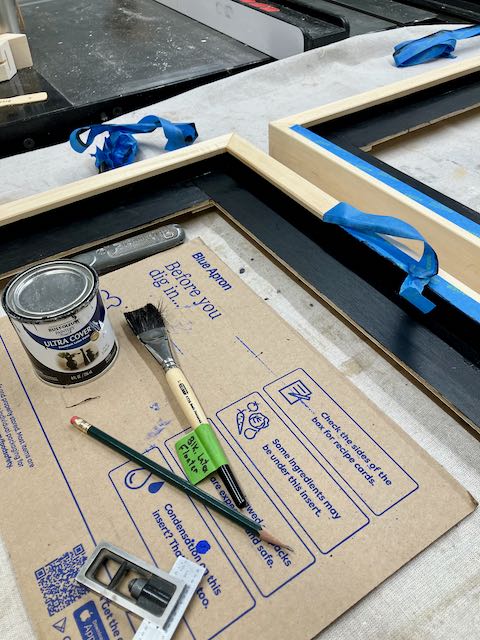
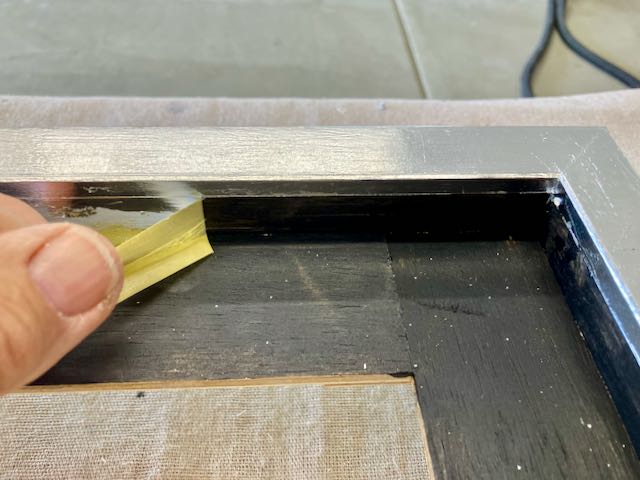
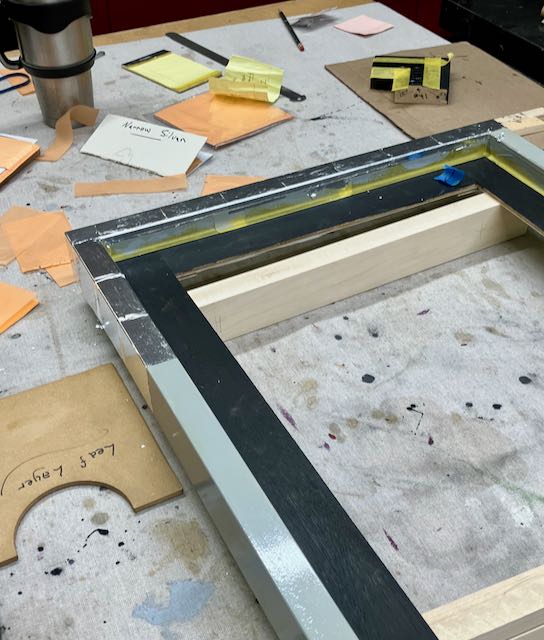
The first step to the finish process is to use Zinsser Seal Coat shellac on every surface. Once dry I lightly sand with 400 grit paper. Next up is taping off the top edge to apply a flat black paint to the inside of the frame. I tape down about 1/2″ from the top and use latex simply because it’s easy to clean up. Once that’s dry, the black areas are taped off so that the gray burnisher/sealer can be applied. Prior to applying the slow set size the frame is buffed with 4/0 oil free steel wool. In my experience, whenever an area is taped off for gilding it’s best to press the taped area down firmly and remove the tape right after gilding. I used to wait until the size was completely set (24 hours or so) but that could result in a jagged edge. By carefully pulling the tape off before the size has set I find that any leaf that wants to rip off can usually be pressed down while slowly pulling the tape off.
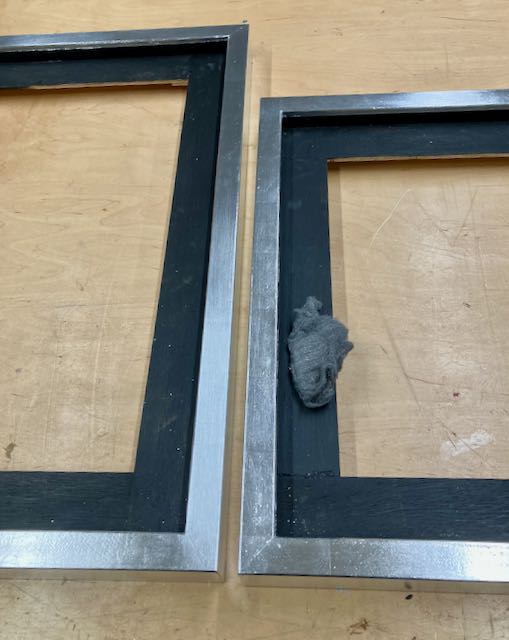
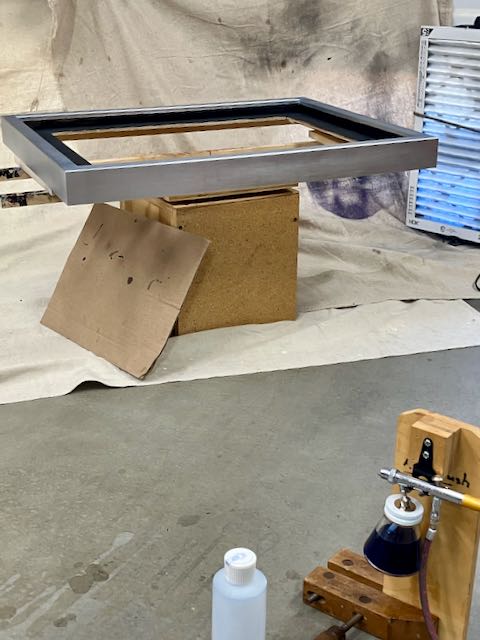
Imitation silver leaf always needs to be sealed to prevent it from tarnishing, my preference for that is Platinum Blonde shellac made from flakes. Since the paintings for both of these frames have a blue palette the shellac was tinted with French Ultramarine Blue dry pigments. To tone down the garishness of the silver leaf it was lightly buffed with 4/0 steel wool prior to airbrushing on the shellac, you can see the difference it makes in the left photo. After the toning was dry, cotton pads and Liberon clear Black Bison wax was used to rub out the shellac and add a slight sheen.
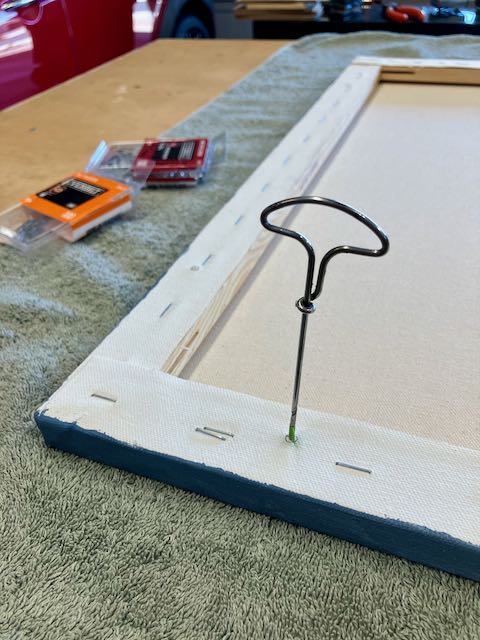
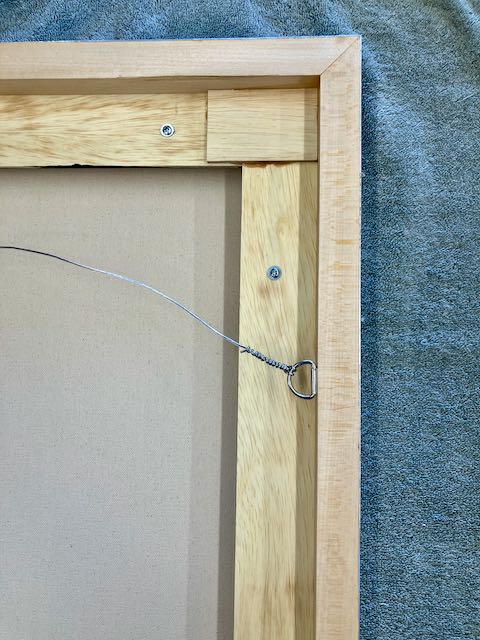
The final step of course is to install the artwork. Holes are located and drilled through the plywood using a 1/4″ forstner bit. I’ve found that the forstner leaves a clean hole which allows for any slight adjustments. Number 6 screws with washers are used, the hole size allows for slight adjustment. My process is to use spacers to center the painting and then locate the holes from underneath the frame. They are pre-drilled with a gimlet and the art is attached with the screws, snug at first to allow any adjustments in case the painting is slightly out of square; this does happen sometimes! One thing I like about the depth of the frame pieces is that the D-ring can be installed so that it isn’t visible from the side. In the picture showing the back view you can see the gusset that is glued into each corner.
So there it is, my process for floater frames which I’m happy with as is my wife and her gallery. Are there any other frame makers that use a similar process? Like I said earlier, Las Vegas doesn’t have a thriving art scene so there are few that I can share frame making with.
Handworks 2026
The Abraham boys and their posse are at it again and Handworks 2026 is barreling down the pike. It will be Friday and Saturday of Labor Day weekend, in the lovely village of Amana, Iowa. I’ll be there again close to dead center of the Festhalle, hawking my wares such as they are. Polissoirs, beeswax and shellac wax, videos, and original c. 1765 Roubo prints, etc.
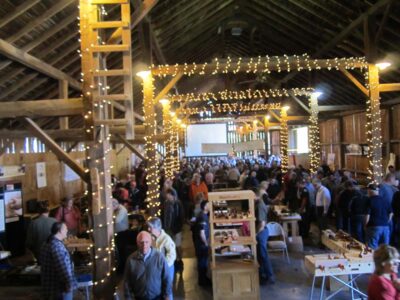
The Festhalle from Handworks 2013
It’s the most amazing tool festival of hand woodworking you will even encounter with visitors and makers from around the globe if the tradition holds.
I’m already ramping up my truckload of stuff to take with me, at the moment creating a pile on and under a workbench I will be taking and making wax processing part of almost every day from now on.
This just might be my last long road trip other than family priorities. We just don’t have the oomph for drives like that anymore.
cherry miniature chest pt IX..........
I had my annual peepers check this AM. Got there at 0730 for my 0830 appointment. I went early because Rte 10 gets nutso with rush hour traffic. It worked in my favor because at 0740 my annual exam began. An hour later I was driving home with 20/20 vision. It seems like every year the exam takes a wee bit longer and they add new tests and checks. Hopefully that is what it is and not because I can't remember what happened a year ago.
 |
| chest attached to the base |
I used two screws on each bearer to secure the chest to them.
 |
| not rocking |
Happy with this. I was expecting some rocking because the base had a teeny bit of twist. Maybe the chest pulled it straight but it doesn't matter. The chest is tight and flat to the bearers and base ain't rocking.
 |
| moldings |
Got the four moldings sawn out over the lengths needed. This is as far as I got in the AM session. My peepers were dilated and I was working with sunglasses on and it wasn't working. I couldn't focus and see clearly so I went upstairs and did the crossword and sudoku puzzles.
 |
| up side of the lid |
Got the first coat on the lid and it didn't pop like I thought it would. I like the sapwood and the black grain lines. There are black gum pocket/lines on the back stop too. Subsequent coats of shellac should pop this.
 |
| sizing the moldings |
The molding under my finger is a test piece. I used it make sure the front molding is positioned dead on the corner.
 |
| yikes |
I had seen this but I thought it was a black gum pocket. The peepers still weren't operating at 100%. The screw was too close to the edge and caused the bulge.
 |
| fixed |
Squirted some glue in to the crack and clamped it shut. I'm lucky with this fix because the molding will hide all of it.
 |
| first one done |
Got the first molding set, checked, then glued and nailed in place. The plan is to repeat this for the two short ends. The last one I will trim/fit between the short open ends.
 |
| got 3 attached |
Fitting the last long molding in place was batting next.
 |
| sanding stick |
Used a 120 grit sanding stick to sweeten the miters. The corners of the chest after planing and sanding were slightly off 90°.
 |
| sigh |
Over corrected my trimming and the last molding is short. This gap is too wide (and ugly) to ignore. I have one more piece of molding left to replace this one.
 |
| the problem |
This short side molding is a few frog hairs short of the corner. I pulled this one off and used the last long molding to get a new short side one.
 |
| new molding |
Got the left corner tight.
 |
| ditto for the right side |
Happy with the fit of the miters on the back. Glued and nailed it off and with that the moldings were done.
 |
| hmm....... |
This was the molding I had dyed the bare wood and I can see a color difference between this and the other three. Got lucky because I wasn't pay attention as to where this molding was going. If it had been at the front I would have ripped it out and replaced it with a new molding.
 |
| decided |
My choices were to rip out one of these to match the 1 1/2" square leg.
Instead I'm going to knock these two down to 1 1/2" because they are the
exact same length.
 |
| done |
I got one leg blank for any oops that might bite me on the arse.
 |
| done |
I got all the parts needed for this bench/stool/plant stand. Four legs, 6 rails, and one stretcher for the bottom rails . The board on the right is an extra rail, again for any potential oops.
In between getting shellac on the cherry chest I'll start working on the new project. I'll be doweling this like I did for Leo's desk. I will use the 6mm dowel jig I just bought for my Dowel Max jig.
accidental woodworker
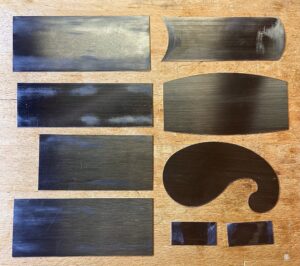
The scrapers I use
Submerged Treasure
I love tales like this. I knew of an instance in some southern swamp where they discovered an ancient sunken cypress trunk that was so valuable the salvage company had around-the-clock guards protecting it until they could find just the right buyer who had just the right project. I vaguely recall it went to a developer who was going to use it in all the public spaces is a huge skyscraper somewhere. I think the dimensions of trunk were 48+” diameter at the top and 180-plus feet long. That’s a mighty big tree.
I’d heard the asking price was $7 million.
Many years ago back in Maryland we had a micro-burst that uprooted a number for mature tulip poplar trees, the largest of which measured 24″ in diameter at the first branch, which was at the 60-foot mark. I was unable to find a sawyer willing to deal with it, so given the cycle of life it has now gone back to the earth.
Pages
