
Hand Tool Headlines
The Woodworking Blogs Aggregator
“Glory to God in the highest heaven, and on earth peace to those on whom his favor rests.” - Luke 2:14
Be sure to visit the Hand Tool Headlines section - scores of my favorite woodworking blogs in one place.
The Barn on White Run

One Last Rodeo – Handworks 2026
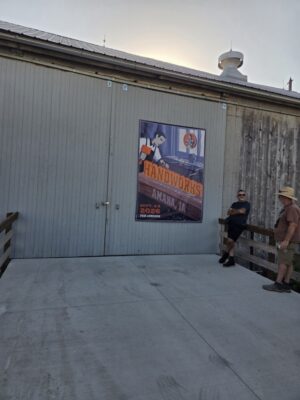
In what will almost certainly be my last long trip unrelated to family matters, Mrs. Barn and I hit the road for a Labor Day weekend toolapalooza in Amana, Iowa, for the fifth (?) convening of Handworks, a mondo gathering of hand woodworking enthusiasts. The trip was very long, two full days of driving each way (I took a full-to-the-brim truckload) and even though the gathering of several thousand friends old and new is a delight, it is just too much for us. Part of the problem is that Mrs. Barn’s CR-V is excruciating for me to ride or drive; it was not made for linebacker-sized folks. My large pickup is a perfect fit but Mrs. Barn hates driving it. Oh well. I still get many invitations to travel to speak and teach but at this point I decline them all. The Wood and Shop school fits my needs just perfectly as it is two hours away from Shangri-la. That I can do easily. Two days each way? Not so much.
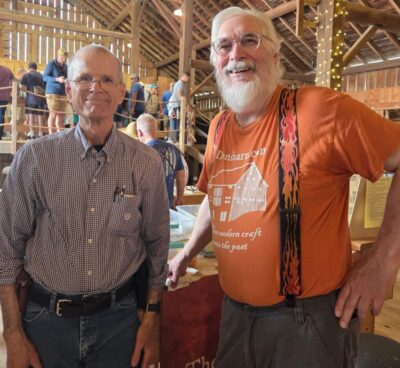
We were joined by dear friends Mr. and Mrs. Ripplin’ John.
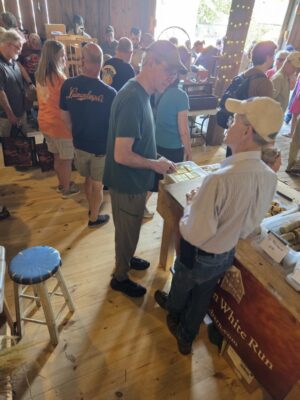
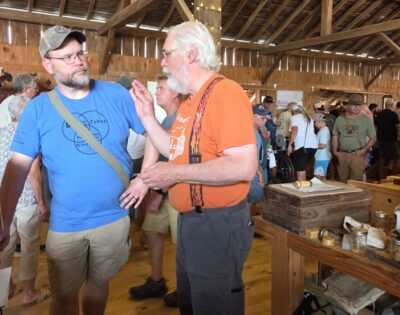
John was with me side by side throughout the event as multitudes of folks wanted to ask about historical wood finishing and we were delighted to explain and demonstrate. While we were doing that the Misseses were out and about doing gal-pal stuff.
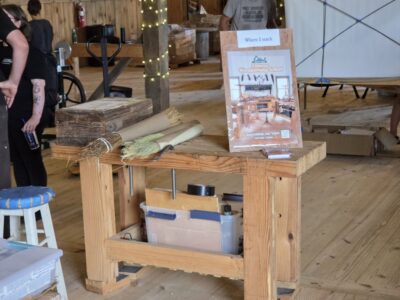
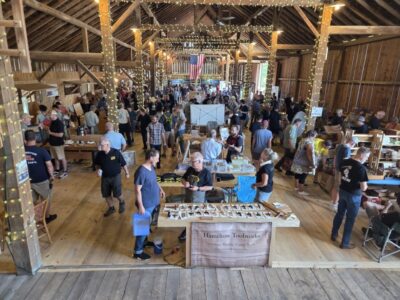
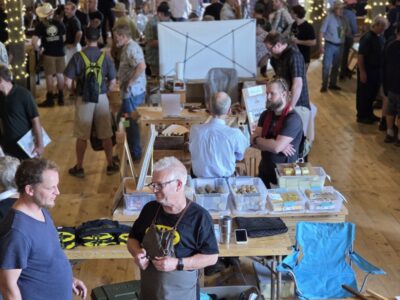
We were among the first to set up, near the center of the giant Festhalle. I brought two of my smaller workbenches to use as display and demonstration space. Soon the place was filled with enthusiasts of every stripe. I was glad to see that the demographics of the attendees was becoming broader and especially younger. It gave me hope for the future of the skill set.
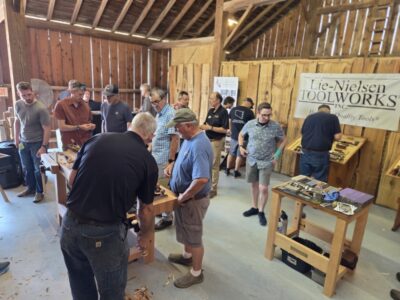
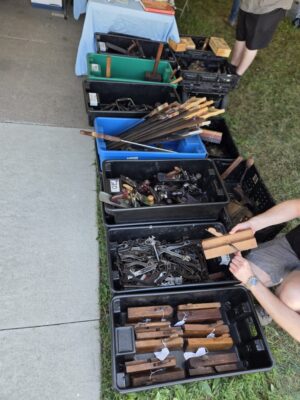
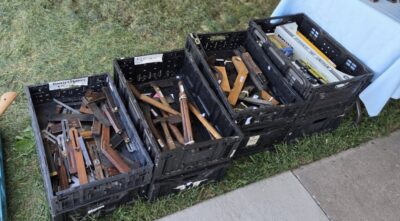
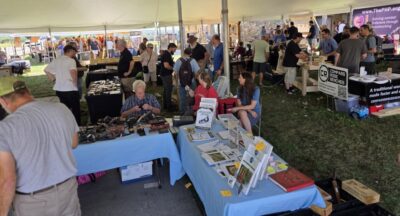

The Festhalle was only one of many venues for the event, I think the total this time was seven. They were all filled with a bajillion tools, old and new. I only managed to get pictures of about 10% of the goings-on.
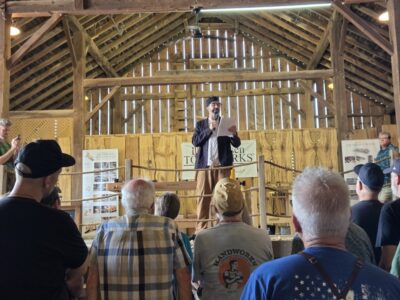

On the second morning the packed house was regaled first with a stirring rendition of The Star Spangled Banner magnificently presented by Mike Siemsen followed by a recitation by Chris Schwarz of some old-codger-ish correspondence between a Welsh Stick Chair maker and an American host regarding some workshops. Very entertaining stuff.
One final note is a comment on the weather, which was a stark counterpoint to the first Handworks. At Handworks 1 the weather was absolutely frigid, a very cold and rainy Memorial Day weekend fifteen years ago. This year the air in central Iowa was stifling, temps in the mid 90s with a choking level of humidity. With every handshake, two hands stuck together. They day after the event was much cooler. Oh well.
Latest Conversation
My most recent conversation with long-time friend, broadcaster Brian Wilson, is now posted on his Substack, Brian Wilson Writes. If pungent conversation about the state of the culture it might not be for you.
Not Mussorgski
It was not the Pictures From An Exhibition but rather pictures from an exhibition of traditional wood finishing as last month I taught another iteration of my class at Joshua Farnsworth’s Wood and Shop classroom. Oddly, three days is barely enough time to scratch the surface of the topic while still changing the students’ mindsets pretty profoundly.
So I present, Pictures From An Exhibition of Historic Wood Finishing, featuring performers (students) from all over North America.


Clothespin Nirvana
For many years I’ve been a fan of Herrick Kimball and his Planet Whizbang site. He is one of the most inventive guys on the interwebz.
I’ve posted occasionally about my fixation with the utility of clothespins in the shop, employing them for a whole host of uses. I’m always on the lookout for good clothespins and currently have a shoebox full of them on the clamp rack. Since even better ones are cheap, I use and dispose them frequently.

Even Mrs. Barn appreciates a good clothespin as most of our laundry is hung on the line. A while ago I bought her some of Herrick’s clothespins from his Classic American Clothespin website.
Holy cow! They are so different in quality that they are different in kind. I mean, who makes clothespins from kiln-dried ash, and oversized to boot (compare it to a pretty good quality clothespin from Ace hardware.)
Maybe my search for the perfect clothespin is over.
Rasslin’ A Super Slinky
Last week my brother and I laid the new 2″ HDPE penstock (pipe) for my microhydroturbine system to power the barn (and the cabin if necessary). Last winter absolutely trashed the existing pipeline of Schedule 40 PVC.

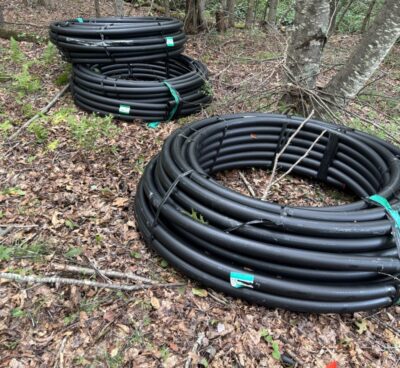
The 2″ HDPE came in giant ~6-foot coils, each of which weighed several hundred pounds. Once these were unraveled we had a rasslin’ match that looked like a monster movie with giant snakes. If you’ve never handled large dimension HDPE it is unbelievably tough and strong, slippery and cantankerous. Not to mention ridiculously expensive compared to Sch40 PVC, but I am expecting it to be worth the added investment. I got 15 years from the Sch40 PVC so this should outlast my time in Shangri-la.


Even two stout redneck brothers were no match for the Super Slinky. We wound up lashing the end to a long rope, feeding the rope along the path we wanted the pipeline to follow, and then pulling it up the ravine with my beloved little 4WD S10. The pipe was more than a match for two ~septuagenarians but was no match for 210 h.p. x 4500 lbs.

Here are the old and new, side by side. This level of damage to the old penstock was present in about 75% of the 1000+-foot length.

We finally connected the new pipeline into the system and had water flowing! I discovered that even at the bottom there was a crack in the PVC joints, so that needs to get replaced as soon as I can find the time. It’s working, now, but who knows for how long?
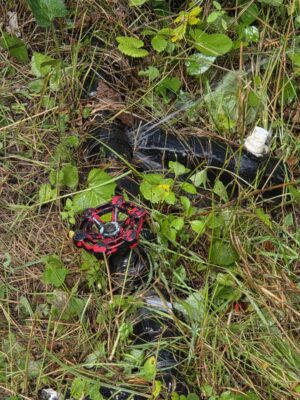
The work is not done by any means. I’ll let the new HDPE pipeline relax and lose its coilification to the greatest degree possible, then work the line from top to bottom leveling and lashing it. Reducing the up and down of the lay is critical to making the flow have as little turbulence as possible. If all goes well I will be able to run the system year round. Here’s hopin’.
This Week
Just as last week was all about loading up and teaching Historic Woodworking (more about that later) this week is all about unspooling, laying and connecting over a thousand feet of 2-inch Heavy Duty Polyethylene water line for my hydropower system. My brother is here for a visit and I am working him like a rented mule.
The water line is heavy but not brutally so, each of the four coils is probably about 350 lbs, but being coiled up for an unknown period of time it is set hard into the coil shape. Basically it is like straightening out a giant Slinky that wants to beat you up at every turn.
Stay tuned.
I’ll Be Watching With Great Interest
I actually watch a lot of Japanese woodworking videos and welcome this new tutorial approach. As much as I like the videos in Japanese shops, they are usually in Japanese and mostly without translation. Since I neither read nor speak Japanese this English chyron approach is most welcome. Not that I do much better with English…
Cootville
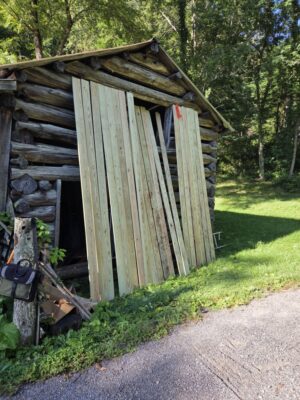
Not only was a substantial portion of the inventory worthless, it was all soaking wet. I had to change my shirt after loading my struck. I wound up standing it outside for five days to get it somewhat dry.
My name is Don, and I’m an old coot.
Last week Mrs. Barn and I took one of our occasional trips to the big city, in part for me to restock some routine building supplies. It had been a very long time since I bought much in the building materials realm as I had really stocked up while constructing the barn almost two decades ago. Slowly over time that inventory had dwindled down and it was time to do a little restocking. Plus, replacing some decking was on the autumn agenda.
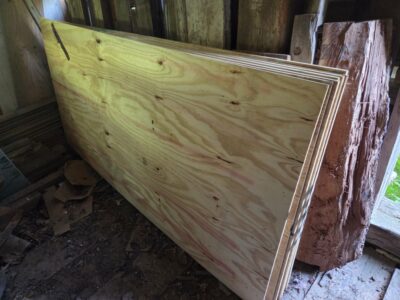
The sticker shock almost put me into a wallet-coma. Some CDX plywood, nothing special to say the very least. Enough decking to refurbish an 8’x12′ deck with some left over (even disregarding the need to sort through the pile since about a third of it was useless). Checkout was well on its way to ONE THOUSAND DOLLARS. To say that I was ranting all the way home like a curmudgeonly old coot vastly underemphasizes the pungence of my rhetoric. Not only do they not call material what it is, they tripled the prices since I last bought stuff. $60 for a 3/4″ sheet of CDX plywood? $14 for a 12-foot piece of PT/SYP decking? Insanity.
It would be easy enough to condemn the lumber stores and the lumber markets, but markets just do what markets do. Their moral duty is to maximize legal profits on behalf of their shareholders.
The real crisis is inflation, a crisis I do not believe we has a culture have the knowledge, wisdom, or courage to address.
It would be easy enough to blame the bankers, especially The Fed. But even though they are integral to the crisis, the central bankers are only doing what the legislative, executive, and judicial politicians are instructing them to do.
Even though they are misanthropes integral to the crisis, the spineless weasel elected politicians are only doing what the electorate is instructing them to do; spend money on us that we do not have. When legislators and executives spend money they do not have, in order to purchase votes they need as they need food, water, and air, there are only two “solutions.” 1) raise tax revenues to cover the expenditures, or 2) create/borrow phony baloney money to do the deed.
The limits to the first are well established as history has revealed an almost iron-clad truth: governments can only extract about 23% of the economy in taxes regardless of the taxation scheme. Hence the drive towards totalitarian collectivism, a/k/a abolition of an economy.
As for the creation of phony baloney money, also known as fiat currency, the only limit is political. The blame for inflation comes down to us, the electorate. In the aggregate we demand the gubmint give us stuff we cannot afford and cannot be paid for. So they do the “rational” thing, they create money out of ones and zeroes and fractional reserves, reducing the worth of the money in existence. Intrinsic prices are not rising, it’s the value of the money that is falling. That has always been and always will be the proximate cause.
Until we in the electorate tell them to stop spending money on us (yeah that’s gonna happen) the inflation locomotive will be picking up steam as it charges down the tracks, the engineers unaware that the bridge up ahead is collapsed (if it has not yet occurred, servicing the debt will soon be the largest component of the Federal budget). And collapse is the only possible end point. Get ready for it. I do not know the current score in the game nor do I know how much time is left on the clock. But I know the end result.
So Don, are you saying you are smarter than all the smart guys in Washington?
Yup.
But then I live in Cootville and the perspective is not in sync with the outside world. As CS Lewis said, “Reality is a ruthless instructor. It does not care whether you agree with it or not.”
A Shovel Ready Project
I’m not spending 100% of my time fighting the Rearrangeritis War. I still try to spend a couple hours a day writing, although not as fast as I would like, and portions of almost every day with chores around the homestead. One such chore is maintaining the driveway.
If you recall, several years ago I had the driveway to the barn rebuilt with hard packed “Limestone dust,” a pea gravel sized aggregate in common use out here in the hinterlands. (Shangri-la is immediately adjacent to a gravel quarry). The material packs to become almost concretious and serves its purpose well.

Then came the monster ice storm of last winter and the torrential rains of last spring. The frost-heave and runoff from these events took its toll not only on my microhydropower waterline, soon to be replaced en toto, but now I must spend moments of many days reconstructing the crown and shoulders of the roadway. The material is so hard it broke my hoe so I must break it down with a derelict adz, the only tool I have with the heft and robustness to accomplish the task. It was one of several old adzes I bought at a tool auction many moons ago. Two of the adzes are kept razor sharp, but this one is just a beefy hoe that I use for all sorts of digging fun. I repaired the original hoe but now use it mostly as a rake. The adz has the additional advantage of being three times wider than my pickaxe, which would have been my other option.
Cue Rod Serling
Good Evening, Ladies and Gentlemen
Consider if you will, a man with the shop of his dreams, dreams that formed at the knee of his father working together at the bench well over a half century ago. This shop is in Shangri-la, a place and a refuge from the maelstrom from the surrounding civilization swirling down the drain.
Unfortunately our subject is not the most orderly fellow in the world, and over the years his shop and all its contents have slowly drifted into disorder. The time has come for him to impose order on the space and all its contents, tools and supplies requisite for almost any sort of project imaginable.
If this fellow were you in a one-car garage workshop, how long would it take you to clean and organize every cubic foot of it? Now imagine that instead of a one-car garage your workshop is equivalent to a 36-car garage and you get the sense of the task before him
Welcome, my friends, to the Rearranger Zone.
So that’s what I have been up to almost 100% of my shop time since last Thanksgiving, with hopes the undertaking will be complete this coming Thanksgiving.

By far my favorite woodworking shop video of all time was James “Stumpy Nubs” Hamilton’s presentation of “Rearrangeritis,” a debilitating disease for most craftsmen.
I will write more about this soon, but the plain and simple facts are that, in addition to being more than a little bit whimsical in my shop arranging and housekeeping, two realities have emerged. First, I use the space and setups differently than I had originally imagined. Second, what I am doing in the space has evolved over the years so even if the original organization was correct, it is so no longer.
Whenever I take too long between posts I’ll get a gentle query or two as to my well-being. All is well, I’m just cleaning and reorganizing and wrestling with this current bout of Rearrangeritis.
Double Barn Portrait Selfie

During his recent impromptu visit my brother took a whimsical double-barn-portrait selfie. I was amused. Some folks think we resemble each other (our wives say we even walk exactly the same) but we don’t see it. ;-)
A Walk in the Woods
We’ve been blessed with a couple of days’ semi-impromptu visit from my brother and his wife, who taught school with Mrs. Barn about fifty(!) years ago. Since it was sorta last minute I didn’t have much of an activity agenda. We trimmed up the walnut trees in the yard, toured the garden and greenhouse, confirmed that the late frost had left all the apple trees fruit-less except for one small crabapple, then hiked up the hill to assess the microhydro water line in preparation for replacing it when they return in August. Goodness, the old Schedule 40 PVC line was trashed by the brutal ice storm last winter.
We walked along with me running the traveler along the ground to get a reasonable measurement of how much of the black poly pipe to order. Were two rolls of 2″ x 500′ going to be enough? Well, the rough measurement was 1,007 feet, so I will have to either use a little of the Schedule 40 at one end or the other or order another hundred feet of the black poly.

Meanwhile, just above the weir we could see a large tree had fallen across the original logging road so we walked another 150 yards to it. And what a tree it was! The amount of firewood we can harvest will be impressive.

The tree was struck by lightning and felled very recently (the leaves were withered but still green on the branches) and it was a big ‘un. At four feet off the ground the girth was eleven feet. Another very large tree had fallen right next to it, probably in the same storm.

So come August we will be hard at work. Sugar maple ain’t the best firewood but it’s better than nothing. Especially if you have tons of it.
We Hold These Truths … (2026)
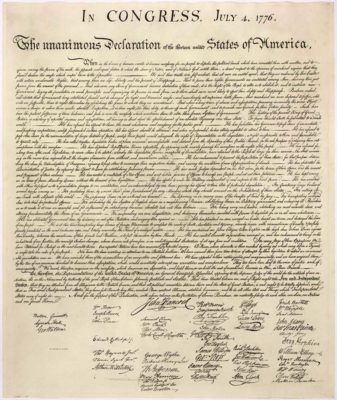
This reminder is presented annually, revised a bit from time to time. Despite dozens of recitations, I can never read the last line of The Declaration out loud because I am overcome with emotion. – DCW
Tomorrow my fellow Patriots and I, however many of us there are, will commemorate and celebrate the 250th anniversary of the most profound statement of human aspiration ever known. We have already endured two violent wars of secession, the first from 1775-1783 and the second from 1861-1865, and I pray that our third one can be avoided by a peaceful segregation of a populace that no longer shares a common vision. Again this year I am especially drawn to the passage “mankind are more disposed to suffer, while evils are sufferable, than to right themselves by abolishing the forms to which they are accustomed.” This sentiment was later expressed by John F. Kennedy, as “When peaceful rebellion is made impossible, violent rebellion becomes inevitable.”
As our nation is seemingly rife with incurious, gullible and servile inhabitants, we would be well-served to reflect seriously on the document encapsulating the mission statement for the greatest nation ever known to man, the only nation ever founded on a creed and geography or lineage. It was and is of course imperfect, no institution created by fallen and sinful men and women can be anything else.
I am an unabashed partisan in the cause of Life, Liberty, and Property (the original draft wording) and find The Declaration of Independence to be the most noble civil document ever created by mankind. I pray you will read and reflect on the ideas expressed by men who pledged their lives, their fortunes, and their sacred honor to pursue the path of liberty. Reading it is much like reading the Minor Prophets of the Old Testament; more up-to-date regarding the human condition than tomorrow’s headlines.
God Bless America, and may righteousness flourish and wickedness be overcome.
========================================================
IN CONGRESS, July 4, 1776.
The unanimous Declaration of the thirteen united States of America,
When in the Course of human events, it becomes necessary for one people to dissolve the political bands which have connected them with another, and to assume among the powers of the earth, the separate and equal station to which the Laws of Nature and of Nature’s God entitle them, a decent respect to the opinions of mankind requires that they should declare the causes which impel them to the separation.
We hold these truths to be self-evident, that all men are created equal, that they are endowed by their Creator with certain unalienable Rights, that among these are Life, Liberty and the pursuit of Happiness.–That to secure these rights, Governments are instituted among Men, deriving their just powers from the consent of the governed, –That whenever any Form of Government becomes destructive of these ends, it is the Right of the People to alter or to abolish it, and to institute new Government, laying its foundation on such principles and organizing its powers in such form, as to them shall seem most likely to effect their Safety and Happiness. Prudence, indeed, will dictate that Governments long established should not be changed for light and transient causes; and accordingly all experience hath shewn, that mankind are more disposed to suffer, while evils are sufferable, than to right themselves by abolishing the forms to which they are accustomed. But when a long train of abuses and usurpations, pursuing invariably the same Object evinces a design to reduce them under absolute Despotism, it is their right, it is their duty, to throw off such Government, and to provide new Guards for their future security.–Such has been the patient sufferance of these Colonies; and such is now the necessity which constrains them to alter their former Systems of Government. The history of the present King of Great Britain is a history of repeated injuries and usurpations, all having in direct object the establishment of an absolute Tyranny over these States. To prove this, let Facts be submitted to a candid world.
He has refused his Assent to Laws, the most wholesome and necessary for the public good.
He has forbidden his Governors to pass Laws of immediate and pressing importance, unless suspended in their operation till his Assent should be obtained; and when so suspended, he has utterly neglected to attend to them.
He has refused to pass other Laws for the accommodation of large districts of people, unless those people would relinquish the right of Representation in the Legislature, a right inestimable to them and formidable to tyrants only.
He has called together legislative bodies at places unusual, uncomfortable, and distant from the depository of their public Records, for the sole purpose of fatiguing them into compliance with his measures.
He has dissolved Representative Houses repeatedly, for opposing with manly firmness his invasions on the rights of the people.
He has refused for a long time, after such dissolutions, to cause others to be elected; whereby the Legislative powers, incapable of Annihilation, have returned to the People at large for their exercise; the State remaining in the mean time exposed to all the dangers of invasion from without, and convulsions within.
He has endeavoured to prevent the population of these States; for that purpose obstructing the Laws for Naturalization of Foreigners; refusing to pass others to encourage their migrations hither, and raising the conditions of new Appropriations of Lands.
He has obstructed the Administration of Justice, by refusing his Assent to Laws for establishing Judiciary powers.
He has made Judges dependent on his Will alone, for the tenure of their offices, and the amount and payment of their salaries.
He has erected a multitude of New Offices, and sent hither swarms of Officers to harrass our people, and eat out their substance.
He has kept among us, in times of peace, Standing Armies without the Consent of our legislatures.
He has affected to render the Military independent of and superior to the Civil power.
He has combined with others to subject us to a jurisdiction foreign to our constitution, and unacknowledged by our laws; giving his Assent to their Acts of pretended Legislation:
For Quartering large bodies of armed troops among us:
For protecting them, by a mock Trial, from punishment for any Murders which they should commit on the Inhabitants of these States:
For cutting off our Trade with all parts of the world:
For imposing Taxes on us without our Consent:
For depriving us in many cases, of the benefits of Trial by Jury:
For transporting us beyond Seas to be tried for pretended offences
For abolishing the free System of English Laws in a neighbouring Province, establishing therein an Arbitrary government, and enlarging its Boundaries so as to render it at once an example and fit instrument for introducing the same absolute rule into these Colonies:
For taking away our Charters, abolishing our most valuable Laws, and altering fundamentally the Forms of our Governments:
For suspending our own Legislatures, and declaring themselves invested with power to legislate for us in all cases whatsoever.
He has abdicated Government here, by declaring us out of his Protection and waging War against us.
He has plundered our seas, ravaged our Coasts, burnt our towns, and destroyed the lives of our people.
He is at this time transporting large Armies of foreign Mercenaries to compleat the works of death, desolation and tyranny, already begun with circumstances of Cruelty & perfidy scarcely paralleled in the most barbarous ages, and totally unworthy the Head of a civilized nation.
He has constrained our fellow Citizens taken Captive on the high Seas to bear Arms against their Country, to become the executioners of their friends and Brethren, or to fall themselves by their Hands.
He has excited domestic insurrections amongst us, and has endeavoured to bring on the inhabitants of our frontiers, the merciless Indian Savages, whose known rule of warfare, is an undistinguished destruction of all ages, sexes and conditions.
In every stage of these Oppressions We have Petitioned for Redress in the most humble terms: Our repeated Petitions have been answered only by repeated injury. A Prince whose character is thus marked by every act which may define a Tyrant, is unfit to be the ruler of a free people.
Nor have We been wanting in attentions to our Brittish brethren. We have warned them from time to time of attempts by their legislature to extend an unwarrantable jurisdiction over us. We have reminded them of the circumstances of our emigration and settlement here. We have appealed to their native justice and magnanimity, and we have conjured them by the ties of our common kindred to disavow these usurpations, which, would inevitably interrupt our connections and correspondence. They too have been deaf to the voice of justice and of consanguinity. We must, therefore, acquiesce in the necessity, which denounces our Separation, and hold them, as we hold the rest of mankind, Enemies in War, in Peace Friends.
We, therefore, the Representatives of the united States of America, in General Congress, Assembled, appealing to the Supreme Judge of the world for the rectitude of our intentions, do, in the Name, and by Authority of the good People of these Colonies, solemnly publish and declare, That these United Colonies are, and of Right ought to be Free and Independent States; that they are Absolved from all Allegiance to the British Crown, and that all political connection between them and the State of Great Britain, is and ought to be totally dissolved; and that as Free and Independent States, they have full Power to levy War, conclude Peace, contract Alliances, establish Commerce, and to do all other Acts and Things which Independent States may of right do. And for the support of this Declaration, with a firm reliance on the protection of divine Providence, we mutually pledge to each other our Lives, our Fortunes and our sacred Honor.
Button Gwinnett
Lyman Hall
George Walton
William Hooper
Joseph Hewes
John Penn
Edward Rutledge
Thomas Heyward, Jr.
Thomas Lynch, Jr.
Arthur Middleton
John Hancock
Samuel Chase
William Paca
Thomas Stone
Charles Carroll of Carrollton
George Wythe
Richard Henry Lee
Thomas Jefferson
Benjamin Harrison
Thomas Nelson, Jr.
Francis Lightfoot Lee
Carter Braxton
Robert Morris
Benjamin Rush
Benjamin Franklin
John Morton
George Clymer
James Smith
George Taylor
James Wilson
George Ross
Caesar Rodney
George Read
Thomas McKean
William Floyd
Philip Livingston
Francis Lewis
Lewis Morris
Richard Stockton
John Witherspoon
Francis Hopkinson
John Hart
Abraham Clark
Josiah Bartlett
William Whipple
Samuel Adams
John Adams
Robert Treat Paine
Elbridge Gerry
Stephen Hopkins
William Ellery
Roger Sherman
Samuel Huntington
William Williams
Oliver Wolcott
Matthew Thornton
Paperwork
More than thirty years ago I made a built-in cabinet in the living room to hold all manner of contents you would expect for a living room wall unit. Included in the design and construction was a set of shoji sliding doors using Japanese mulberry bark paper for the screens. I learned right quick that having paper panels on cabinet doors is not optimal for a home occupied by little ones. I soon replaced the original papers with new ones and backed them with plexiglass to minimize the puncturing and tearing of the lovely paper.

Recently I took another look at the shoji and saw another dozen or so tears that had occurred of the intervening decades. One by one I took them down to the basement shop to repair them. Unfortunately all I had was scraps from the original construction and installation or I would have simply replaced complete sections of the paper en toto.


My first effort to follow that trail was to order some new mulberry bark paper that turned out to be beautiful but not a good match to the originals. So all I could do was use my scraps of the original paper and make the necessary repairs.
Here’s an example of one repair, a protocol I followed successfully on the nearly dozen tears.

This tear is adjacent to one of the shoji frame elements, The dark area near the upper center of the image is a previous repair, still wet from the repair. As the repair dries it will resume the color of the original paper and thus become invisible to the standard viewer.

Here’s the scrap of the original paper left over from the construction 30 years ago. One edge is straight to match the shoji frame, the other is torn, or “deckled” to provide a feathered edge allowing the perfect blending with the underlying sheet being repaired.

After mixing up the adhesive, in this case dilute wallpaper past methycellulose, the repair ws laid in place and the adhesive brushed onto the margin and wicked in, binding the repair.

Next time I return to Mordo I will try to remember to take a picture of the finished project. The repairs really do look nearly invisible, complying with the “Six-foo-six-inch rule” that governed our work in the museum. In other words, from a standard viewing distance of six feet the repair is invisible, but close-up (“six inch”) it is discernable.
A Very Nice Taste of Plane Wellness
Rex Krueger has posted a very nice video snapshot of Plane Wellness’ Handtool Haven 2026, where I was one of the speakers and exhibitors.
Wax Processing – Blend 31
I didn’t need to make any more blocks of beeswax for the moment, so I concentrated on turning my purified beeswax into Blend 31.
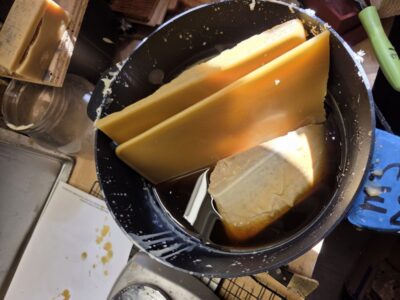
The preparation is indeed exotic (/sarc). I weigh out several hundred grams of shellac wax, then three times as much of the purified beeswax. It all goes into the cooker to melt together at a slightly higher temperature than is necessary for the beeswax alone.
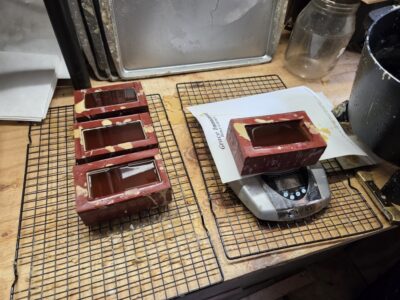
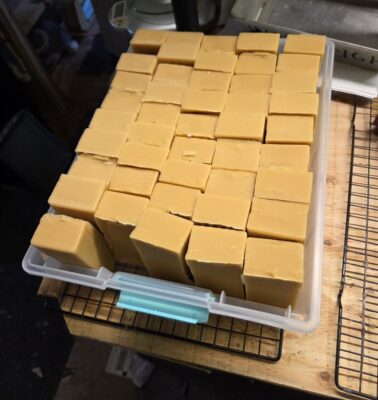
Once it was all melted uniformly I ladled it into the silicone molds I made a long time ago that have served me well all these years. Given the temperature of the room I can make a new pour every 30-45 minutes as the blocks cool and can be removed from the molds. They are still pretty warm at this point and need to be set aside to cool completely.
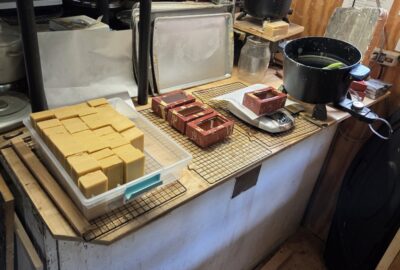
A good day’s production is almost 50 units. I make four at a time, and each extraction/pour takes about 5-7 minutes.
Now on to the wrapping and packaging of the wax to take it to Handworks 2026.
Wax Processing III
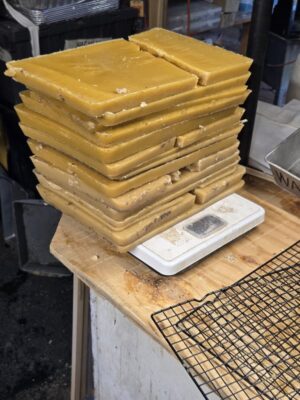
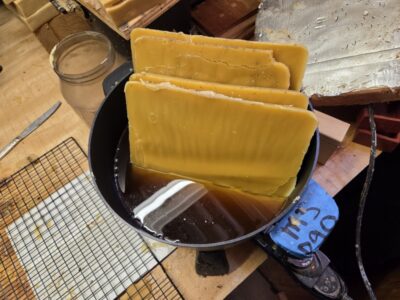
I re-melt the 75% clean blocks in my cooker and then filter them through my favorite medium for the task, Bounty *full sheet* paper towels.
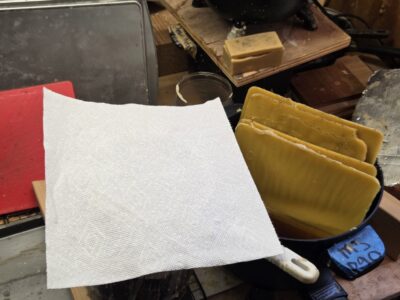

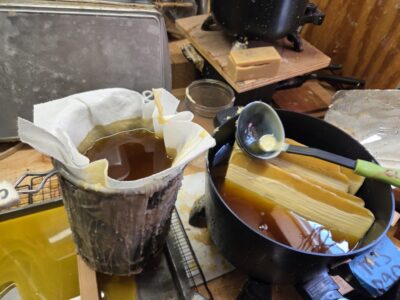
The paper towels are placed inside a kitchen pasta strainer for support, which is then placed inside a section of stovepipe that is held up on the edges of the cookie sheet, and then the molten wax is ladled through.

The output is drizzled into cookie sheets dedicated for that purpose.
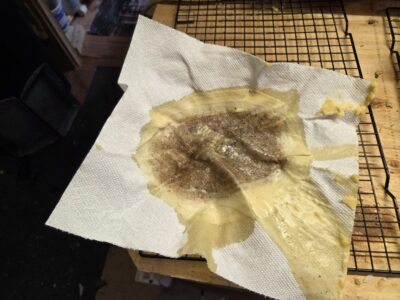
I replace the filter membrane for each new cookie sheet casting. This is what the used filter sheet looks like after one cookie sheet casting. This does not get discarded, it is re-used as a firestarter in the wood stove in the winter.
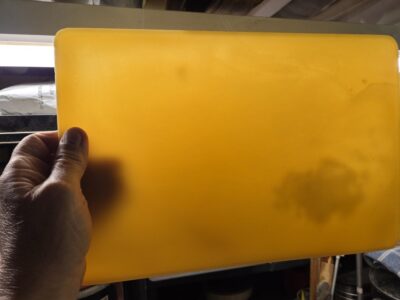
The result is a full-sheet roughly 1/4″ thick that is wonderfully clean and pure. Since the cast sheet is so thin it starts cooling immediately, resulting in an uneven thickness. It’s now ready for whatever comes next, casting the 1/4 lb. beeswax blocks, formulating and casting Blend 31, or playing with new concoctions.
Up next – Blend 31.
My Ongoing Conversation With Brian
The latest installment of the forty-year-long conversation with my friend “retired” broadcaster Brian Wilson (who cannot shake the habit), was posted at his Brian Wilson Writes Substack. If you enjoy provocative strident discussions about forbidden topics, give it a listen. If you do not, don’t.