
Hand Tool Headlines
The Woodworking Blogs Aggregator
“Glory to God in the highest heaven, and on earth peace to those on whom his favor rests.” - Luke 2:14
Norse Woodsmith Blog Feeds
Roubo On Marquetry Back In Stock Soon!
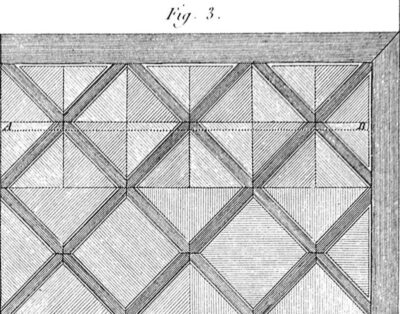
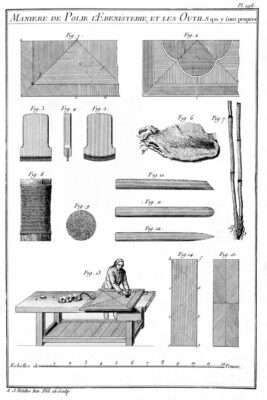
The folks at Lost Art Press have confirmed the Roubo On Marquetry, the volume that got it all started, is now at the printer for a second production run. The expected availability is around Christmas, after having been sold out for the past year. Just in time, if you get my drift.
The book is the result of the answer to a simple question I asked of Michele Pagan: “Could you translate a little of this?” It contains the wisdom related to my great interests, marquetry and finishing.
I’ve got a smile on my face.
The Bosnian, Ottoman-Influenced Arabian Style Bookshelf Part 8 – Arched Panels

We’re inching closer and closer to the end of the build. In this part of the build, I’m going to make the arched panels. These panels will have simple carvings and cut-outs along the bottom edge. They serve no purpose other than decoration, but to keep the bookcase historically accurate, I had to include them. I do think they add beauty and character to the bookcase.
The first step is to edge-glue two boards together to get a wider board.
Now, I know they’re not identical, not even similar to each other. None of that is a problem because they’ll be stained, and the difference between the two won’t even be noticed.
I only planed one side because the other will never be seen. This was common practice 200 years ago. Cabinetmakers concentrated their efforts on the surfaces that would be visible, leaving hidden surfaces less refined. I suspect the change towards preparing both faces came gradually as machinery made the work quicker and easier.
I think preparing a surface that will never be seen is a ridiculous waste of time. Why spend time preparing something that serves no purpose other than to be hidden? Before machinery, that extra work would have taken time and effort that could have been put to better use elsewhere. Today, with modern machinery, preparing both faces takes considerably less effort, so I can understand why the practice has changed. But when you’re working by hand, I see no reason to do unnecessary work simply because that’s what people expect.

When I need to carve something, I always draw it on the computer and print out the drawing. I then glue the printout onto the wood and carve from there. Some people trace their drawings onto the wood, but I find that doubling up on the work. You’ve drawn it once, so why draw it again?
I understand that some people believe the paper will dull their chisels more quickly, but so will the wood itself. Others might be concerned about removing the glued paper afterwards. I see plenty of people scraping it off, and I don’t understand why they go to all that trouble when turps will reactivate the glue, allowing the paper to be wiped off easily. It also doesn’t affect the finish.

Now I repeat the same on the other three panels.

This is the other side of that panel, and as you can see, the surface isn’t prepared at all.
The next step is to attach the panel to the inside of the bookcase. I was going to use brads to nail it onto the ½ inch lip of the strips that I attached earlier in the project. It was too risky to nail it down without possibly breaking the glue bond and breaking off the strips, so I just glued it in place and it worked perfectly. This wood is hoop pine from the 1930s. Hoop pine straight out of a kiln is a little hard to work with using hand tools, and it certainly gives your body a workout. But when you cut rabbets and other joinery it’s so crisp that not even a machine can repeat it. Once it properly acclimates and settles at around 8%, it planes easily and cuts easily, but you do lose that crispness. I haven’t come across a woodworker who makes anything from hoop pine, and nor have I ever come across a timber yard that doesn’t try and talk you out of buying it. Timber yards all try and slander the wood, but they’re all dead wrong. It’s a fantastic bit of wood that should be used for more than just broom handles.

one more day........
 |
| came this close |
I got 5 coats on the box and the lid and I'm calling that part done. In the AM I'll install the Soss hinges and I'll rub down the box and lid with Howard's Feed 'n Wax. Then the oohs and aahs can commence followed by much dancing and rejoicing in Mudville.
I spent most of the day resting and doing nothing. I made two trips to the shop to slap on shellac and that was it. Last night I hit the rack at 2200 and 5 minutes later I launched into a 15 minute coughing fit. After that I coughed on and off for the rest of the night. The last time I looked at the clock it said 0235. I must have drifted off after that and woke again at 0330 coughing again.
The rest of the night pretty much stuck to the same dance steps. I finally went vertical a little after 0700 feeling like crappola. That feeling stayed with me all day long. Tomorrow I'll go to the VA and pick my Rx and I'm looking forward to getting some relief. Everything on my body that can be crossed is, not that I'm superstitious.
accidental woodworker
Sign Your Work!
As Edward Tufte walked around the seminar room holding up an original printing of Newton’s Philosophiæ Naturalis Principia Mathematica, he repeatedly said, “Sign Your Work!” He showed us Newton’s handwritten signature on the flyleaf of that book. Then, he turned to the back flyleaf and showed the signature of the man who set the type and printed the books.
That was from one of Tufte’s seminars that I attended several decades ago. At the root, Tufte is a statistician, data/information analyst, and artist. His gift to our world is how to visually organize data in useful, instantly understood ways. Perhaps he was the father of what we now call “info graphics.”
Today, if you are interested, that seminar is still relevant and is an online course.
At the time I attended his seminar, he was publishing 3 books, the bottom 3 on this stack. He was such a stickler for detail that he created his own publishing company, Graphics Press, and did all of the finicky typesetting and illustration placement for these books.

Those books were invaluable to me as I progressed through 40 years of work at IBM, ending up in what was then their prestigious Research Division. My son. also a data driven geek in the earliest stages of the AI/SI industry now owns those books and I sometimes remind him “Sign Your Work.” Be proud of what you do and let others know who you are.
The Future Keeps Happening

In recent years, life has changed a lot for all of us and sometimes not. Watching and listening to any news might leave anyone thinking about hoping in a future. But if you go back to the 1960s, as I can now, you will recall distinct similarities with the advent of nuclear threats with capabilities between two world powers as power-filled nations and a potential outcome that could signal the end of the world as we knew it. So what's changed? The goodness of our COVID year was a year of recognising elements of humanity that came to the forefront instead of having been quite buried; it was a belief in humanity doing the right thing as we saw sacrifices made on every level, kindness, support, willing and open compliance for the better good of all and then international unity. It didn't take too long for that to leave us and for life to go back to the old normal of dysfunctionality. People who had drawn closer become self protecting rather than considering the better good of the whole, we see that that seems to have waned in our going backwards instead of forwards. We have threats of wars since COVID that we have not seen in almost a century. Nothing's much different than the 1960s with wars and rumours of wars and nothing's off the table. Violence is the violation of any limits. But it is different these days, of course it is. Violence is always distanced from the perpetrators when projectiles in the form of bullets and rockets are used. It's very different than physical attacks and all the more by a laptop directing drones with warheads. But violence is violence, no matter how it's carried out.
 The fence stretches from front to back and then across the back from left to right. Concrete posts and gravel boards make for longevity and easy replacement.
The significance of establishing boundaries is that they keep things in place. Think shelves and cupboards, houses and boxes, carrier bags and balloons. The importance of limits in joinery and woodworking for we woodworkers is that they make the work critical by boundaries we set. I first heard it in the US: "Good fences make good neighbours." Today, I see a million boundaries designed to force life to work for all things. The contents of a tree stem, 70% water is tightly held to deliver the essential life support to the leaves through which we exchange or breathe for fresh air Understanding parameters keeps life sane and sanity is what craftsmanship is all about.
 The knife defines the dividing lines between waste and wanted. Its cut wall that severs the fibres across the grain.
I use crisp walls made by knife, knifewalls, I renamed knife mark made by a marking knife because it doesn't match the outcome; knife with wall does, so I married them as a single word so now it exists much more accurately than knife mark because the sharp knife doesn't merely mark or only score the surface, it delivers a definitive wall created by a knife-edge cutting capability, a means to separate the waste from the wanted; areas more deeply defined in crisp cut lines we then cut directly into with other sharp tools like chisels and saws, planes, spokeshaves and such like that.
 I pare cut the shoulders using the knifewall to slot my chisel in before pushing. The cuts are pristine, so the shoulders come tight up to the stile inside and out..
Cut away from these knifewalls and the joint will be either loose or too tight. If it's loose, there is no appropriate remedy, too tight means more work. Force doesn't work without a split and bruising occurring somewhere at some point. We strive for an accuracy that mitigates miscuts and mistakes with every incursion in one way or another. My dovetails come straight from the saw and the resulting saw kerf becomes key to keying surfaces that ultimately absorb the glue which then interlocks the surface fibres by a water-based expansion so that when the glue dries lock the meeting surfaces permanently together. When the glue swells the fibres, two and more meeting surfaces permanently tie the knot of permanence in the process. Most woodworkers look for a perfect insertion of one part into another with no surface fuzz and fail to give value to the reality that the surface fibres left from a handsaw cut, compress and expand to key the surfaces with these interlocking fibres and that's because we can scarcely see or feel what's taking place inside the joint but they are there nonetheless permanently bound as one.
 I see the composition of hands and keep working though i am tempted to stop and take in the sight and sound, even in a knife cut.
Future and the belief in it wakes me with hope first thing for my everyday. I have seen this work for six decades so far. In the sixties, when we were really concerned and worried by "The Bomb!" the threat was as real then as it is now. The remoteness of distant, non-physical contact aggression established by missiles capably crossing great and short distances with an accuracy never seen before, has not made humanity any better but even worse if that's possible. But we know that acts of aggression warrant defence when we have something worth defending. It was when I went to work and made, when I saw that my handwork could distance the threat of nuclear to a fading distance of nothingness, I realised that my hands on my saws and planes, chisels, etc., took me into a place of safety and, well, nothing happened at that time and not for six decades. That's not the case these days. A drone sent by a man operating a keyboard can and does cause some very serious issues. If AI takes this on and human emotion and empathy are eliminated, who knows what the next new level will be. Some of you may not know of my police days when I worked shifts and carried a firearm. It became my normal for years. But my arrests were mostly people with other means of violence than guns. An axe here, a knife there and then too a car often became as much a weapon of offence as a broken bottle in a pub bar. In my day back then, bricks were lobbed of motorway bridges onto passing cars below. I dealt with worse than that.
No machines on this next project. Plane cuts and saw strokes all the way through. Twelve mortise and tenons, four half housings, four housing dadoes, tongue and groove backboards and coves from a homemade plane.I'm about to launch into a new project for our next woodworking masterclasses Sellers' home project. I intend to replicate one I designed and made 20 years ago, one that has a reliable and genuine mechanical mechanism and one that I have found can be adjusted to the microsecond if that's what matters to anyone. I have taken the oak from my desk cupboards to repurpose them in new piece. The new office space disallows the whole desk I once had, so this will be a positive outcome.
almost done.......
First thing this AM after posting the blog I went to the VA to pick up a Rx. I finally got a hold of pulmonary and they gave me a new Rx. It is for managing the cough but when I got to the VA the pharmacy was closed. No weekend pickups. I should have gone on friday but I didn't want to deal with the school bus traffic. I'll have to go back on monday to get it. Which is just as well because the doc told me to make sure that I get my flu and COVID shots up to date. With my current lung issues getting either one of them would suck beyond drinking pond scum.
 |
| cooked |
I came back to the shop last night after dinner and resisted the urge to take this out of the clamps. I let it be to fully cook overnight to impart as much strength as possible to the miters.
 |
| better |
I got the 3rd coat of shellac on the box and the lid. Now I can see a wee bit of shine and a definite difference between the shellac and the raw pine. It would appear that 3 coats are needed for that to pop.
Based on the last outing with this shellac I am wiping down the shellac with steel wool between each coat. So far it appears to be setting up and drying unlike the last time. I haven't feel any stickiness between the coats so far.
 |
| doesn't fit |
The front to back (long sides) fit nicely but the short ends don't. The right side will drop in but the left won't. I penciled the over and it is a strong 32nd. The decision was where to remove to get it to fit. Removing it from the base would be difficult so I opted to plane/sand the box bottom.
 |
| took a while |
I took my time planing/sanding the bottom until it fit. I didn't want to end up with ugly looking gaps. The gaps changed on me with a slight one on the front right. I tried reversing the the box 180 but the gap was still there.
There was also the gap on the back left short side that was there on the dry fit up. With the base glued and cooked, it shrunk a little.
I was careful with the fitting because I didn't want to have any of the miters open up on me. I still don't have good luck with miters staying glued but today they cooperated.
 |
| based glued on |
When I went to the VA the shortness of breath kicked my arse big time. The pharmacy is a hike even though I got a good spot in the parking lot. I had to stop and catch my breath 4 times walking to it. Last week when I had my podiatry appointment I had gone to the pharmacy and I got winded but I didn't have to stop and catch my breath.
This little trip sapped my strength and made me tired. I spent most the morning sitting at my desk resting with my eyes closed. I made a brief appearance in the shop in the PM to finish up what I started in the AM working on the box.
 |
| chamfers |
I planed a chamfer (20 strokes on each side) to finish up the base. I did the chamfer to lighten the base and make it look thinner. I am finding that the less I walk around in the shop the more I can do. Most of what I accomplished in the PM involved me standing at the bench mostly.
 |
| first coat |
I'll try to get back to the shop at least once more to slap on the 2nd coat. I still don't have issues walking down the stairs but coming up them against gravity ain't so good anymore. I have to stop in the back hallway to catch my breath before I navigate the final 3 steps up into the kitchen.
This box would have taken me no more than a couple of days pre lung surgery but that is the way it is. Next month marks one year since the initial lung cancer diagnosis and June will be one year post tumor removal surgery. I'm settling into a rhythm with this now. I'm comfortable with working in the shop whenever I can. I like that a whole better then vegging out sitting on my arse or worse laying in bed staring at the ceiling.
accidental woodworker
shellac time........
 |
| one down, three to go |
The left short side was done first with the front long side next. I worked my way around the bottom until all four miters closed up.
 |
| a lot to remove |
Rabbeted miter corners confuse me a lot. Rather then saw the miter closer to the line I used the plane and shaved it to the line. When I got close I stopped and took one shaving, checked it, and repeated until the miter closed up at the corner.
 |
| um....... |
The back left corner has a small gap with the other three sides pretty much seamless. I am not putting a small molding on top the base. So I had to play and fuss with it a bit to get to this point. This gap is due the corner of the box being slightly out of square.
 |
| happy face on |
Got the base band clamped and the box dropped into it without a problem. I can live with the gap.
 |
| final cutout |
Clamped the sides together and drilled a 7/8" hole 1 1/2" in from each end.
 |
| double line |
Before I drilled the holes I had ran a line to mark where the base cutout would be. I cut the line out on the bandsaw.
 |
| needed some massaging |
When I tightened the band clamp pulling the miters tight, it also twisted the base. After tightening it I saw that the base wasn't laying flat on the tablesaw. I loosened the band clamp until the base laid flat with no rocking. I added the quick grips closing the miters up tight. This will cook until the AM.
 |
| first coat |
I was not expecting to get the shellac on the box today. But once the base was glued and clamped there wasn't anymore woodworking to do.
 |
| hmm....... |
I almost made the me-steak of applying shellac to the whole box. Glad I thought it through because you can't glue over shellac for the long term. Instead I applied shellac to the inside and the top of it. I'll do the rest of the box after I glue the base to the box.
 |
| 2 coats |
The build ain't happening as quickly as I would like. It barely looks any different then raw pine. I had planned to put only three coats on the inside of the box but I'll probably have to be put on more than that.
accidental woodworker
The Bosnian, Ottoman-Influenced Arabian Style Bookshelf Part 7 – Mouldings
The next step to this project is making the moulding. I haven’t done much moulding since I made my set of moulding planes back in 2017. Ironic, isn’t it? In this age mouldings aren’t called for unless you’re reproducing antique furniture. While I made a complete set, half a set is really all you need, and take “need” lightly, because truth be told it is more a desire than an actual need. Let’s be honest, if I could have every shelf, row after row, filled with moulding planes, I would. I love hand tools, I love looking at them and using them. I also love history, so let’s have a quick look at the history of mouldings. I won’t be diving into the history of moulding planes. That would need an article on its own.
The earliest mouldings were architectural features, particularly in stone and masonry. Ancient builders shaped stone to create projecting edges, recessed channels and decorative profiles. These features helped define the boundaries of buildings and created patterns of light and shadow. The ancient Egyptians used moulded architectural details, and the Greeks and Romans developed sophisticated systems of architectural profiles.
Woodworking followed its own path. Early craftsmen could create mouldings by carving, scraping and cutting wood with edged tools. As woodworking techniques developed, specialised tools made it easier to reproduce the same profile repeatedly.
Greek architecture developed a sophisticated vocabulary of profiles, including the torus, ovolo, cavetto and cyma, and the Romans inherited and further developed these forms.
Wooden mouldings developed alongside architectural woodworking, although the precise chronology is difficult to establish. The Romans certainly used decorative mouldings in their furniture and wooden interiors. The important point is that the idea of a moulding was not invented for woodworking. Woodworkers adapted an established architectural tradition to their own material.
Designing a Profile
I didn’t know exactly what I wanted, so I drew a few profiles. Now I don’t rightly remember whether I took these profiles from historically existing ones or came up with them on my own. They all looked good, but I didn’t want to fuss too much around them and settled on this one.


Preparing the Profile
Using the rabbet plane I made back in 2017, I first cut a rabbet along the length of the timber.


People often wonder how to start a rabbet without using a fence. The trick is to lean the plane so that the arris rests in the groove you made with your marking gauge.
Start by carefully widening that groove with the plane, keeping the arris running in it to guide the cut. With each successive pass, gradually tilt the plane towards the vertical position until it is standing upright. Once you get the hang of it, it’s a straightforward way to start a rabbet without a fence.

I then cut two smaller rabbets to form tracks for the moulding plane to follow.


Shaping the Moulding
It’s difficult to film while holding the plane in one hand and the camera in the other, but I’ll explain what I’m doing.
To form the cove on the lower half of the profile, I used a No. 7 round. As I push the plane along the timber, the lower half of its sole rides against the bottom rabbet, guiding the plane as the iron cuts the cove.

It’s funny, though. According to Graham Blackburn, the English call this a hollow because it forms a cove or hollow. It makes perfect sense. Who changed the name? No one knows. For the upper part of the profile, I used a hollow. These are the results I got.

Very attractive, and that’s the real beauty of hollows and rounds. You have an endless variety of profiles to choose from. You can reproduce existing profiles or design new ones, rather than being limited to the profiles of dedicated moulding planes.
If, however, you regularly use a specific profile, it makes sense to have a dedicated plane for it. Speed and efficiency always win hands down.
Shooting the Mitres
Another important tool is a mitre shooting board. It allows you to refine the mitred ends of your mouldings so they fit nearly together.

Why Make the Moulding in One Length?
In this next example, I wanted to show you why you should make a moulding long enough to cover the entire bookcase rather than making it from several shorter pieces.
As you can clearly see, the two pieces don’t match perfectly. It’s difficult to reproduce exactly the same profile on two separate pieces of wood when shaping them by hand.

Whenever possible, make the moulding in one continuous length to cover the entire section of your project. This avoids mismatched profiles at the joints and gives you a cleaner result.
Hence why, back in the day, workbenches were often 9 or 12 feet long. Joiners’ benches were typically 12 feet because they worked on larger pieces than furniture makers.
If you put everything together, it comes out nicely and gives the bookcase that perfect finishing touch.

Boullework Marquetry (!) Class 2027
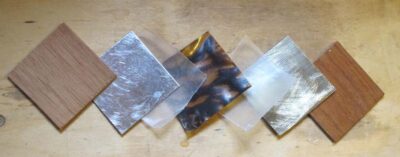
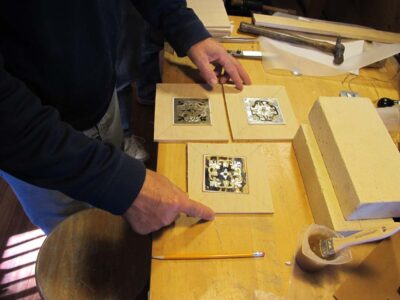
The “stack” we will be sawing into elegant patterns: plywood or mat-board outer sheets, pewter and brass sheet, waxed paper, and “tordonshell.”
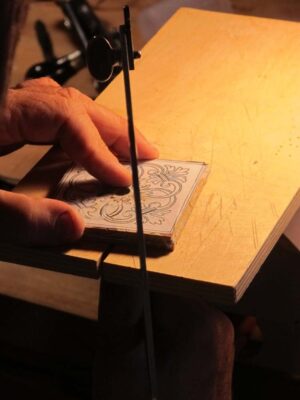
I am very pleased to confirm that Joshua Farnsworth over at Wood and Shop has scheduled my Boullework Marquetry class for this upcoming year. I’ve been working on persuading him for some time, this one is pretty far outside the comfort zone for the school, so I urge you to support us in this listing.
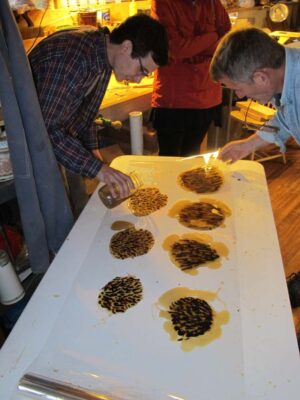
We’ll be making some of my own invention, “tordonshell.” I’ll have pre-made shell for everyone to use in the class; this is for the students to take home.
I look forward to seeing you in Earlysville VA, September 20-22, 2027.
Woodworking Class: Boulle Work Marquetry with Don Williams (3 Days)
shavings & still not done........
Still slugging my way through the box. It is taking a lot longer than I thought it would even with the health issues factored in. It is a small project but the devil is in the build steps that I changed again today. I'm so close to the slapping on some shellac but no check mark for the done column today. Maybe tomorrow or the.....
 |
| new lid |
Resawing it as much as I can on the tablesaw. Like the first one I'll complete it with the japanese saw.
 |
| hmm..... |
I tried to resaw the web evenly top to bottom but wandered off. I was doing good until I flipped it to complete the cut from the opposite direction.
 |
| new lid |
Got 8mm dowel locators in the holes in the box. These are made for twist bits and not brad point drill bits. Regardless, they locate the drill point in the lid.
 |
| hmm..... |
Soss hinges dry fitted and the back looks good. The joint line is consistent R/L but it isn't dead nuts flush. The lid is off a couple of frog hairs but not along the entire length.
 |
| ta da |
I like the 'no hinge' look of these. They don't act like a stop hinge but that might change once I secure the hinges with #2 screws.
 |
| ???? |
The lid gap is tapered, close on the left and wider on the right. The Soss hinge on the right isn't centered on the box. In spite of that the lid opens and closes smoothly. No binding or hesitation at all.
 |
| hmm..... |
First change with the box build. Decided to put a base on the box to dress it up a wee bit. I sawed the 3/4" stock down to 5/8" because 3/4" looked too thick and clunky looking. The initial plan was to glue up the box, install bearers, and then glue the box to them.
 |
| change two |
I didn't like the thickness of the base at 5/8". I sawed a 3/16" wide rabbet in the base for the box to sit on. That leaves it a wee bit less than a 1/2" - you can see the difference in left and short (thicker) side.
 |
| sneak peek |
I changed to this because when I was dry fitting the base I made the first long one short. With the rabbet I now have a 1/4" plus of wiggle room. I plan to do a cutout on the bottom of the base. I'll do that before I glue the base together.
Last night was peaceful with little coughing and lots of uninterrupted, blissful sleep. I had 3 toilet trot races but no coughing and I dropped off to sleep right away. When I went vertical in the AM, no coughing. Usually that is a given and it varies from a few fits to seemingly endless as in when will I stop trying to hack up a lung. I was looking forward to having a nice relatively cough free day with a AM and PM shop session.
All that got flushed after lunch. I went into a spasm that left me light headed and wanting to lose lunch several times. This fit was the worse one I've had since the lung surgery in June. It wiped me out and 30 minutes after it stopped I was still wiped slick. I went to the shop late in the day just to get my camera. At least one more day before this box gets done.
accidental woodworker
The Bosnian, Ottoman-Influenced Arabian Style Bookshelf Part 6
Sorry for the long gap between articles. I could say I’ve been busy, but the truth is I’ve been vegetating. With that out of the way, let’s get into it.

This time I’m tackling the front frame. Normally you’d add one to hide the exposed edges of the plywood. My reason is different. I want to carve some leaves into it, so here it’s purely decoration.
I skip the tape measure. I hold each piece against the bookcase and mark it with a knife where it needs cutting. On the first side that’s directly below the top moulding. After cutting, it’s a perfect fit. I repeat the same thing on the opposite side.

Then I lay both pieces on the bench and carve the leaves. I don’t lay them out first, I just cut them by eye. I carve them fairly deep because I apply stain with a rag, and a rag skips over the carved out areas. They stay the natural colour of the wood while the surface takes the stain, and that contrast of dark and light is what gives the frame its Spanish, Andalusian look.


I now finish the top and bottom by repeating the same method as I did on the sides. Once all four are carved, I glue and clamp them to the bookcase. The frame is wider than the thickness of the bookcase sides, so it leaves a lip. That lip is where the arched panel will attach, which you’ll see later in the project.
Because it’s softwood, 30 minutes or so is enough for the glue to grab. After that I nail the frame and putty the nail holes. I could have left the glue to cure overnight, but I wanted to get it done.
Next up, I’ll make a small moulding that sits directly below the top moulding.


shavings & still not done......
 |
| from yesterday |
This was the last thing I did in the shop before I killed the lights yesterday. 1/8" plywood I have learned is more than sufficient for a box of this size.
 |
| hmm...... |
Put the Soss hinges in and checked the swing and how much clearance there was. It is basically 2 frog hairs and beveling either the lid or the box wouldn't help. The hinges are too close the edge - the bevel would eat into the hinge holes.
I was going to make a new lid with the hinge mortises inset further in away from the edge. That plan went south on the express in a hurry so I stuck with what I got.
 |
| flushing the bottom |
Sawed off most of the bottom overhang before planing and sanding it flush. I paid attention this time to make sure I wasn't throwing it out of square again. The front edge was bit on the wonky side. There was a hump in the middle with the left side corner square but the right one was out to lunch. Some things you just let go because it still looks good.
 |
| signature look |
I went back and forth about beveling the back and in the end I didn't. With the hinge mortises so close to the edge the bevel of the top might have exposed them. I didn't want to chance being wrong or right about that.
 |
| can you see it |
Made a small finger grabbie thing on the underside of the lid. Opening and closing the lid as is without would have worked but this only took a minute a whack out.
 |
| a real big sigh |
I didn't go postal on this and just excepted it. I put the grabbie thing on the wrong edge. I did it there because that is where I had the center of the back edge marked. After looking at it I decided it was for the best because the grabbie thing looked like crap against the bevel. It looked too thin and looked like a big me-steak.
 |
| new lid upcoming |
I had three pieces of pine to choose from and picked the one that had most straightest grain. All of them had swirls and cathedrals that looked too busy.
 |
| ran out of gas |
I'll finish the new lid in the AM or PM. The other box is still waiting for its turn at the workbench.
Had a terrible night last night trying to sleep. I had been coughing continually all day long and it didn't slow down when I hit the rack. I would cough, it would stop, I would fall asleep, and then I would wake up coughing. Wash, rinse, and repeat all night long. This was something new as before this I would wake up and then I would cough a minute or so after. Now I was waking up coughing.
I finally said No Mas and went vertical and instantly felt like crap. All morning long I felt like a carpet that had the snot beaten out of it. Didn't even entertain any thoughts of wandering down to the shop. Feeling like this sucked pond scum where I just wanted to take nap. The nap wasn't happening because the coughing just would not stop. Hoping that this is just a another bad day that it will be better in the AM.
accidental woodworker
101 Hand Planing for Beginners CRASH Course
My New Workspace

It takes time to develop your workspace . . . to establish the version you've created in one or more places and reestablish it in a new one if that's what you have to do. What I have learned through the decades is that being different to be yourself is mostly all that matters. I haven't had a series of machines adjacent to my workbench since I lived in the USA. That's almost 20 years. I mainly had the half a dozen machines to mill wood for my classes of 16 students who need upwards of fifty sticks of wood to make their projects from. I rely solely on a single 14" bandsaw now. It takes a two-foot by two-foot footprint with a dust extractor next to it. We all make choices good or bad and need to live with them either way. I'm looking for something more in my life than machine cutting every stick and stem. I'm still evolving as a woodworker and each day seems to be a decision day. What excess do I need or want to get rid of next?
Being aged 77 on January and having yet still my steady hands, good eyesight and no aches or pains anywhere in my body is mostly down to lifestyle and healthy choices in food, exercising and especially my work. Every healthcare professional I meet with now that I am old ask me the same questions. "How long have you been retired?" and then, secondly, "How many units of alcohol do you take in a week?" I usually say something smart like I retired in 1965 when I started woodworking for a living or let's try how many units of alcohol I consume in a year. I have never really cared for alcohol and certainly never needed it for anything, and my work is physical activity because, well, I'm a manual worker.
 The electrician told me how many metres of wires it has taken to wire the workshop I will soon work in and then the office area for video processing our work, but we did the job top-notch for longevity and each of the guys exemplifies excellence in every area of workmanship with the most excellent work ethic.
 Woodworking is a lifestyle for me. I've integrated into all of my daily activity by visiting woodlands, harvesting trees, creating pieces large and small and making my living from selling what I made. More latterly I have taught others to work with wood using hand tools and converted one or two from machining wood to become more hand tool oriented. These life choices have made me contented and fairly healthy too. But don't get me wrong. There's nothing wrong with machining wood and owning machines. Let's just not confuse the two very different entities as one and the same. No, no, no.
 It looks less than it is currently with the plasterwork dried out now and a lot more work done. Just hate waltzing around their workspace with my phone out.
 Joseph and I were able to hang the two lighting tracks that hold our fuller lighting rigs. We are aiming for a free floor space with flexibility. Because we have insulated for noise and temperature control, we have air control and filtering for fresh air. This is not just a woodworking workshop but a space for half a dozen other creatives to deliver.
Moving workshops these last few months and having been settled for the last seven years has been difficult for me. Even though we replicated my temporary space as closely as possible to the one I have been in since 2019, there has been a kind of creeping occupation I could very much live without. What I had prior to this was a wholly evolved workspace I finally felt matched my best shot at a domestic home workshop with the practicality of making anything I want from wood using hand tools. So, by 'domestic' I mean a workshop space that I could make just about anything needed for a home or office in in reasonable comfort. And remember, please, I just made the last hundred and more furniture pieces in a space the size of a single car UK (not USA) garage, so that is roughly 5 metres by 3.3 metres, so 16 feet by 11. Of course, we have other things that take up space; a pair of stepladders, saw horses, work support, wood, the list is endless.
 The curved path took longer than a straight one, but it definitely enhanced the final appearance. Raised beds are now in since this pic was taken and soon the turf will cover the earth again. Can't wait!
Though missing my work zone proper, I have been enjoying getting on with other things. Being on-site, the builders have shown extraordinary diligence working through the extreme high-heat summer days with no respite and not stopping in recent days on the outdoor work when it rained. I have enjoyed seeing their accuracy and work ethic along with their consistent high standards of workmanship. We are but a few days away from handover. The electrician wired the office plugs and has the conduit in my space for lighting and plugs. He's thinking Friday to be done on what's left. Mario is but six square metres away from finishing up 150 square metres of paving parking spaces, walkways, two patio areas and about to be garden plot. The larges block pavers are 8" by 5" with others 5" by 5". He's spent four weeks on his knees to do that.
Mario is the most patient man I know. He started with two scaffold poles, a truck load of sand and 150 square metres of paving blocksMy sedum roof is on and successful and as green as can be. This, together with the open or porous paving, reduces my carbon footprint on the whole development to as near zero as possible.
 Sedum in crates of soil covers our waterproof roof both sides for a green way forward.
 more shavings........
Been sleeping late and today I woke up just before 0800. Last night was peaceful too. I barely coughed at all and I was only entered in one toilet trot race. I coughed off an on all day but nowhere near the volume and intensity yesterday. I hope this trend continues because it was nice for a change.
 |
| ready for clean up |
The box looked good when I eyeballed it. All the tails/pins appeared to be gap free.
 |
| flushing the corners |
The bottom of a box (or a drawer) is the reference surface. I flushed the corners first and then ran the #3 around it a few times.
 |
| happy face on |
The bottom is twist free. If I wanted to be totally anal I would run a knife line all around the top and then plane down to it. That would make the bottom and top parallel. But that isn't necessary for this box.
 |
| Soss hinges |
These are the smallest Soss hinges I have with a 8mm diameter. The minimum stock thickness for them is 7/16" and the box is between 3/8 and 7/16. I am going to use them regardless.
 |
| flushing the top |
The top is now twist free too.
 |
| cleaning the box |
Instead of planing the box I sanded it. The tails/pins were no more than a frog hair off flush. First one out of the starting blocks was 80 grit followed by 120.
 |
| hmm...... |
I want the lid to overhang the box at the front. The tablesaw wasn't able to make the complete resaw cut. Finished it with my japanese saw.
 |
| it is gone |
Flushed the web first and then planed it until it was a 1/2" thick. I made it that thick to accommodate the 3/8" depth needed for the Soss hinge.
 |
| minimum |
I went with a frog hair more then a 1/2" to allow for the spur on the 8mm brad point drill bit.
 |
| close, oh so close |
The front and back walls on the hinges in the box look ok. The ones in the lid aren't the same. They ended up painfully close to the outside edge. Thinking now that maybe I should have pushed the back of the lid past the back of the box a wee bit.
The instructions say to drill a 8.2mm hole for the hinges. I drilled 8mm holes and the hinges fit in them snug. The lid opened and closed without any hiccups. 8.2mm seems to be oversized and the hinges wouldn't fit even with the screws installed.
 |
| #2 FH screws |
There is a groove on both sides of the hinge, top and bottom. They are for a #2 screw to secure and keep them from twisting and uplifting when the lid is opened/closed.
 |
| hmm...... |
The outside of the box ain't square. The inside is dead nuts square. There is also a slight bow in the back long side. I didn't expect the sanding to go nutso and throw the box out of square. Used the #3 to square the back corners. I left the front one alone. I did this to help with evening the overhang on the ends.
 |
| slight curve |
Didn't get to the smaller box but there is always tomorrow. I got the planer to the tool guy and he said that the way he does the belt change is to loosen the big pulley. When I had first looked at changing the belt I had thought that was the way to replace it. Don't know when he'll get around to it and I'll get it back.
accidental woodworker
How Turning Tools Work
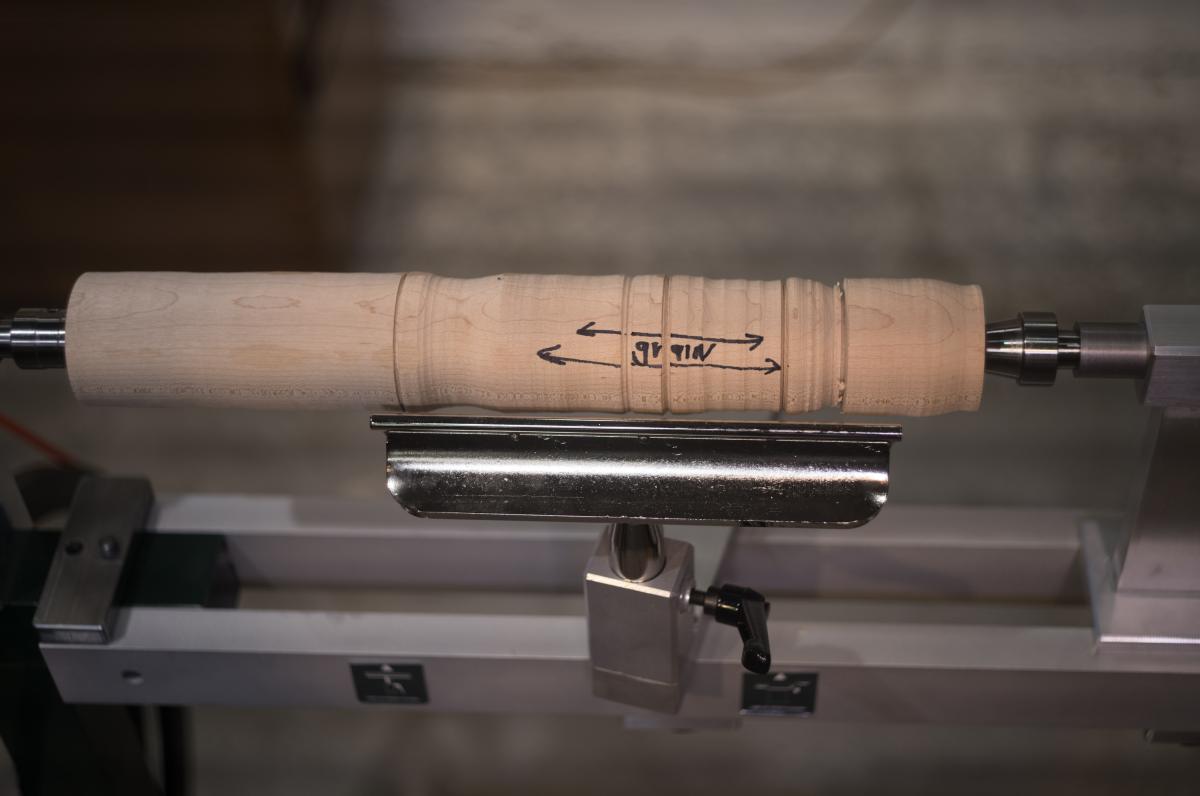 When spindle turning between centers you are always peeling perpendicular to the grain
Do you learn the way I do?
If we're talking about a hands-on skill like turning, I need to understand why a process works. I have a terrible memory for procedure, so unless I understand the procedure steps in context, I won't be able to remember the procedure.
When I begin to learn turning I read a lot and saw a lot of videos. But very little of that information was about the "why." It was mostly about the "how."
This series is about the "why." It won't of itself teach you how to turn, but it may help give some context that can complement other turning instruction.
Before we look at the tools, let's look at what we're trying to accomplish. There are two types of turning: the first is spindle turning (above) - think chair legs, candlesticks and banisters. The wood is mounted end-to-end between centers, with the grain running parallel to the spindle of the lathe. When you turn a spindle, you're always cutting across the grain.
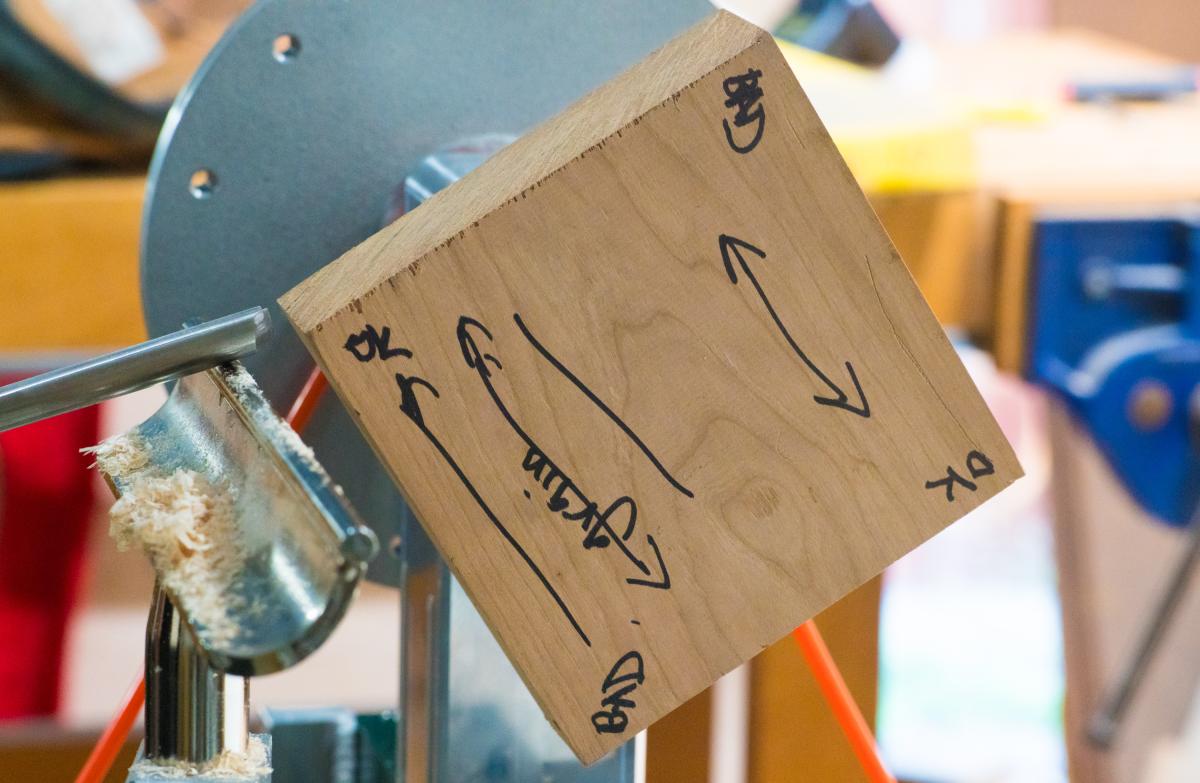 With bowl turning, the grain is always shifting direction
The second type of turning is bowl turning. In this type of turning, the wood is mounted perpendicular to the spindle. As the wood rotates in the lathe, you may be cutting along the grain, with the grain, or half the time directly into the grain, albeit the wrong way. This presents a lots of problems cutting against the grain.
We'll look at bowl turning another time, but for now, let's look at spindle turning in more detail. As I just mentioned, you're cutting across or perpendicular to the grain. Typically when you cut across grain, the wood simply peels away. Different species offer different experiences. If you have a very stringy wood, it will peel away leaving a rough surface. On a fine and dense wood, you'll get a fine surface. There's no real danger of tear-out, except on corners of the cut (where the wood will splinter out if the corners of the cutting tool are buried in the wood).
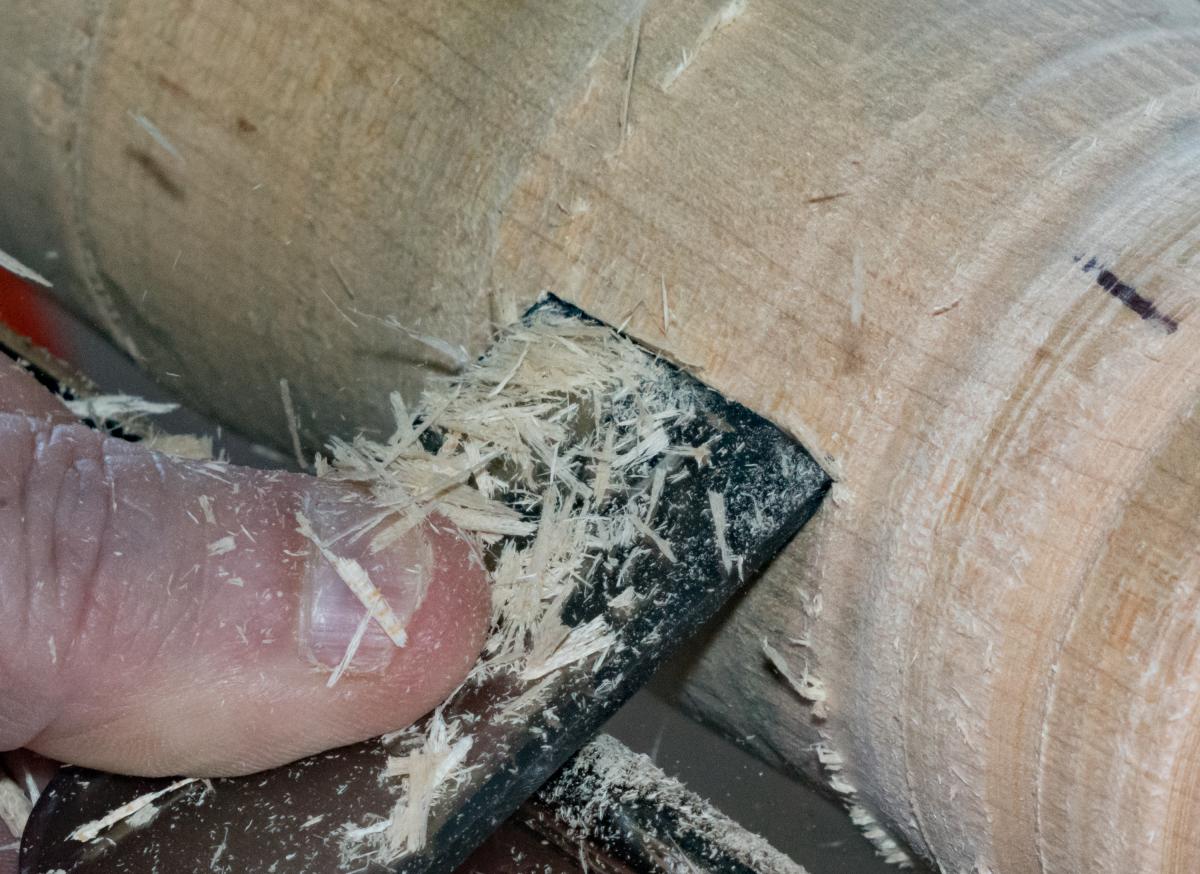 With a straight chisel, the wood just splinters out at the corners of the chisel
The very simple solution to splintering out at the corners of a straight tool is instead of a straight tool is to use a gouge that cuts and peels the wood away in the middle - and then gracefully exits and shears the fibers at the corners of the tool without splintering. This is essentially how all spindle turning tools work. The center of the gouge peels away material, and the curved sides exit cleanly.
A continental gouge, which has a gentle curve to it, can cut cleanly, provided you don't have too heavy a cut, which can engage the corners of the tool. A roughing gouge, with its high sides and U-shaped profile, can take very deep cuts and still cut cleanly. A thumbnail spindle gouge, has a nose (finger) sticking out in the center of the tool so it can cut deeper, but the tool still has the raised sides of a gouge so it can do some shearing at the sides and leave with a clean transition at the edges of the cut.
Skew chisels, and scraping tools, both of which are flat and don't have a curved gouge geometry for a clean cutting on the sides are used differently than gouges and I will look at them analytically another time.
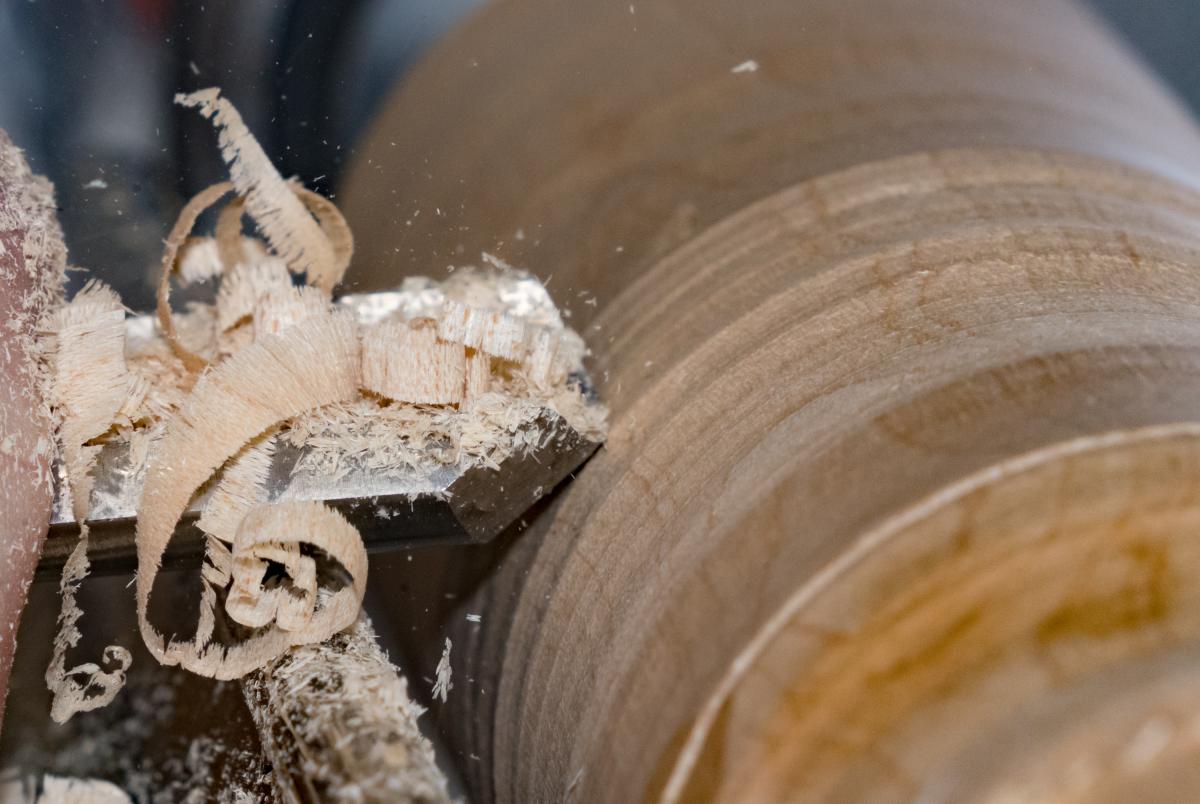 Nice clean shavings
The next issue is how to hold the tool against the material. The turning tool is always braced on the tool rest and kept steady by one hand holding on at the end of the handle. But that's not enough to rigidity to keep the tool moving even a fraction of an inch up and down as it can pivot on the rest. So the tool won't cut evenly or consistently.
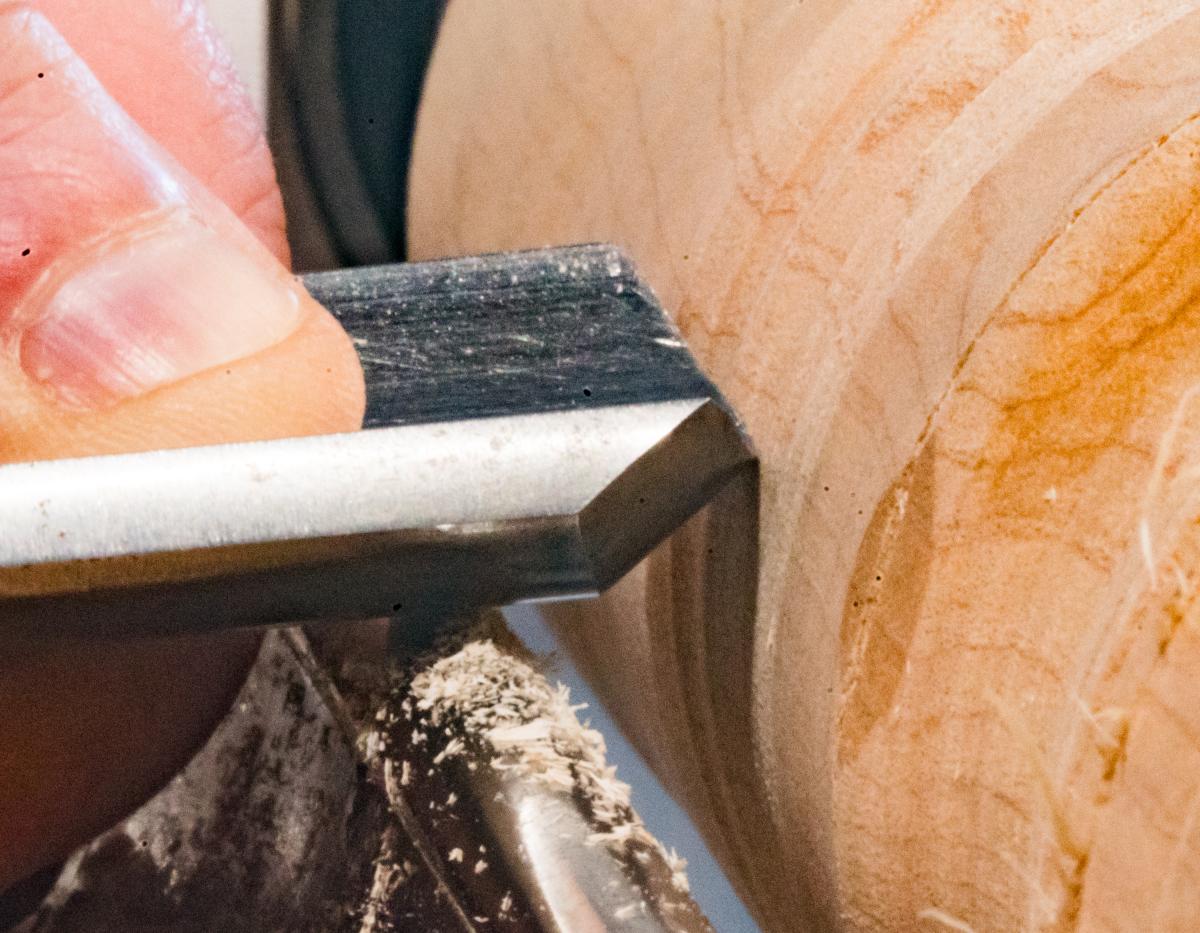 Holding the tool with no support leads to chatter and uneven cutting
The tool is unsupported as in the photo above, it will cut, but even holding the tool as steady as you can, there will be enough movement at the cutting edge so that you will not get a steady, even cut. The cutting edge will bounce up and down, going in the work too deeply, or bounding out entirely. The tool is essentially a see saw.
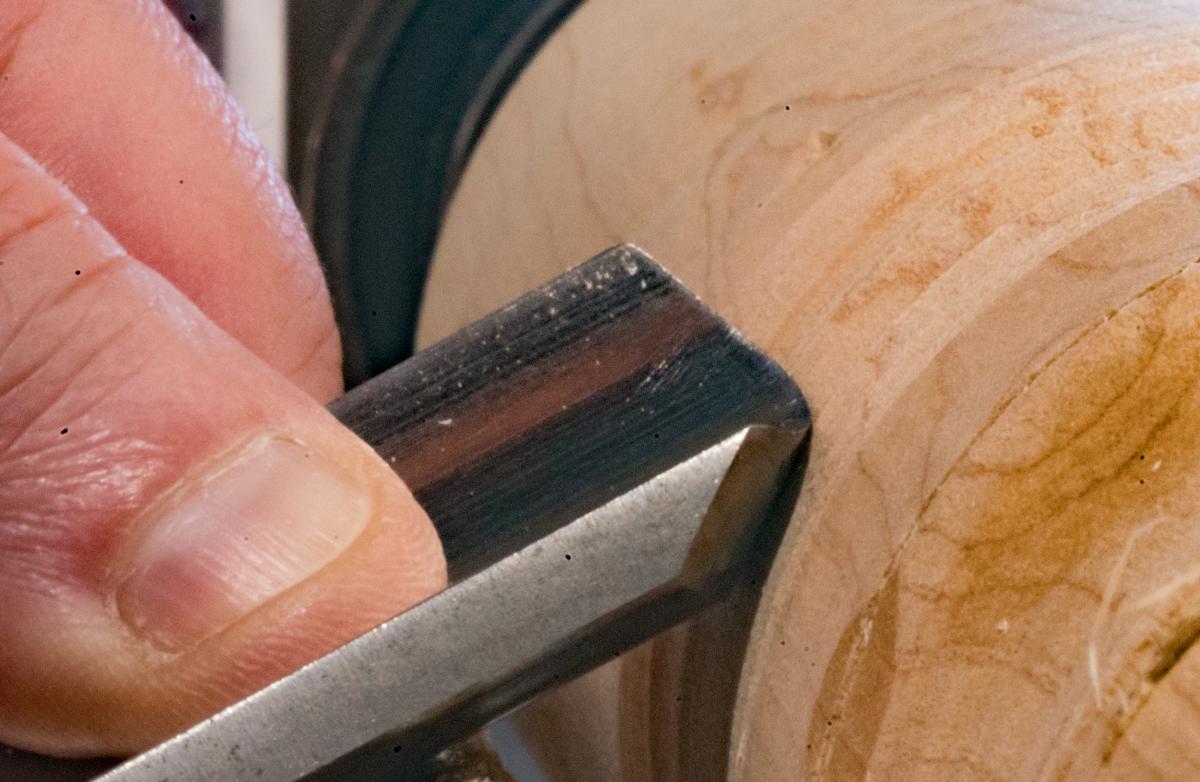 Riding the bevel on the work - a nice clean, smooth surface
The key to smooth, even, shiny surfaces is riding the bevel of the turning tool on the spinning work. In the image above we have two places for support: the tool rest; and the work itself. You can easily hold a steady position because the tool cannot lift out of the cut and you are holding the tool hand up against resistance and the tool cannot dig deeper into the cut because the bevel is rubbing against the work as it turns. You get continuous, long shavings, a smooth surface, and controlled cutting - because the tool is prevented from bouncing in and out of the cut. The position of the tool rest, how far above or below the work centerline it is and how far away the tool rest is from the work is determined to make it is easy for you to position the tool so it naturally allows the tool bevel to rub against the work as the work is turned smaller. Riding the bevel is generally how all turning is done. There are exceptions. The most notable being when you are taking a new piece of stock and turning it from square to round. No matter how much you might want to ride the bevel, between cutting the corners of the stock round, there is no support so steady hand holding may be the best you can do.
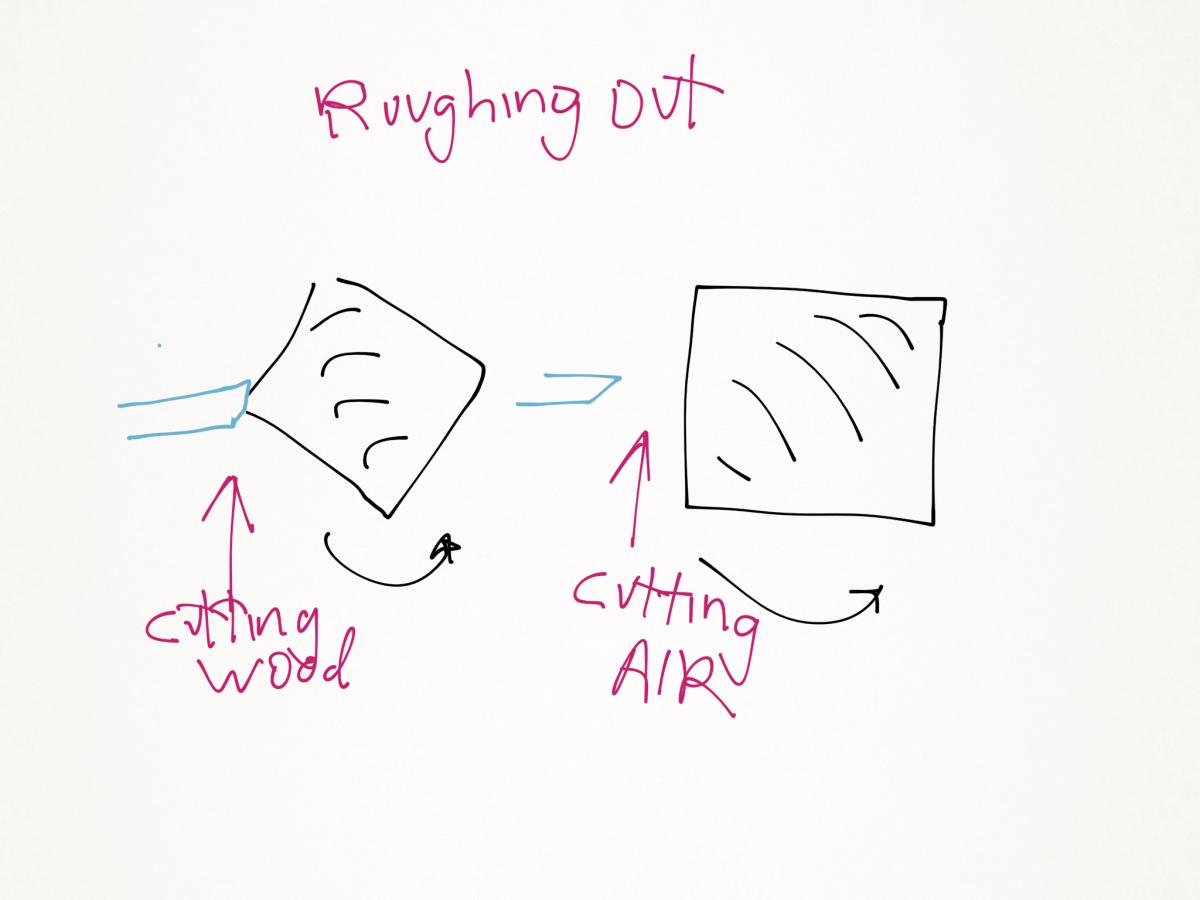 When roughing from square, the tool is unsupported as it rounds the stock
Once I understood these basic principles I could easily focus on easy turning. I don't think for example of my tool rest is high or low, but how well the tool is cutting. If I am getting a ragged cut, or have trouble with control I know to look to see if the tool bevel is supported by the work, or am bouncing free. And the fix becomes obvious.
Unwanted Harvest
For the past few weeks we’ve been afflicted by the nuisance of being bombarded by thousands of two-inch ball bearings cascading down into the yard. You might call these ball bearings “black walnuts” but we just view them as hazards of the yard and hillside to be navigated around.
Neither of us like eating black walnuts so we see nothing beneficial in their presence. In addition, many of Mrs. Barn’s plants, especially in the vegetable garden, are harmed by the toxic juglone in walnuts, walnut leaves, and walnut sap. She’s had to reconfigure the garden continuously to accommodate the magnificent trees growing just outside the west end of the fenced area.

Bombing season is drawing to a close so I will rake up the trash-can-full of these dangerous nuisances in the coming days. If only we had a better breed of squirrels to haul them all away. We’ve got gigantic squirrels here (seriously, almost as big as the cat) but the bums are too lazy to bother with our needs and clean up the yard.
made some shavings........
 |
| hmm....... |
Made it to the shop late and I was determined to make something. Even if it was something I didn't need. On the flip side I just had the desire to work with my hands and have something to show for the effort. So a box it is but with a twist. The long sides will be thicker than the ends. I can't remember if I have made a box with different thicknesses of the sides. Not only different thicknesses, the dovetails will be on the teeny side.
 |
| made a detour |
While I was figuring out the dimensions of the box I saw a scrap of pine by the tablesaw and resawed it to 3/8" thick. I'll make a box out of it first. Then plan was to get both boxes glued and cooking by the end of the PM session.
 |
| my shavings |
I was able to plane the sawn face smooth and flat without expiring. I didn't have a coughing fit but I had to take 10 to catch my breath.
 |
| not my usual box |
I sized the box so the long sides are twice the size of the ends. I also sawed the sides so that the grain flowed around continuously.
 |
| tails sawn |
I have gotten in the habit of using the dozuki saw for stock thinner then a 1/2". No headaches sawing the tails which was welcomed. No fits or shortness of breath issues.
 |
| no Moxon |
I had thought of using the Moxon to do this but nixed it. If I was making a lot of boxes I would have done that. Instead I used this handy jig for setting the height of the pin board.
 |
| off the saw |
I didn't lose anything with my dovetail skill set. It appears that this type of work is something I can still do. It is relatively stationary and doesn't involve a lot of exertion. Both diagonals agreed on 8 3/4".
 |
| happy accident? |
I thought I had centered the middle tail. The left pin socket is noticeably larger than the right one. I must have read my centering rule wrong. I didn't have my glasses and I didn't want to go topside to get them. Looks like I should have.
 |
| happy face |
The inside corners are gap free. This is something that I don't always get.
 |
| opposite end |
I usually end up with one or two gaps on the inside but not today.
 |
| it is square on the inside |
No need for clamps as the tails/pins are on the snug side. I had to fuss with it a bit to get here. I had used a clamp to close one tail/pin and that threw the diagonals off.
 |
| kind of like the asymmetrical look |
The plan is to glue a piece of 1/8" plywood for the bottom of the box. IMO that would mean making sure the larger pin/tail is at the bottom and the thinner one is under the lid.
Didn't get to the thickness box but it will give me something to look forward to in the AM. I had to go topside during the AM session and that wore me out. I sat down at my desk to catch my breath and once I did, I didn't feel like getting back up. Spoiler alert - stayed there for over an hour.
Called the repair shop this AM and he said that he was out of the shop today. He also said that he has replaced the drive belt several times. I'll drop the lunchbox off to him tomorrow.
accidental woodworker
Try Before You Buy at Ultimate Tools Oct 22
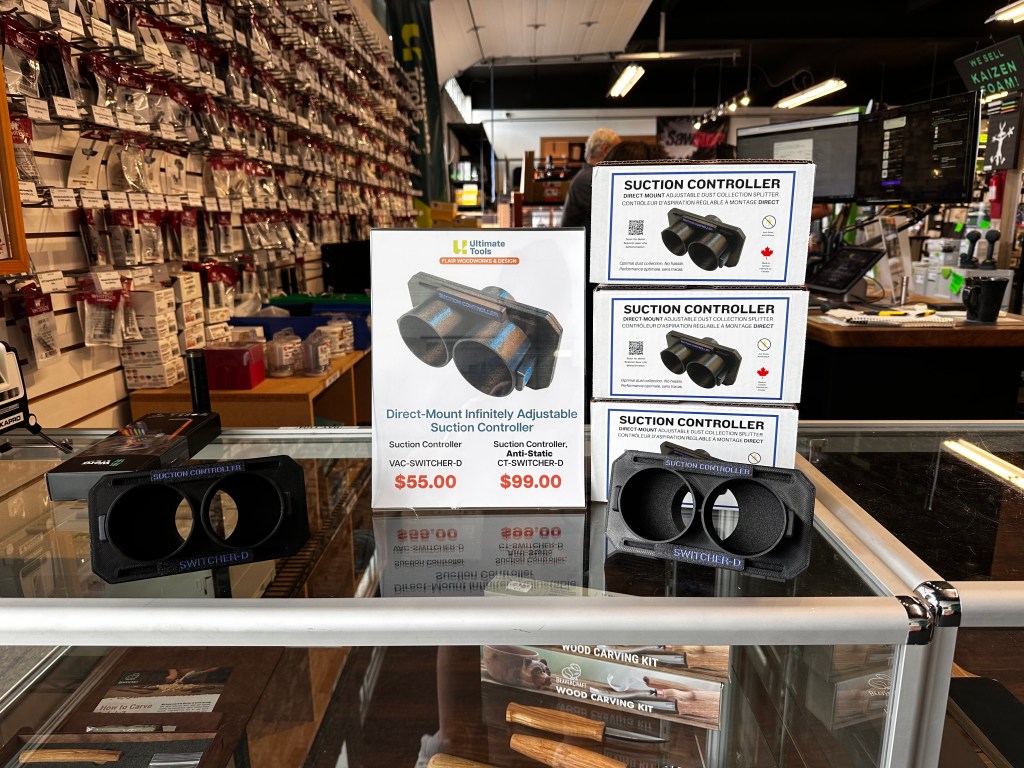
Find me at Ultimate Tools this Thursday to learn all about Suction Controller, plus lots of other amazing top-tier tools at their annual Oktober Tool Fest event which is one of the biggest woodworking events in the Lower Mainland.
Other reps will be there to demonstrate and educate you on tools from Mafell, Lamello, Mirka, Sia and Robbox. There will also be lots in-store deals you won’t find anywhere else.
Where: Ultimate Tools, 3847 1st Avenue, Burnaby, BC
When: Thursday October 22, 10 AM to 3 PM
Woodworking and art
Pages
