Hand Tool Headlines
The Woodworking Blogs Aggregator
“Glory to God in the highest heaven, and on earth peace to those on whom his favor rests.” - Luke 2:14
Be sure to visit the Hand Tool Headlines section - scores of my favorite woodworking blogs in one place.
Elia Bizzari - Hand Tool Woodworking
Old Bodger Videos

I’ve been on the pole lathe turning a pile of parts for upcoming 18th-Century Chairmaking classes. I’ve turned a few hundred parts on the pole lathe before, but this is the first time I’ve turned this many – 75 legs or so – on the pole lathe in one go. I’m really enjoying it.
Batch production like this is one of the best ways to develop skills. My surfaces are getting smoother and my work more efficient. It’s also forced me to make a few changes to my lathe treadle. Body positions that were passable for an hour became unbearable after a day. Now, I’ll benefit from the changes every time I use the lathe.
This time at the lathe has also reinforced what I already knew: turning on the pole lathe can be just as fast as a power lathe. I’ve been turning Samuel Wing’s simple chair legs in less than four minutes, starting with turned cylinders (I used the power lathe for roughing these cylinders, which is much faster for this). Could I turn the legs faster on the power lathe? Maybe, but I doubt it. Would the surfaces be smoother on the power lathe? Probably. But then again I’ve spent the last 25 years turning on the power lathe, so that’s a unfair comparison.
Another good way to develop skills is by watching people who know what they are doing. So I’ve been revisiting videos of the old English chair bodgers, trying to learn their secrets. A few videos I’ve posted here before. But there’s at least two I haven’t, and they’re some of the best:
This first one is from the BBC, ca. 1950. It’s of a pair of brothers, Owen and Alexander Dean, some of the last chair-leg turners in England. Watching this again, I saw something new: the chisel can stay put when the treadle stroke ends. I’ve been backing it up slightly before the next cut, but there’s no need for that – just leave it in place and begin again on the next treadle stroke. Saves a lot of energy.
The second video is from 1941 and is of Albert Carter, chair-leg turner. The narrator says he works 14-hour days and turns out about 10 gross per week, or 1440 legs. If he’s working 6 days per week, and doesn’t break for lunch or tea or anything, that’s 3.5 minutes per leg. Was he splitting and shaving all those legs himself? If so, he’s doing pretty well for a 75-year-old.
The post Old Bodger Videos first appeared on Elia Bizzarri - Hand Tool Woodworking.A Favorite New Technique
“Your book is next.” These welcome words greeted me a few days ago as I opened my email. Megan Fitzpatrick is my editor, Lost Art Press is my publisher, and my book may see the light of day sometime soon. Sure, there’s still lots of editing and formatting for Megan to do, but it’s begun in earnest now.
One of my favorite new techniques that I learned during the book-writing process was boiled joints. I’ve written about them before, but here’s a clip from my talk at the Working Wood in the 18th Century conference at Colonial Williamsburg a few weeks ago, showing how they’re done:
I just this week learned how to edit videos. This is my first, and I’m rather surprised at how simple and fun the process is. Maybe more will come.
The post A Favorite New Technique first appeared on Elia Bizzarri - Hand Tool Woodworking.For Sale: My First Lathe, My First Drill Press, and a Grinder
January has been a busy month for me. Last weekend, I went to Colonial Williamsburg to give a talk on the Samuel Wing chair. At the end of two 90-minute sessions my friend Jerome Bias (who was also presenting at the conference) came up on stage to help me assemble the back. It was an especially recalcitrant back, so my wife Morgan also came up to help:

Both presentations were fun, and I was quite happy (thanks to planemaker Steve Slocum for both photos):

Earlier in January, I drove to northern VA to buy an automatic knife grinder for grinding our travisher and reamer blades. I’ve been having local grinding shops do this grinding, but it seems time to move it to my shop. This grinder is as big as a lathe, so we need a spot to put it. Hence, some machines for sale. The best is first – my very first lathe, now owned by Seth Elliott who makes the travishers and tenon cutters that I sell. Here’s what he has to say about it:

For Sale: A Powermatic 90—Elia’s First Lathe
The tool-making section of Hand Tool Woodworking, where I spend my time, is an enclosed shed with big sliding doors off the back of Elia’s main shop. It’s got a little Jotul wood stove and a great view of the woods. Ironically, we use several power tools to make our hand tools and have intentionally housed most of them in this back shop area to keep the noise and dust somewhat isolated. With a 24″ planer, 14″ band saw, table saw, steam box, spindle sander, belt/disc sander, router, grinder, lathe, and drill press, space is at a premium.

Still, for the past couple years Elia has graciously allowed me to store his old pea-green Powermatic 90 lathe against one wall. He originally purchased this lathe in 2004, did put a single-phase motor in it, and turned on it for fifteen years until selling it to me after scoring his massive Wadkin pattermaker’s lathe. I used it for a few years in my own shop that I had
set up in an elderly neighbor’s outbuilding down the street from me. After she passed, and I had to break-down that shop, we moved it back to Elia’s shop with the intention of replacing the small Delta lathe I had been using there. My lathe use for the toolmaking is limited, however, and it makes sense for Elia to keep the Delta—a somewhat-mobile lathe—for the occasional demo. So, I’ve decided to stop letting the Powermatic collect dust and instead get it into the hands of someone who will use it.
I had plans to save it for another permutation of my own shop on my own property, but that project will not be happening any time soon and Elia has just bought a metal grinder that needs that wall space in the tool-making shop. Sorry as I am to see it go, it makes the most sense at this time.
It’s an excellent lathe. The Powermatic Company in Tennessee made the PM90 from 1955 to1998. There’s a great thread on its history
on the OWWM.org website. Its owner’s manual and parts list can be found on the same site. From that, it looks like this one is from 1961. These lathes became popular for use in high-school shop classes and gained a reputation for standing up to less-than-careful use. It weighs in at 600 pounds and is therefore quite stable. It has a variable speed lever that shifts easily from1000 to 4000 rpm. This one is currently set up with a 1 hp motor and a single-phase, 220v connection. Also included, in addition to original metal tool rest stand (minus the tool-rest itself), is a longer wooden one that Elia built for turning chair parts and also a sturdy tool stand/rest for outboard turning.
Asking price is $1500. The buyer will need a way to load the lathe as we have no lift.
Contact Seth for more info.


I (Elia) am also selling a couple machines. The first is a drill press. It was Peter Ross’s first drill press that he bought in the 80’s. I bought it from him when I moved into my current shop, and it became my first drill press. The motor promptly burned out, so I put a nice 3/4hp, 110v Dayton motor on it and we’ve made thousands of tools on it since. It runs great and has a couple nice features: a very nice quick-set depth stop and a table crank. But it’s a little small for our work and the quill has some run-out, which can cause vibration when drilling metal and reaming large holes (read tenon-cutters). So I recently bought a bigger Powermatic drill press (also from Peter) and this one’s got to go.
$150


When I bought my automatic knife grinder, the owner had five pedestal grinders he was also selling. On impulse, I bought the best one, and immediately regretted it. Not that it’s not a nice grinder – it’s much quieter and better-built than mine. But do I really want to spend time tearing my grinding setup apart and putting it back together again? No! So I’m selling this grinder for what I’ve got in it.
$250
The post For Sale: My First Lathe, My First Drill Press, and a Grinder first appeared on Elia Bizzarri - Hand Tool Woodworking.2026 Chair and Wheelbarrow Classes
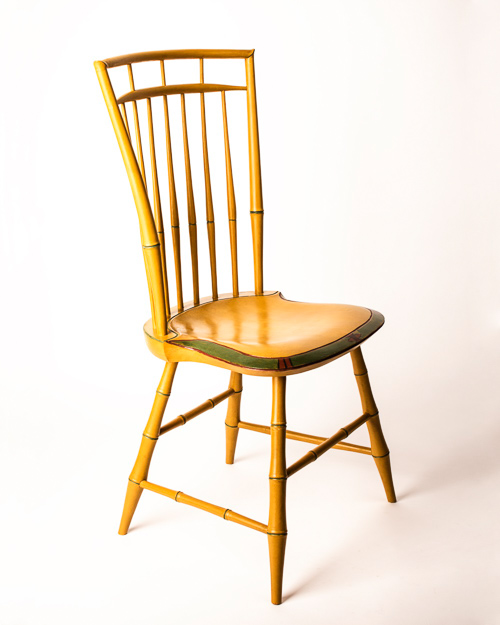
I just finished teaching my last class of the year, on 18th Century Chairmaking. A highlight for me was a trip to our local auction house to view a turn-of-the-19th-Century bow back chair made by the McKim Brothers of Richmond, Virginia (photo from the Leland Little website):

The auction-house folks were gracious enough to allow me to trace the very nice, sculptural seat:

I made a copy of the seat during class the next day and intend to offer it as a variation for future students in this 18th Century Chairmaking Class. Teaching this class was fun, and I’m fired up to do it again. Here’s a few classes for next year (there will probably be more next summer and fall, but this is what I’ve got for now):

18th CENTURY LOOP BACK SIDE CHAIR
March 23rd to 28th, 2026 (at my shop)
May 4th to 9th, 2026 (at my shop)

TRADITIONAL WHEELBARROW w/ PETER ROSS & ELIA BIZZARRI
October 5th-10th, 2026 (at my shop)
I’m doing the lottery system again: email me by 8am on Thursday (December 18th) to be entered into the lottery for the class(es) you want. After that, any class opening will be available for purchase through the website shopping cart.
Hope to see you next year!
The post 2026 Chair and Wheelbarrow Classes first appeared on Elia Bizzarri - Hand Tool Woodworking.