
Hand Tool Headlines
The Woodworking Blogs Aggregator
“Glory to God in the highest heaven, and on earth peace to those on whom his favor rests.” - Luke 2:14
Norse Woodsmith Blog Feeds
Old Doma Demo
At last I’m back with an update. A lot has happened over the past few months. I’ve been working on our renovation project pretty much nonstop, aside from a few breaks for some small commissions and teaching. But the big project dominating my time this year has been renovating our kitchen, and I’ll share the… Read More »Old Doma Demo
The post Old Doma Demo appeared first on Big Sand Woodworking.
New Model Mandolin: 7
Well, this is another long video but so, so much to get through!
The bridge is made and I have brief chat about its design, the strings go on and I show you how I set-up my mandolins. And finally……..the New Model Mandolin gets to sing its first notes!
So, cuppa at the ready and off we go.
Cheers Gary
hardware dresser, 2nd to last post.........
 |
| switched |
The metal knobs were too large (IMO) for the dresser drawers. Decided to use one shaker knob per drawer. All of the tenons on the knobs were about a 64th over 3/8".
 |
| quick jig |
The tenon length was 3/4" and the drawer fronts were a 1/2". This jig allowed me to saw the length to a little less than a 1/2".
 |
| done |
I centered the knobs on each drawer front and it looks good to my eye. I found a site that sells shaker knobs. It is wood-dowel dot com. I was able to get three of the sizes I use the most. The one size that wasn't available was the largest but I don't use that size often. I'll check back on it occasionally to see if they pop up.
 |
| hmm....... |
I have 31 containers to transfer to the drawers. I have 51 compartments available to fill up. There are 7 containers that are wood screws that I am not putting in the hardware dresser. I intend to put machine and metal screws only along with washers, nuts, etc.
 |
| new frame project |
I don't remember where I saw this but it was (email?) about a printer who makes paper like they did in the 1770s. He printed copies of this Declaration using the font and printing methods from this time period. I'll be making a frame for this and another for a certificate my wife wants framed.
 |
| heavy |
I didn't realize how much weight the hardware would impart on the drawers. I'll keep an eye on it and see if it makes the drawer runners sag.
 |
| found more |
I found 5 cardboard boxes of wood screws. I remember these being left over from a McFeely's order from many, many moons ago.
There is a heat wave in its 3rd day in my part of the universe. It hit 97F - 36C at my house today. It kinda sapped me and I didn't do anything in the PM session except to start filling up the dresser. All that is left to do on the dresser is to fit the base molding and slap on a few coats of shellac. Hoping to get that done in the AM and start on the two new pic frames.
accidental woodworker
New Substack Post - In Search of the Best Finish for a Classical Guitar: Revisted and Revised
We Hold These Truths … (2026)
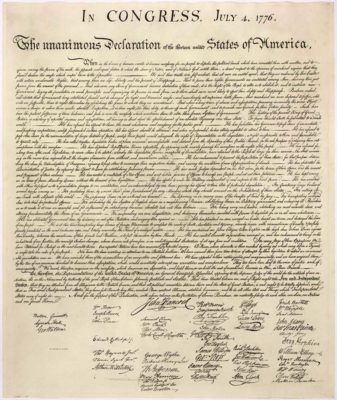
This reminder is presented annually, revised a bit from time to time. Despite dozens of recitations, I can never read the last line of The Declaration out loud because I am overcome with emotion. – DCW
Tomorrow my fellow Patriots and I, however many of us there are, will commemorate and celebrate the 250th anniversary of the most profound statement of human aspiration ever known. We have already endured two violent wars of secession, the first from 1775-1783 and the second from 1861-1865, and I pray that our third one can be avoided by a peaceful segregation of a populace that no longer shares a common vision. Again this year I am especially drawn to the passage “mankind are more disposed to suffer, while evils are sufferable, than to right themselves by abolishing the forms to which they are accustomed.” This sentiment was later expressed by John F. Kennedy, as “When peaceful rebellion is made impossible, violent rebellion becomes inevitable.”
As our nation is seemingly rife with incurious, gullible and servile inhabitants, we would be well-served to reflect seriously on the document encapsulating the mission statement for the greatest nation ever known to man, the only nation ever founded on a creed and geography or lineage. It was and is of course imperfect, no institution created by fallen and sinful men and women can be anything else.
I am an unabashed partisan in the cause of Life, Liberty, and Property (the original draft wording) and find The Declaration of Independence to be the most noble civil document ever created by mankind. I pray you will read and reflect on the ideas expressed by men who pledged their lives, their fortunes, and their sacred honor to pursue the path of liberty. Reading it is much like reading the Minor Prophets of the Old Testament; more up-to-date regarding the human condition than tomorrow’s headlines.
God Bless America, and may righteousness flourish and wickedness be overcome.
========================================================
IN CONGRESS, July 4, 1776.
The unanimous Declaration of the thirteen united States of America,
When in the Course of human events, it becomes necessary for one people to dissolve the political bands which have connected them with another, and to assume among the powers of the earth, the separate and equal station to which the Laws of Nature and of Nature’s God entitle them, a decent respect to the opinions of mankind requires that they should declare the causes which impel them to the separation.
We hold these truths to be self-evident, that all men are created equal, that they are endowed by their Creator with certain unalienable Rights, that among these are Life, Liberty and the pursuit of Happiness.–That to secure these rights, Governments are instituted among Men, deriving their just powers from the consent of the governed, –That whenever any Form of Government becomes destructive of these ends, it is the Right of the People to alter or to abolish it, and to institute new Government, laying its foundation on such principles and organizing its powers in such form, as to them shall seem most likely to effect their Safety and Happiness. Prudence, indeed, will dictate that Governments long established should not be changed for light and transient causes; and accordingly all experience hath shewn, that mankind are more disposed to suffer, while evils are sufferable, than to right themselves by abolishing the forms to which they are accustomed. But when a long train of abuses and usurpations, pursuing invariably the same Object evinces a design to reduce them under absolute Despotism, it is their right, it is their duty, to throw off such Government, and to provide new Guards for their future security.–Such has been the patient sufferance of these Colonies; and such is now the necessity which constrains them to alter their former Systems of Government. The history of the present King of Great Britain is a history of repeated injuries and usurpations, all having in direct object the establishment of an absolute Tyranny over these States. To prove this, let Facts be submitted to a candid world.
He has refused his Assent to Laws, the most wholesome and necessary for the public good.
He has forbidden his Governors to pass Laws of immediate and pressing importance, unless suspended in their operation till his Assent should be obtained; and when so suspended, he has utterly neglected to attend to them.
He has refused to pass other Laws for the accommodation of large districts of people, unless those people would relinquish the right of Representation in the Legislature, a right inestimable to them and formidable to tyrants only.
He has called together legislative bodies at places unusual, uncomfortable, and distant from the depository of their public Records, for the sole purpose of fatiguing them into compliance with his measures.
He has dissolved Representative Houses repeatedly, for opposing with manly firmness his invasions on the rights of the people.
He has refused for a long time, after such dissolutions, to cause others to be elected; whereby the Legislative powers, incapable of Annihilation, have returned to the People at large for their exercise; the State remaining in the mean time exposed to all the dangers of invasion from without, and convulsions within.
He has endeavoured to prevent the population of these States; for that purpose obstructing the Laws for Naturalization of Foreigners; refusing to pass others to encourage their migrations hither, and raising the conditions of new Appropriations of Lands.
He has obstructed the Administration of Justice, by refusing his Assent to Laws for establishing Judiciary powers.
He has made Judges dependent on his Will alone, for the tenure of their offices, and the amount and payment of their salaries.
He has erected a multitude of New Offices, and sent hither swarms of Officers to harrass our people, and eat out their substance.
He has kept among us, in times of peace, Standing Armies without the Consent of our legislatures.
He has affected to render the Military independent of and superior to the Civil power.
He has combined with others to subject us to a jurisdiction foreign to our constitution, and unacknowledged by our laws; giving his Assent to their Acts of pretended Legislation:
For Quartering large bodies of armed troops among us:
For protecting them, by a mock Trial, from punishment for any Murders which they should commit on the Inhabitants of these States:
For cutting off our Trade with all parts of the world:
For imposing Taxes on us without our Consent:
For depriving us in many cases, of the benefits of Trial by Jury:
For transporting us beyond Seas to be tried for pretended offences
For abolishing the free System of English Laws in a neighbouring Province, establishing therein an Arbitrary government, and enlarging its Boundaries so as to render it at once an example and fit instrument for introducing the same absolute rule into these Colonies:
For taking away our Charters, abolishing our most valuable Laws, and altering fundamentally the Forms of our Governments:
For suspending our own Legislatures, and declaring themselves invested with power to legislate for us in all cases whatsoever.
He has abdicated Government here, by declaring us out of his Protection and waging War against us.
He has plundered our seas, ravaged our Coasts, burnt our towns, and destroyed the lives of our people.
He is at this time transporting large Armies of foreign Mercenaries to compleat the works of death, desolation and tyranny, already begun with circumstances of Cruelty & perfidy scarcely paralleled in the most barbarous ages, and totally unworthy the Head of a civilized nation.
He has constrained our fellow Citizens taken Captive on the high Seas to bear Arms against their Country, to become the executioners of their friends and Brethren, or to fall themselves by their Hands.
He has excited domestic insurrections amongst us, and has endeavoured to bring on the inhabitants of our frontiers, the merciless Indian Savages, whose known rule of warfare, is an undistinguished destruction of all ages, sexes and conditions.
In every stage of these Oppressions We have Petitioned for Redress in the most humble terms: Our repeated Petitions have been answered only by repeated injury. A Prince whose character is thus marked by every act which may define a Tyrant, is unfit to be the ruler of a free people.
Nor have We been wanting in attentions to our Brittish brethren. We have warned them from time to time of attempts by their legislature to extend an unwarrantable jurisdiction over us. We have reminded them of the circumstances of our emigration and settlement here. We have appealed to their native justice and magnanimity, and we have conjured them by the ties of our common kindred to disavow these usurpations, which, would inevitably interrupt our connections and correspondence. They too have been deaf to the voice of justice and of consanguinity. We must, therefore, acquiesce in the necessity, which denounces our Separation, and hold them, as we hold the rest of mankind, Enemies in War, in Peace Friends.
We, therefore, the Representatives of the united States of America, in General Congress, Assembled, appealing to the Supreme Judge of the world for the rectitude of our intentions, do, in the Name, and by Authority of the good People of these Colonies, solemnly publish and declare, That these United Colonies are, and of Right ought to be Free and Independent States; that they are Absolved from all Allegiance to the British Crown, and that all political connection between them and the State of Great Britain, is and ought to be totally dissolved; and that as Free and Independent States, they have full Power to levy War, conclude Peace, contract Alliances, establish Commerce, and to do all other Acts and Things which Independent States may of right do. And for the support of this Declaration, with a firm reliance on the protection of divine Providence, we mutually pledge to each other our Lives, our Fortunes and our sacred Honor.
Button Gwinnett
Lyman Hall
George Walton
William Hooper
Joseph Hewes
John Penn
Edward Rutledge
Thomas Heyward, Jr.
Thomas Lynch, Jr.
Arthur Middleton
John Hancock
Samuel Chase
William Paca
Thomas Stone
Charles Carroll of Carrollton
George Wythe
Richard Henry Lee
Thomas Jefferson
Benjamin Harrison
Thomas Nelson, Jr.
Francis Lightfoot Lee
Carter Braxton
Robert Morris
Benjamin Rush
Benjamin Franklin
John Morton
George Clymer
James Smith
George Taylor
James Wilson
George Ross
Caesar Rodney
George Read
Thomas McKean
William Floyd
Philip Livingston
Francis Lewis
Lewis Morris
Richard Stockton
John Witherspoon
Francis Hopkinson
John Hart
Abraham Clark
Josiah Bartlett
William Whipple
Samuel Adams
John Adams
Robert Treat Paine
Elbridge Gerry
Stephen Hopkins
William Ellery
Roger Sherman
Samuel Huntington
William Williams
Oliver Wolcott
Matthew Thornton
The wood monitor
hardware dresser pt XVII.........
 |
| dry fitted |
Feeling a little better today, still sore and painful with movement, but I could manage it. Chopping the pins took me almost an hour. A concession on my part to minimize antagonizing the pain center. It laid flat on the bench with no rocking but the tails and pins weren't fully seated.
 |
| last one |
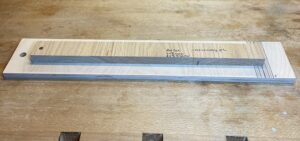
I didn't forget to do the cutout for the base. Clamped two sides together and drilled a 1" hole.
 |
| one more last thing |
Used rasps to smooth out the undulations for the bandsaw. A few swipes with 100 grit and all four were done.
 |
| happy face on |
A quick check to ensure the dresser fit within the base.
 |
| hmm....... |
Needed some help closing up the tails and pins. It took me almost 2 hours to get to this point. Before surgery I don't think this would have taken me more than 30 minutes. I am getting a wee bit faster but still not anywhere near where I was prior to surgery.
 |
| done |
Evened and smoothed the four sides of the base with the #3. A quick sand with 80 grit finished the base.
 |
| oops |
A mind fart - I made the base on this side out to the outside edge of the molding. It should have been shortened to match the side of the dresser.
 |
| hmm...... |
This cove molding is too tall - The bottom drawer can't open. The bearers are set down 1/8" from the top. If the bottom rails on the dresser had been 3/4" thick the cove molding would have fit but the front and back bottom rails are 1/2" thick.
 |
| problem |
 |
| hmm....... |
I had a smaller molding but I didn't want to use it. If fits and the bottom drawer clears it and opens/closes freely. The moldings will only go on 3 sides. It will butt into the flat stock and be mitered at the front.
 |
| just needs knobs |
 |
| too big |
Ten of these 1 3/6" knobs for $2.52 and it is too big for the smallest drawer. It is barely small enough to fit on the 4 larger drawers. Rethinking whether or not to switch back to the shaker knobs. One option is to use a small shaker knob for the top drawer and the metal ones for the other four?
When I enlisted in the Navy in October of 1974 I was 5' 11" and 221 lbs. On my oncology appointment this week I weighed 251 but I had shrunk to 5' 7 3/8". I don't feel shorter and nurse said around age 25 we all start to shrink. I had noticed this over the years but I thought it was faulty measuring equipment. It ain't so boys and girls.
The pain in my left side is getting better as in less painful. I still have a stubborn bubble of fluid on the center of my chest and lower left rib cage. It hasn't changed in size for several days. My heart rate is normalized somewhat. It is now in the high 60s to middle 70s. Still high for me, I usually have a resting heart beat of 45-50. For several days now it hasn't gone nutso racing up to 120 to 130. I still think the fluid bubble is the cause for my heart rate headaches.
accidental woodworker
Watch This Before Refurbishing a PLOW PLANE!!
Independence Day Sale: Online Classes

I honor of the USA’s big birthday, I’m offering all my online classes at a 50% discount. These are the classes that I made during the pandemic (one that I did with other people like Curtis Buchanan and Jane Mickelborough aren’t on sale this time). The classes are:
GREENWOOD CLASS with ELIA BIZZARRI
WOOD TURNING FOR CHAIRMAKERS with ELIA BIZZARRI
DRAWKNIFE CLASS with ELIA BIZZARRI
DRILL BITS: POSITIVE TOOLS FOR MAKING NEGATIVE SPACES with ELIA BIZZARRI
MAKE A REAMER with ELIA BIZZARRI
OCTAGONAL TABLE with ELIA BIZZARRI
MILK PAINT VIDEO with ELIA BIZZARRI
Happy Holiday!
The post Independence Day Sale: Online Classes first appeared on Elia Bizzarri - Hand Tool Woodworking.Paperwork
More than thirty years ago I made a built-in cabinet in the living room to hold all manner of contents you would expect for a living room wall unit. Included in the design and construction was a set of shoji sliding doors using Japanese mulberry bark paper for the screens. I learned right quick that having paper panels on cabinet doors is not optimal for a home occupied by little ones. I soon replaced the original papers with new ones and backed them with plexiglass to minimize the puncturing and tearing of the lovely paper.

Recently I took another look at the shoji and saw another dozen or so tears that had occurred of the intervening decades. One by one I took them down to the basement shop to repair them. Unfortunately all I had was scraps from the original construction and installation or I would have simply replaced complete sections of the paper en toto.


My first effort to follow that trail was to order some new mulberry bark paper that turned out to be beautiful but not a good match to the originals. So all I could do was use my scraps of the original paper and make the necessary repairs.
Here’s an example of one repair, a protocol I followed successfully on the nearly dozen tears.

This tear is adjacent to one of the shoji frame elements, The dark area near the upper center of the image is a previous repair, still wet from the repair. As the repair dries it will resume the color of the original paper and thus become invisible to the standard viewer.

Here’s the scrap of the original paper left over from the construction 30 years ago. One edge is straight to match the shoji frame, the other is torn, or “deckled” to provide a feathered edge allowing the perfect blending with the underlying sheet being repaired.

After mixing up the adhesive, in this case dilute wallpaper past methycellulose, the repair ws laid in place and the adhesive brushed onto the margin and wicked in, binding the repair.

Next time I return to Mordo I will try to remember to take a picture of the finished project. The repairs really do look nearly invisible, complying with the “Six-foo-six-inch rule” that governed our work in the museum. In other words, from a standard viewing distance of six feet the repair is invisible, but close-up (“six inch”) it is discernable.
took a left turn........
Last night after dinner I experienced a new pain that turned me into stone. There was an intense pain on my lower left side. It was a constant, heavy pain that didn't go away. It said hello with every movement I made, especially so with my left arm. The night was fitful but I did manage to sleep for a couple of hours. By morning the pain had subsided some but movement still woke up the pain.
I thought I was at the apex of healing/feeling good and sliding down the other side. I spent most of the day sitting at desk watching You Tube. I picked vids that played for a long time because moving the mouse sucked pond scum. I watched hours of The Joy of Painting.
Around 1300 I was feeling a bit better and wandered down to the shop. That turned out to be a me-steak. By the time I decided to kill the lights I had just finished a 5 minute coughing fit. That didn't feel good and it is something I wanted to avoid at all costs.
 |
| hmm....... |
The back stop thing had cooked and nothing moved when I took the clamps. Yesterday when I put this here it wasn't a problem. Today when I picked it up to move it to the sharpening bench, I felt it. There was a tugging sensation in the left side of my chest.
 |
| stopped chamfer |
This looks good IMO. If the chamfer had run out to the end I think it would have been too close to the end of the back stop.
 |
| didn't make |
Initially I felt good and I thought I could get the pins/tails done and dry fitted. Almost but no cigar. I sawed the pins but couldn't chop them. Maybe tomorrow I'll feel a bit better and I can finish the dovetailing.
I went with a single tail because two half pins and one tail would have been too thin IMO. For a base this will work without any hiccups.
accidental woodworker
Part 4: Perfect Spindles Without A Lathe: Making the ‘Chair Maker’s Shooting Board’
This video is part 4 of a 6 part course: Gearing Up For Chair Making: Pt 4 Follow on YouTube My goal for this course is to equip you with the knowledge and tools to design & build your own chairs from scratch.Once this is complete, I’ll come up with some projects so we can […]
The post Part 4: Perfect Spindles Without A Lathe: Making the ‘Chair Maker’s Shooting Board’ appeared first on The English Woodworker.
Box for Plow Plane Irons
Until now, I've stored the irons for my wooden plow plane in a roll that gets put in a drawer. The roll wasn't some multiple-compartment, fancy leather gizmo; it was nothing more than an old kitchen towel. The irons deserved better, so I made a box for them.
For whatever reason, I often get stuck on design. I looked online and found a few images of plow plane iron boxes. They typically were vertical boxes with a lid that hinged to the side and each iron stands on end in its own slot. While I liked that, I was having a tough time in my head with grain direction of the parts as well as methods of construction. In the end I decided on a flat-ish box with a horizontal compartment for each iron. The box has a sliding lid. It's got 9 compartments; 8 for the set of irons I bought for the plane and an extra for the iron that came with the plane.
 |
| Two 10" long sides and a 6" long front and back |
 |
| Dovetailed and dry fit |
 |
| 1/8" grooves were made top and bottom, starting 1/8" from the edges |
 |
| Then (8) 1/8" dadoes were cut into the front and back |
Cutting dadoes this small can be a real challenge, but it went much quicker after gaining some experience. I used my homemade mini router plane to get the bottoms to depth.
The bottom of the box fits into the grooves in the sides, front and back. It's just shy of 1/4" thick, so I rabbeted the edges to fit the grooves.
 |
| Getting ready to rabbet using the moving fillister |
 |
| Here's the box's bottom rabbeted |
 |
| Here's dry-fitting the bottom |
 |
| 1/8" hardboard dividers in the dry-fitted box |
In this picture, you can see that I've cut down the box's front piece to allow the sliding lid to get in its grooves. It started out the same width as the back for easier marking and cutting during the dovetailing and grooving stages.
 |
| Sliding lid |
Two more details: the dividers were shaped to allow easier grabbing of the irons, and a thumb catch was carved into the lid to make the box easier to open.
 |
| The shaped dividers, with irons in place |
 |
| Thumb catch on the lid |
The glue-up was OK, though I initially messed up - even after a few dry-fits. The order of putting the components together was key to get it glued up properly. I gave the box a few coats of shellac on all outside surfaces, with none on the inside.
Here's one last detail. The front edge of the box's top has a piece of wood glued to its end grain. This hides the entry grooves and makes the front of the box look nicer. I realize it a cross grained glue-up, but I've done this before on a similar box which has held up for about five years now.
 |
| Glamour shot |
 |
| And with the lid partially open |
Good little project. The plow plane irons deserved a home of their own. Now I just have to figure out where the box will live in my cramped shop.
hardware dresser pt XV........
 |
| last night |
Got the bottom glued and nailed first. Then I sawed the dividers and installed them. One corner of the drawer was up slightly so I weighed it down with paint cans overnight.
 |
| hmm...... |
This plastic container came with 100 screws - it now has 92. It fit in 3 of the compartments I checked. Note to self - next dresser comes with 12 compartments.
 |
| off cuts |
These off cuts are from when I thinned the drawer parts to a 1/2" thick. They are a wee bit wider and longer then the drawer fronts. Not only would they cover the plywood bottom, they will cover the dovetails.
 |
| first drawer |
Squeezed in getting the off cuts glued onto the five drawer fronts. I'll be able to play with them when I get back home from the VA.
 |
| 3 down, 2 to go |
The glue up went off without any hiccups. One drawer will require some wood putty work. One corner of the drawer front has a big chip missing.
 |
| confirmed |
I had set the miter gauge but almost an inch too much. Maybe I'll get lucky and find some odd shaped/long hardware that will fit in these compartments.
 |
sneak peek |
I think the veneer looks better than the original drawer front. The top drawer doesn't have the color streak the other 4 drawers have. It didn't occur to me that I could have used a cut off from one of the wider drawers. I was stuck on stupid thinking I could only use the cut off from the thinnest drawer (which didn't have a color streak).
 |
| hmm....... |
Decided to leave the drawer fronts slightly proud at the front. They are all about the same with the bottom drawer sticking out a few frog hairs more than the others.
 |
| losing less than 1/8" |
I sawed a bit off the back of all the drawers to even out the amount of proud of the drawers. After I did this I evened out the proud by eye by planing the off cuts I glued to the drawer fronts.
 |
| done |
I thought of building out the front of the dresser but nixed it. The proud of the drawers is a little less then 1/8". The amount of the proud doesn't look out of place or odd (IMO) when viewed from the sides.
 |
| chamfer done |
Did a stopped chamfer - it would have looked crowded against the back stop thing if I had gone to end.
 |
| hmm...... |
Checked my shaker knob supply and this depletes it. I have just enough to put two knobs on each drawer, with either size. I think the drawers are small enough that I could get away with one knob per drawer. This is what I would like to use but maybe not.
I had bought some blackish knobs on sale at Lowes specifically to use on this dresser. I think I'll use them instead and save my limited supply of shaker knobs for something else.
 |
| hmm...... |
I don't want a three sided base. I want it to go 360 but in order to do that I need to clip the molding holding the back. I sawed it so the bottom of the molding was even with the top of the back rail.
 |
| sigh |
Made a Lowes run and bought two 1x8 pine boards. Somehow I did a mind meld with a rock and managed to screw up the long sides of the base.
 |
| for tomorrow |
Ripped out two new long sides - double, triple checked them correct. Laid out the base cut out for tomorrow. Ran out of gas again. I was feeling tired and I have learned not to work when I feel this way. I'll get back to this in the AM.
The oncology appointment went well. Met with the doc and I'll be doing one treatment of chemo. It will consist of 4 treatments 3 weeks apart. After that I go on a surveillance regimen with MRI s and CT s to monitor my body checking for a recurrence of the lung cancer.
The important thing with the chemo is this is it. There won't be a follow up chemo round. The doc said because I am only getting 4 treatments that it is rare to get any lingering chemo side effects. And I can say No Mas at any time with it.
accidental woodworker
In close reach
hardware dresser pt XIV........
 |
| dry fitted dividers |
I applied glue to the underside only. I didn't put any glue on the vertical ends.
 |
| hmm...... |
The dividers were a frog hair off but there is enough flexibility in 1/8" plywood to align them with the grooves. Decided to fit each drawer I've done so far rather than wait until all five are glued and cooked.
 |
| layout for the half laps |
With the nine compartment layout I only have to layout for one end. I set the distance for it, sawed it, and then flipped it 180 to saw the other end.
 |
| fitting |
First step was to flush the 1/8" plywood all the way around. It is getting easier to fit drawers. The key for me is one, take my time. And two, look at the fit of the drawer from the front and the rear. Thirdly, don't go nutso and take too many shavings at once.
 |
| one down, four to go |
I am not that thrilled with the look of the plywood bottom. I glued it to the bottom because I didn't want the bottom inset in grooves. I also didn't want to give the little bit of real estate that would have eaten up. I have been eyeballing the off cuts from sawing the drawers to a 1/2" thick - I can glue it on the fronts and cover the 1/8" plywood bottoms.
 |
| hmm....... |
Wasn't expecting this. I thought it would have been closer to flush. My first thought on fixing it is too saw the proud off the back of the drawer.
 |
| how? |
This was making me scratch the bald spot on the roof raw. I don't know how the compartments on this drawer are different sizes.
 |
| ????? |
I laid out the dividers the same for both drawers but one is correct (left) and one wandered out into La La Land. It looks like I screwed up setting the stop on the miter gauge.
 |
| 3 fitted |
So far the first 3 drawers have about the same amount of proud.
 |
| 3 down, two more to go |
From the front I kind of like the proud look of the drawer fronts. The problem is what and how do I deal with the look from the sides?
 |
| #4 dry fitted |
It was looking like I might get all five drawers at least glued and cooking before quitting time.
 |
| yikes |
Made two boo boos with drawer #4. The first was I ripped one side a wee bit too much. Not a problem because the bottom of the drawer is flush - this gap will be on the side. I wanted it at the back but it ended up here.
The 2nd boo boo was the side split when I glued it up. I thumped it with my fist while seating the tail/pin and it gave up the ship. I glued the split and the 1/8" plywood bottom will bridge the split and keep the side together.
 |
| drawer #4 |
The last two drawers will have 12 compartments. A little bit of apprehension that I did the half laps right and it would fit in the drawer.
 |
| drawer #4 |
I think I should have gone with 12 compartments for all of the drawers. If a plastic container will fit in one of the 12, I'll be golden.
 |
| one left |
Drawer #4 took longer to fit then the other 3. I think it was because of the 12 dividers which aren't that easy to plane and knock down. Got it done and it opens and closes freely.
 |
| drawer #5 |
This drawer was rocking a little bit. The paint cans flattened the drawer. After ten minutes I removed the cans to check it. The drawer stayed flat on the workbench. I put the cans back on the let it cook.
I'll be done with this in the AM. All that is left to do is to make the base which I don't have any stock for. I used the base stock to get the drawers from. I'll have to make a Lowes run to get some pine for that.
I have an appointment with oncology tomorrow at 1000. I still haven't made up mind about the possibility of having to do chemo. Losing my hair I don't care if it happens. I don't want any nerve damage that would interfere with my woodworking. I'll find out what the game plan is in the AM.
accidental woodworker
Pages
