
Hand Tool Headlines
The Woodworking Blogs Aggregator
“Glory to God in the highest heaven, and on earth peace to those on whom his favor rests.” - Luke 2:14
Be sure to visit the Hand Tool Headlines section - scores of my favorite woodworking blogs in one place.
General Woodworking
first bookcase pt X.......
 |
| ready |
I eyeballed the bookcase checking for any holidays and found none. Last night after dinner I had put primer on the molding. This AM I sanded it down with 320 grit, wiped down it down and rolled on the first top coat.
 |
| nope |
Used a roller to apply the top coat and I like the look. No brush marks and the coverage looks smooth. I had to brush some parts - corners and the molded edges of the shelves.
 |
| the left one |
Both frames have the same molded outside edge. The left one I got today and it is just a wee bit larger then the right one. That is the one I made first and ran a bead on the inside of edge. I still don't remember how I made that frame. Pretty sure that I ran the bead before sawing the miters but it is still fuzzy.
 |
| fuzzy looking but done |
Finally got all the of the black scraped off. There are a few scattered spots of black in dings that I can't get out.
 |
| ready for paint |
I got all the screws and loose parts wire brushed. The frame came out better then I thought it would - cast iron doesn't shine up as nicely as brass does. I'll wipe everything down with acetone before I paint it.
 |
| hmm....... |
The plan as of now is to roll on the 2nd coat after dinner. That will have given the bookcase over 8 hours to dry after the first coat.
I got a 'honey can you......' project. I'm going to Highlands Hardwoods in New Hampshire in the AM. I called Koszela lumber and they didn't have all the sizes I needed. My wife likes bland looking wood so I'm making it out of poplar. I need 3/4, 5/4, and 6/4 and only Highland has all three in stock.
accidental woodworker
A Few More New-To-Me Tools
Last post I wrote about buying several tools from the widow of a woodworker who, after several months of grieving, was ready to let go of her husband's tools. On a separate occasion, I got a few more things from her and this post shows them.
 |
| A few more new-to-me items |
I already have a pair of mag goggles (though I can't seem to find them right now), but these had an extra lens that pivots in front of the right eye for extra magnification. This pair does not have a light like my other pair, but it'll be nice to have the extra lens for looking at finer things. It's already helped me get a better view of cutting edges.
I also already have a set of brad point bits, though my set only has 7 bits - 1/8" to 1/2" by 16ths. This new set goes from 1/8" to 1/2" in 64ths, and already it has come in handy when I had to drill a 15/32" hole. The set looks to be in great shape. They had been used, but probably not too much.
 |
| A nice complete set of brad point bits |
I had been looking for a circular (or "compass"? - not sure of the correct term) plane for the last year or two. When I saw this one in the man's collection, I really hoped I could get it.
 |
| Stanley #20 |
 |
| View from above the front portion |
It's a bit grungy and has some issues, but I'll clean it up and get it working. Can't wait to try it out.
Finally, I picked up a book that looked interesting. It's "Shoji and Kumiko Design, Book 1: The Basics", by Desmond King. I had experimented with Kumiko a few years ago and enjoyed it. And I recall seeing King's name when I was researching Kumiko at that time. This book will give me some more information to continue with the techniques.
 |
| Desmond King's Book 1 on Shoji and Kumiko |
That's all for now. I've got some tools to clean up, materials to read, and some woodworking to get to.
In The Showroom and Other News
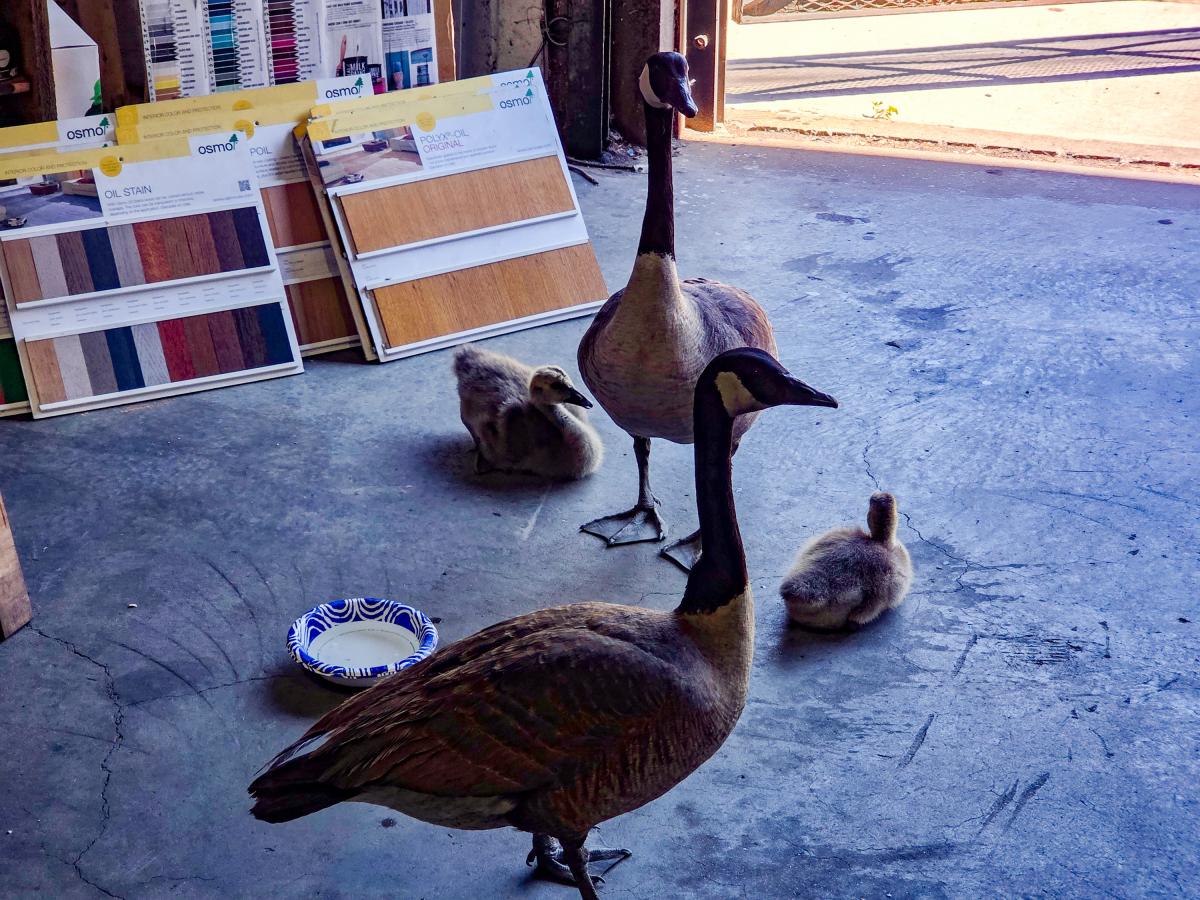
Our showroom barely earns the name - it's just the front part of our warehouse/manufacturing where we have some products on display. But we nevertheless manage to host customers from all over the world, and we're very happy to see them.
Often one of the visitors is driving the visit, with some bored loved ones in tow. We try to suggest local delights that will offset the boring-to-them tool talk. Recently we had visitors from Brazil, Germany, the Dominican Republic and the UK, in addition to states far away from Brooklyn.
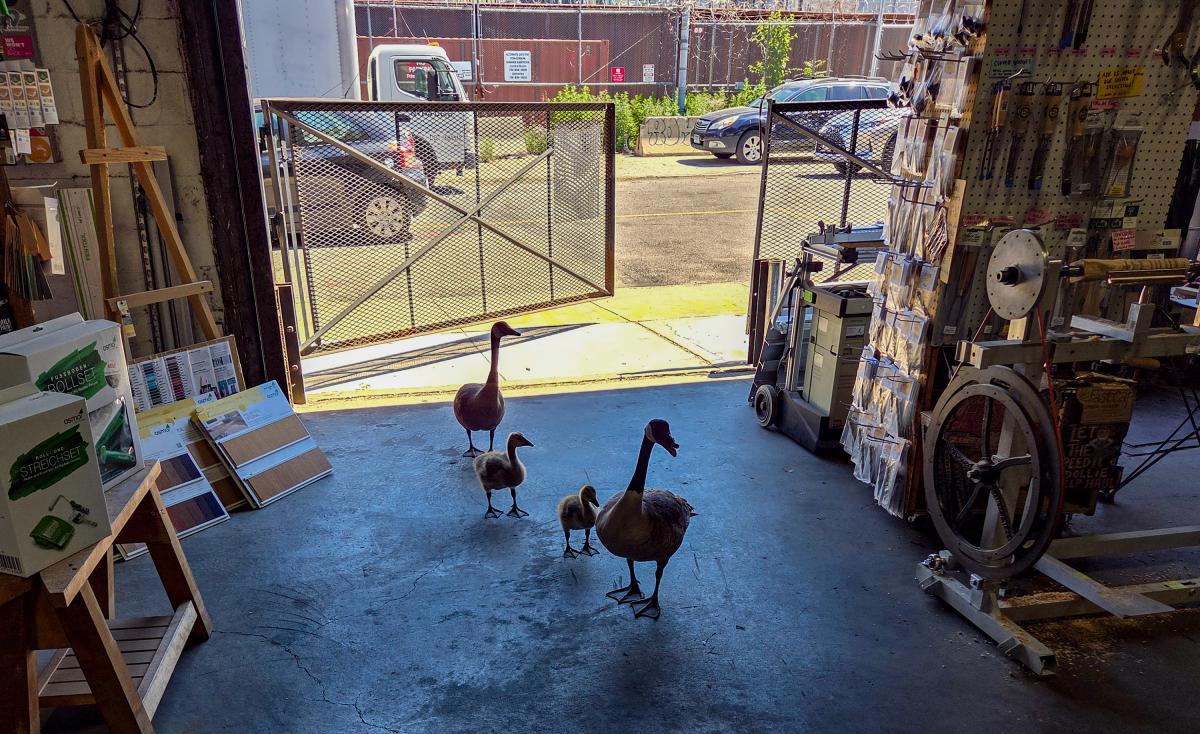
We recently also hosted some local browsers - probably extremely local, as in the river one block away. A family of geese stopped by to check out the shop.
The geese didn't talk much so I don't know their names. It was a family of four, and they really came by to get out of the heat. The father wandered around looking at the tools on the lower shelves. The mom and the two goslings sat down on the cool concrete and rested. They didn't actually buy anything, which isn't a surprise since they didn't seem to have cash, a card or a phone. I suppose having webbed flippers not fingers is a handicap for woodworking. But you didn't hear it from me - I like to be encouraging. Basically they visited to get out of the heat, have some water, and use the bathroom (let's just say their habits here left room for improvement). Just to be safe, we called animal protection to find out if we should do anything special to protect them - we're down the block from an expressway extension with a lot of traffic. Animal Protection said that if the geese didn't seem to be in distress, which they weren't, they would probably wander up and down the block and go back to the river.
Apparently this is what they did, we've seen them several times subsequently. They're I guess staycationing in the city for the summer or at least until the goslings are old enough to fly. Our FedEx driver said he has seen them in other spots in the neighborhood near the river, so there's probably a way for them to get to water. But I don't exactly know where. We have been delighted to see that the goslings have definitely been growing and look pretty healthy. So that's very nice. I know this is a story about retail not woodworking, but one of the best parts about buying things in person whether you're doing it by coming to the store or calling up, is the personal connection we get when we actually meet our customers. Even if they're just plain quackers.
In other news, we are almost finished delivering all the pre-ordered treadle lathes. Delivery has definitely been slower than we would like, because we are having trouble with some of our suppliers. Manufacturing is hard! We will be taking a few lathes to Hand Works in Amana. How many we will bring depends on if we get another shipment of bases from our welder. And we just won't know for at least another week. Either way, we should be able to reopen ordering either just before Amana or just after. (We hope.)
That leaves me right into saying I'm looking forward to seeing a lot of you at Handworks on the first weekend of September. It's the only woodworking show we do, and it's well worth the effort for both us and you. Pretty much the entire hand tool world is there and the admission is free. It's a great, fun, exhausting time for all. The big problem is for me is that I've been to every single Handworks, and because I'm working a booth I have yet to really see the show. But stop on by, say hello, play with the lathe. You will have a great time.
first bookcase pt IX...........
 |
| it fits |
I had my 2nd chemo cocktail this AM but before I left I checked the base and how/if the molding fitted. The base fits well along the front gap free not that it matters much.
 |
| left side |
This gap is tapered going wide at the front to almost nothing at the back. The gap is because of me planing the tails/pins flush. I didn't check or pay any attention to keeping the corner square.
 |
| right side is a little better |
 |
| hmm...... |
Got lucky and planing the top of the base was correct. There is a strong 16th between the top of the molding and the top of the bottom shelf. I would have liked it to have been an 1/8" but this is acceptable.
 |
| I like it |
This is the look of the miter off the saw. I am going with this because it is a paint grade miter and it will look tight and gap free when the paint is on it.
It was 1334 before I made it back to the shop today. The chemo infusion took forever. I got there at 0815 for blood work. I got my premed infusion at 0930 and I left finally at 1220. After filling the pie hole I ambled down to the shop.
 |
| sanded |
I am gluing the molding to the base only. I will nail (pin nails) it to the base and the bottom shelf. That should be more than adequate for securing the molding. Sanded the primer off with 80 grit.
 |
| securing the base |
I went back and forth with putting the base on now or waiting until I painted the bookcase and base separately. Nixed that because I have to apply primer to molding after it is secured. Two of the screws poked through and said hello. Replaced those two with 1 1/4" long ones and filled the errant holes with putty.
 |
| sigh |
I checked the molding dry and it look good to go. I glued and nailed off the front and left side moldings and got a surprise when it came time to do the right one. The front molding ran long about an 1/8". I used a chisel to trim it so the heel was on the outside edge of the side. I didn't chisel it at 45 though. I eyeballed the short leg and checked it - it was way off. I tried several times to adjust the angle by sawing and that wasn't working.
I used a 100 grit sanding stick to getting the mating miter to match. It was easier going then I thought it would be. I eventually got the miter 99% gap free with a minor space at the toe. I filled that in with wood putty. The paint will hide that sin.
I set all the pin nails and filled them in with putty. After dinner I'll go back to the shop and sand them smooth and apply the primer to the molding.
 |
| fixed |
Initially I thought having a gap here at the back wasn't a big deal. But I didn't think the gap would be as big as it is. After seeing it I decided to put a shim in around the middle. The shim is about 9-10" long and roughly centered on the back rail.
 |
| done - ish |
There are few stubborn spots on the interior that are resisting my charms trying to scrape. Overall I'm satisfied with the removal which now showcases a bazillion dings and casting imperfections. No rush on this and I'll get the last of the recalcitrant paint removed.
 |
| hmm...... |
I found another can of red paint and two cans of black. The red had a skim coat that I removed and it looks viable. The red sample I did yesterday is toast - it was still tacky and more so than it should have been given the warm temps and the 24hrs. Can states dry to the touch in 4-6 hours. Tossed it into the shitcan without getting a pic of.
 |
| went 1 for two |
The first can of black had thick skim coat with a small puddle of black paint. Tossed that without giving it a second thought. This can was perfect - no skim coat and the paint looked and felt good when I stirred it. I will try it out painting the tenon maker once all the old paint is history.
accidental woodworker
first bookcase pt VIII..........
 |
| prepped |
Got the base sanded (120 grit) and it is was ready for paint. The tear out I filled with putty felt smooth and flush when I checked it with my finger tips. The bearers/cleats are just screwed on and I will screw up through them to secure the bookcase - no glue there neither.
 |
| hmm....... |
I would have bet a lung that this was flush yesterday. Not so today. I had checked that the top of the back was square to face but it wasn't. Squared that up and that increased the light under the square. Same headache on the other side to deal with.
 |
| fixed |
Initially I was going to use veneer but I had to use 5 pieces to get the height needed. Instead I ripped out a thin piece of pine and planed/sanded it until it was flush with the bearer/cleat.
I am going to use the cove molding from yesterday. I took four shavings off the sides and the front which now I think was the wrong way to go. Having trouble trying to visualize if dropping the base will sink the molding down further against the bottom shelf of the bookcase. I'll find out in the AM.
 |
| step one |
Painting the base is a two stepper. Step one is painting the underside and the inside. Step two, to come, is painting the outside faces of the sides.
 |
| flipped a coin |
Heads I left the back natural and tails I painted it. Tails won.
 |
| one more two stepper |
Got the primer on everything except the two outside vertical faces. I'll do them after the paint has dried for a couple of hours.
 |
| the oops |
Mishandled the router removing it after I had routed the rabbet. It on the back top and it should face a wall unseen. I am not painting the backside of the back panel.
 |
| primer coat done |
I will let this go until the AM. Then I will lightly sand it with 320 grit and apply the top coat. I have zero confidence that one will cover. On a brighter note I did like the primer coat - it laid down smoothly with no visible brush marks. Will I get lucky with the top coat?
 |
| it is working |
The paint is coming off effortlessly with the screwdrivers. I got most of the outside done I would say about 90-95%. The inside is scraping off but it is slow going. Hard to hold it conveniently and scrape. Ideally I like scraping having both hands free.
If I remember hardly anyone is selling pint cans of oil based enamel. I need red and black - my black can had skimmed over and is total crappola. I have a can of red but it is iffy. I slapped some on a scrap to see what it looks like when I check it in the AM.
accidental woodworker
first bookcase pt VI.......
 |
| base is done |
Went together off the saw and fit the bottom of the bookcase. Because of the size of the bookcase I increased the height of the base. Raising it up (about a 1/2") makes it easier to access the bottom shelf.
 |
| sigh |
Dinged this up taking it off the workbench. I can't leave this as is because it looks too ugly.
 |
| fixed |
I planed the flat on the front edge and routed the chamfer again. Planed it some more and routed it again. I'm leaving this as it is for now.
 |
| no more |
I could have planed some more and routed the remaining ding on the chamfer. If I had done that the flat would have been thinner then the chamfer. The both of them are about the same now.
 |
| oops |
Got the base back on and I wasn't paying attention. The top of the back rail should have been flush with the top of the bearer/cleat. Instead I made it flush with the top of the base. I secured the ends into the sides with Miller Dowels. I already have the fix rattling around in the brain bucket.
 |
| saw kerfs |
I have to remove/flatten/straighten out about 3/16". Made a bazillion saw kerfs staying just above the pencil layout line.
 |
| working down |
This worked better and quicker than I thought. I didn't have to make this dead nuts straight R/L nor maintain a specific height.
 |
| flush |
This is the only spot, here and on the opposite end, that has to be flush with the bearers/cleats. The bookcase will bear down on the back here.
 |
| hmm....... |
The cove molding is barely a frog hair below the top of the bottom shelf. I had gone to Lowes but the small molding section was as bare as Mother Hubbard's cupboard. I didn't feel like driving to Home Depot but I might make that road trip tomorrow. I don't have a warm and fuzzy about using this molding.
As I was doing this I thought of routing a chamfer on the base. The base fits fairly well on the front and the left side - the right side has a teeny gap. I'm not sure my OCD will allow me to ignore it.
 |
| ouch |
Got some tear out on this side that was so ugly the wood actually cried. It was one of the areas on pine that tears out on every compass point.
 |
| still soaking |
I went searching for my tools from rehabbing planes and nada. I had made several scrapers with sheet rock knife blades and it is them I wanted to use on this. I'm in no hurry and I've been using small blade screwdrivers as scrapers.
accidental woodworker
first bookcase pt VI...........
 |
| done |
Routed the the top and bottom rabbets without any hiccups. Well one hiccup but it is on the back and won't be seen. Squared up the corners and it was ready for the back.
 |
| Lowes run |
I had to buy a full sheet of 1/4" plywood and they sawed it in half. It was a struggle carrying it out to my truck but I managed. I sawed the back out a wee bit wider and longer then needed. I trimmed/planed it until it fit within the rabbets.
 |
| hmm........ |
Seeing the back fitted is making me wish that I wasn't painting this. I like the 'grain' in this plywood a lot.
 |
| base |
I am only doing a 3 sided base. The back 'side' I'll deal with after the base is glued and cooked. Tails laid out and sawn - the chopping will start in the AM.
 |
| half pins |
Last night I slept through the night without getting up once. Closed the peepers around 1030 and woke up at 0530. I had felt bone weary tired before hitting the rack. Today after lunch I felt the same. I haven't this tired/worn out in a very long time.
Of late I've been getting winded quickly. More frequently now I get out of breath coming up the cellar stairs. Carrying the plywood at Lowes was an eye opening. I have never gotten that out breath carrying a light load for such a short distance.
When I'm working in the shop I don't get winded like I do walking up the stairs. I got a wee bit winded planing the dovetails yesterday but I was able to keep going and finish that job.
Maybe this is the 'bone weary tired' that the oncology nurse said I would experience. I cut short the shop time and spent the rest of the day nodding in/out at my desk. If I'm up to I'll finish the base in the AM and start painting the bookcase.
accidental woodworker
A Few New-To-Me Tools
A friend was asked to help a lady sell off her deceased husband's tools. Apparently the man was into woodworking and so much more and had the tools to show for it. He had been a machine woodworker, but he used and collected hand tools as well.
My friend asked if I might want some of the tools, so I went with him one day. Holy mackerel! There was so much stuff. Over 100 chisels, over 100 planes, many saws and hundreds of bits and bobs of every sort. It has taken him weeks to gather and sort all the stuff. This is a bigger job that he imagined.
 |
| A sampling of the chisels (and some other nice things) |
 |
| Planes organized - and he found more planes after this! |
In the picture of the chisels above, if you look closely you can see a Lie-Nielsen shooting plane and at least one other L-N plane. Most of his things weren't old and collectible, but very useable.
I've grabbed a few things, and besides one item, I've paid a fair price for them - there were no bargain basement prices here. The proceeds will go to the widow, so I feel good about that.
Here's the first group of things I got. I'll show a few pics here, and hopefully later I'll post about cleaning/fixing them up and write in much more detail about each item.
 |
| Grinder, 5 planes, and an auger bit box |
Unfortunately the auger bit box did not have a set of bits in it. The box had been altered for some other purpose so only the bottom tier had the fitted semicircular grooves that keep bits safe.
 |
| Russell Jennings auger bit box |
I'm guessing the handle was added at some point - I've not seen a handle on these before. And one screw for the handle went through to the inside of the lid. If there were bits inside, I'd be worried that holding it by the handle would result in disaster if a tier clasp came undone.
Next up was a 3/4" rabbet plane, looking in very good condition. It's a Sandusky and appears to have the number "716" stamped on the toe.
 |
| Sandusky Tool Co. rabbet plane |
Then there was a pair of hollow and round planes by R. W. Hendrickson at 65 1/2 Bowery (presumably a New York City address). Both had the number "10" stamped on the heel.
 |
| H&R pair |
 |
| R. W. Hendrickson 3/4" hollow and round |
The round plane iron is right on 3/4" wide, but the hollow iron is a little more than 1/32" oversized.
The shorter of the two bench planes is a 16" jack by the New York Tool Co. It's got a "12" stamped on the toe. The body is in very good shape. The Auburn Tool Co. iron and cap-iron look good, but I'm sure I'll have to do some work to get them working right.
 |
| 16" long jack plane from New York Tool Co. |
The last plane is this 22" fore plane from an unknown maker. I could not find any identifying marks on the toe. There are several owner marks "AC" stamped on the plane, and "A BYRON COOPER" behind the tote. On the heel is stamped "2 1/2", and that's the iron's width. There is another A BYRON COOPER stamped on the heel, so I'm guessing that's the owner's full name for the "AC" mark.
 |
| 22" fore plane |
 |
| The heel stamps |
I can barely make out a "SORBY" mark on the iron. Can't wait to get this one into working order. The plane is from a dense wood - it seems quite heavy for its size.
Last on the list for this post is a hand crank grinder by The Carborundum Co. of Niagara Falls. Not sure what to make of the different numbers on the decal: NIAGARA NO. 2, and MODEL NO. 70. Is it a #2 or a #70? Regardless, this grinder works so smoothly that I couldn't resist. I paid a lot for this one - hopefully the quality will have been worth it.
 |
| The grinder needs a bit of clean-up, but already works great |
 |
| The logo |
That's is for now. I have a few more tools that I picked up, but I'll post about them separately.
New Model Mandolin: 8
My "New Model" mandolin (as I'm currently calling it) has now been completed. I'm incredibly happy with the final outcome and looking forward to building the next one! Here is the last video in the series and below that a whole batch of photos for you.
Cheers Gary


first bookcase pt V...........
 |
| first blurry pic |
The dial slipped off the auto setting and a few pics came out blurry. Any ways, I behaved and I let the spacer cook overnight. I resisted the urge to play with last night after dinner.
 |
| hmm....... |
The plan was to use this screwed up shelf to give up a couple of dividers. I had doodled placing them on paper last night and gave up on it. The design and placement of the dividers was asymmetrical but I couldn't find something that I liked. I tried one divider, then 2, ending with 6. Didn't like any of them and the shelves will remain open and clear R/L.
 |
| lucked out |
I planed a profile on the edge of the screwed up shelf. I wanted to see how far inboard the profile ran. The outside edge of it was forward of the end of the notch. I didn't want the profile to be at or behind that notch.
 |
| done |
Molded the profile, and then I sanded it, both sides, with 120 grit. These are ready to glue in.
 |
| #4 and #3 |
I flushed the tails/pins on the outside faces with the #4 & #3 planes. The sides there needed to be flush because I will be putting a quarter round molding against it. Before flipping it I hand sanded it with 80 grit (to remove pencil marks) followed with 120 grit in my RO sander.
I will sand the bookcase up to 120 before painting it. I will also be applying a primer coat. I want to see how the wood sanded to 120 helps/hinders the top coats. I have given up on one coat coverage so I know I will be doing a primer coat followed by at least two top coats.
 |
| hmm....... |
Dry fitted the back stop thing. This is the 2nd fitting, the first one was too tall. This one is an 1 1/8" tall and 32" R/L. I can glue this on without it interfering with routing the rabbet.
 |
| choices made |
I rounded the top corners but the first choice was a 22.5° but I nixed that. Instead I routed a 3/8" round over - only on the front edge. I left the back squared off.
 |
| glued and cooking |
I got this glued and cooking around 1030. I let it cook and set until after I got back to barn after filling the pie hole with fish 'n chips.
 |
| Miller Dowels |
These dowels are for 1/2" stock but the larger ones for 3/4" stock don't leave much wiggle room. They have to be dead nuts on the center line. I have used these smaller ones for years now without any hiccups or failures. Used 3 per shelf on both ends.
 |
| done |
Back stop thing is glued, clamped and cooking. It was slightly cupped but I was able to align it easily with the back edge of the bookcase. Routed a chamfer on the front and the two sides.
 |
| the base |
The base will be 4 1/2" high. The two smaller pieces are the cleats that I will screw on the inside of the base and then screw through them to secure the bookcase on them.
 |
| hmm....... |
The whole bookcase (except the base) had been sanded. Used the wood putty to fill in the gaps from the pins, the chip blowouts, and the bazillion dings. I may have to do another application in the AM when I check this.
Almost done with bookcase #1. I'll make the base in the AM and start applying primer to the bookcase. The topcoat will be the same color as the dressers I made for Miles and Leo.
The past few days have turned miserable again. High temps and high humidity. The shop was bearably tolerable and keeping the fan blowing on me helped a lot. Don't know when this will break but it is about normal for this time of the year in New England.
accidental woodworker
How to Flatten a Wooden Hand Plane Sole
first bookcase pt IV..........
 |
| ta da |
I did go back to the shop and chopped the stopped dadoes. First thing this AM I got the top seated in the dadoes. I didn't have to trim/shave either end to get them fitted. However it was awkward and a Royal PITA - I could get one side seated and then I couldn't get the other side seated. Then it seated and the other side would pop out. After see sawing and letting loose with my choicest expletives, I finally got them seated and clamped.
 |
| glued and cooking |
I had to go to the VA to check on a CT test scheduling SNAFU which IMO resolved nothing. Typical government BS. I like the clean look of the front of the sides. Zero glue squeeze out which is expected because I'm painting this. If it was being left natural I would have had rivers of glue.
 |
| oops |
Too late to fix this and I'll have to deal with it now. I could have fixed it before I glued it but I didn't want to flip the bookcase (clamped) to check it I. I need this to be flush with the sides so the rabbet top/bottom matches the side rabbets.
 |
| close |
This is a wee bit higher than the sides. I'll plane it flush after it has been glued and cooked.
 |
| fitting the #3 shelf |
I planed the right side end and then I sanded both ends, top/bottom, before fitting it in the dadoes. It was still a snug fit but I didn't have any problems getting it seated with a mallet.
 |
| nailed it |
Got my 1/8" set back. This will probably increase some because I will
plane this edge to smooth/clean it up and mold a profile on it.
 |
| sawing notches |
The middle (#2) shelf is jinxed. I screwed up sawing the notch on the right and ended up matching the the first screwed up notch on the left end. I went 2 for 3 sawing the right side notches which in baseball ain't too bad.
 |
| yikes |
It doesn't matter that this isn't square. It didn't show when I got the shelf dry fitted and clamped.
 |
| top secured |
I put 3 Miller Dowels on each end to secure the top for insurance. I'm thinking of using Miller Dowels for the shelves too.
 |
| OCD kicked in |
Making a new shelf. I was already having trouble dealing with the one screwed up notch on shelf #2 and with two my OCD went into overdrive. I whacked out a new shelf using the original as the pattern.
 |
| I like |
Glad that I overhung the top instead of leaving it the same size as the sides. I'm not done with making dadoes. I'm thinking of putting a divider on at least one shelf.
 |
| spacer glued and cooking |
There isn't much more left to do on this. Tomorrow I'll decide on dividers and how many. Once that is in the bank, I'll make the base and the back stop thing for the top.
accidental woodworker
first bookcase pt III.........
 |
| I didn't forget |
Made a test rabbet to ensure the fit was ok. This is the plywood I intend to use. Lowes sells 1/2 sheets (48 x48) but it is something that I don't see that often in stock. If not I'll buy a full sheet and have it sawn in half.
 |
| done |
Adjusting the plunge router is/was a ROYAL PITA. It was stiff, uncooperative, and damn near impossible to nudge up/down a frog hair. It took me a bazillion years to get it to the depth I needed. I left it set on it so I can rout the top and bottom rabbets later.
 |
| oops |
Had a senior moment and made the notch wrong. It would have been dead nuts if the shelf went in on the long edge. Way out in left field with the shelf in its correct position. Since I'm painting this I will save the off cut, glue it in instead of making a new shelf.
 |
| fitted it |
The plan is to put the shelves in after the top is glued and set. I don't want the shelves binding and stalling when I do that. I made the shelves a wee looser by planing a few fuzzy shavings off of each side at the ends. I just notched the left ends of the 3 shelves. I'll do the right ends once I get the R/L measurement.
 |
| hmm...... |
The right side has a slight cup to it and the clamps pulled the shelf end tight at the front and back ok. Not sure how well the middle was seated. I will have to make some banana cleats to pull the center in.
 |
| glued and cooking |
Got the first side/bottom glued. I let this cook for a couple of hours before doing the other side/bottom.
 |
| the top |
The top will overhang the ends and the front by 3/4". 1x12 stock if usually 11 1/4" to 11 1/2" wide. I sawed off 2" from a 1x12 board and glued on a 3" plus wide piece. I didn't like the idea of gluing on a thin piece to get the required width.
 |
| hmm...... |
The other side glued and cooking. I put spacers on the open end that was the length of the ID measurement. I added a second one after seeing this.
 |
| putty work |
I filled in the missing blowouts, three on the left one and one on the right. I will most likely have to do at least one more application. The side with three of them were deep and putty shrinks.
 |
| top prepped |
I planed both sides, flushing the joint lines. This doesn't need to anal retentive dead nuts flat or parallel.
 |
| off by 3/8" |
I measured the diagonals and they were off by too much to ignore. I couldn't get a tape to measure the diagonals again due to the clamp. So I screwed down on the clamp until Mr Starrett said all four corners were square.
 |
| marking the top |
I measured and sawed the top to R/L length and laid out 3/4" in from each end for the top dadoes. It was close - aligned the right side on the pencil line and the other pencil line was off by a frog hair. I made a knife tic to mark each end.
 |
| ouch |
The knife line wandered out into La La Land on me. By the time I noticed it, it was too late. Part of the line looks chewed up pretty good but I think I got the knife line square across the width.
 |
| ends |
The plan is to not notch the ends of the tops. Instead I will dead end them into the end of the dado. Ensuring that the ends are crisp and clean.
 |
| I had to do it |
It was past 1500 but I couldn't wait to see how this screwed up knife line turned out. Where the chisel is, it is where the the worse of the chewed up knife line was. It came out pretty good and I'm happy with the recovery.
 |
| left side done |
I may or may not wander back to the shop after dinner and whack out the other wall.
 |
| done |
I really like this - a reproduction of the original Declaration of Independence. Paper made the way it was in 1776 and printed on printing press from the 1700's. Don't know if it was an original or a reproduction press. Now I have to find a hole for it on a wall somewhere.
accidental woodworker
first bookcase pt II...........................
 |
| before I left |
I had my appointment with the the VA this AM and before I left for it I had to check this. I had sawn the 3 shelves to length before checking that they would fit. I measured the baselines between the tails because that is the minimum length that the shelves can be.
 |
| plenty of wiggle room |
I have the left end on the left end tail baseline. The right end is 3/8" past the top of the tails. I need only 5/8" past the baselines for the shelves to fit R/L. I got lucky and I'll do the final length once the carcass is glued and set.
 |
| hmm...... |
The frame has been soaking for a few days now but the paint isn't coming off with the steel wire brush. However, it came off easily when I scraped it with the chisel. The Simple Green softened it enough for it to be scraped. I'm in no hurry for this so I'll let it soak for a few more days.
 |
| PM session |
Used my 2" chisel to chop the dadoes for the shelves. I find that I get straighter walls with a larger chisel.
 |
| first one checked |
I'm getting a lot better at chopping dadoes. All six of them were snug and needed gentle persausion to seat the shelves in the dadoes. The first right one had an added hiccup of being slightly cupped too.
 |
| left side |
The left side seated a wee bit easier then the right side. Overall I don't think I'll have any problems putting any of the three into the sides when that time comes.
 |
| sigh |
I missed seeing where these two decided to hide. I had three before this that I managed to find the chip and glue them back in. These two went instantaneously airborne and went under the radar screen. I had planned to leave the bookcase natural but I will paint them now because these missing chip outs.
 |
| not quite |
I thought I had fully seated this but it wasn't so boys and girls. I'll have to shave the ends of the shelves to fit looser in the dadoes.
 |
| 7 Pees upcoming |
Proper prior planning prevents piss poor performance. Or in other words, sloppy fitting joints. I want the front edge of the shelves to be about a 1/8" inset from the front edge. As is all three shelves are about 3/8" too wide.
 |
| order of operations |
I have to glue the tails/pins together, then mark the dadoes for the top. I need a 1/4" x 1/4" rabbet all the way around for the back. That has to be done on the sides before I do anything else. I can do the rabbet for the top and bottom after the carcass is together. (the 7 pees)
Tomorrow I'll rout the rabbet on the back edges of the sides. I left the rabbeting bit on the side to remind me. I have the step by step order of operation set in the brain bucket but I have mind farted and skipped ahead more than once.
accidental woodworker
first bookcase underway..........
It rained a lot all day long. At times it came down so hard you couldn't see 3 feet ahead. It looked like a slightly gray, blurry wall. The weather report said rain for 3 hours and that ain't what happened. That isn't the bad part of this equation, it was the humidity. The wet wool blanket type that drenches you every time you blink your eyes. The temp was reasonable at 76F - 25C but the humidity was hovering around 92%. I kept a fan blowing on me at my desk and when I was in the shop. Made it bearable and tomorrow is supposed to better.
 |
| original chisel set |
I bought this set in the late 1970s and used them for years. I also didn't know until several years later that they were metric. Broke them out today to chop the dovetails for the first bookcase. I used them as is only stropping them before chopping the tales.
 |
| left side |
Got the tails chopped and moved on to the pins next. Both the left and right side went together off the saw. The plan as of now is to glue one side and let that set up and do the opposite side. Once the sides are set I can then mark the stopped dadoes for the top. Like all plans of Mice and Men, it is subject to change.
 |
| right side |
It was a bit awkward trying to set the left and right side at the same time and I gave up. I had to check the fit solo and it passed.
 |
| hmm....... |
Got two shelves out this 7 foot board. Got lucky that the distance between the knots was greater the length of the shelves. There were 3 knots in this board, two a couple inches in at each end, and one about the middle.
 |
| double, triple checking myself |
I only needed 3 shelves and two of them were mislabeled. I will be setting the width of each dado (R & L) directly off each individual shelf so the labeling needs to be correct.
 |
| reference edge for the shelves |
Before squaring the ends to length, you need a reference that is flat and straight.
 |
| 30 1/2" |
The shelves are done. The span distance for 3/4" pine without sagging is 30-32 inches. My shelves should end up about 30 1/2" allowing for 1/4" deep dadoes on each end. As I typed this I realized that I might have made a boo boo. Before I settled on the length, I should have confirmed the inside width of the bookcase. I'll find out in the AM and if these are toast I'll save them for the 2nd bookcase.
Got my eyeglasses fixed. It took her about 15 minutes to do it. Found out that the holes not lining up was due to the hinge being broken. I hadn't noticed that and don't see how that would have changed the arm and frame holes from aligning. Important thing is I got my shop glasses back.
accidental woodworker
Ladderback chair for sale
I made a few ladderbacks in the past month, one of which was to bring with me to the class I just finished at Pete Galbert’s. These recent chairs are the first of a batch of white oak chairs that will take me a while to get through…
 white oak w hickory bark
The photo’s a bit crooked, not the chair. It’s been fun working this much white oak, I mostly get red around here. Linseed oil finish. Hickory bark seat, woven in a diamond-pattern. The bark was a few strips from the end of a batch, over time their color and texture will blend just fine. Sitting on bark seats creates the best finish they can get.
 diamond weave hickory bark seat
I decided I’m even going to keep one of these chairs. For all the time I’ve spent on them in the past eight or so years, I have none in my house, they all got sold. Time to change that.
 overall view
This chair is for sale – $1,600 includes shipping in the US. I didn’t measure this particular chair, but it’s my standard Jennie Alexander-style chair – they’re about 33 1/2” high, width across the front c. 17” and depth of the seat about12”. Seat height around 17 1/4”.
If you’re interested in this chair, send an email to me at PeterFollansbee7@gmail.com and we can sort out the details. You can send a check or I can send a paypal invoice – including their fee, $1,658. If you come pick it up, we’ll call it $1,450.
new project(s)........
 |
| no more red/orange paint |
Spent some time this AM playing with the adjustable tenon cutter. I got 99.99% of the paint removed except for the ratchet arms. There are few spots hiding out in the nooks and crannies that are being obstinate.
 |
| sigh |
The black paint ain't playing nice nice. The steel wire brush did diddly squat knocking anymore paint off. The paint on this doesn't look that bad but I removed the paint from all the other parts, so I'm bound by law to do the frame. Next batter is stripper.
 |
| hmm........ |
Got the bottom together with no left over parts. All of the screws only fit/go in one place. I was a little apprehensive about remembering that and getting all the screws back where they belong.
 |
| 1st bookcase |
I had to go through all the boards to find two that weren't cupped or bowed. Out of the 12 boards only one (the left one) didn't have a knot in it. I want the carcass of the bookcase to be clear. I'll use the knotted boards for the shelves.
 |
| reference edge |
Used my #8 to straighten and flatten one edge. Next batter was ripping the four to width. I went back and forth on that and settled on 10 3/4". A 1/4' will be lost for the back panel rabbet leaving the shelves to be 10 1/2" deep.
 |
| done |
I was surprised that I didn't have any hiccups flattening the edges. I usually have a few dips and humps to deal with. Surprise, I had none on any of the four I planed.
 |
| dovetails |
Initially I was going to dovetail the top and bottom but I made a left turn. Instead I am dovetailing the bottom and the top I will put in stopped dadoes. I want an overhang on the top and this way I don't waste adding another board to the top.
 |
| had to move it |
The sides of the bookcase are about 42" long. Where I usually put the Moxon wasn't working. The sides were hitting the workbench foot and sticking up too high. I moved it further over to the left. Even there the sides were sitting on the cellar deck but they weren't sticking up too high.
 |
| sawn out |
No problems sawing out the tails, I had clamped the sides together and sawed them as one. I'll chop them out in the AM. I had run out of gas by now. I spent the rest of the PM watching the Welsh chair video reading about it.
accidental woodworker


road trip.......
Made a run out to Gurney's Sawmill this AM. Usually I leave my house around 0700 and I get there about 0745-0750. Today I left closer to 0800 because most of the trip is driving due east right into the rising sun. Most people drive that road at absurdly high speeds which scared me the first I drove out there. Wasn't too bad today and Gurney's didn't have a lot of 1x12 pine to pick and chose.
I left there with six 1x12s by fourteen feet, one 1x12 by twelve feet and one 1x12 by ten feet. The plan is to make a couple of bookcases that I'll use for now stowing shop hardware etc etc. After I'm gone the bookcases can go to Miles and Leo. I'll work on making 2 of them while I study the Welsh chair vid I got from LAP.
 |
| quick drawing |
As a rule I don't like fixed shelf bookcases but this time I'm using fixed shelves. I may add back the extra top shelf, here I nixed it. I have the height where I plan to put them so that is subject to change.
 |
| six 7 foot pine boards |
Getting these out of the truck and into the shop wasn't hard but it also wasn't easy. Of late I've been getting winded and out breath just blinking too fast. Normally I would have carried these down into the shop 3 boards at a time. Today I did one board at a time and slid them down the cellar stairs.
 |
| the rest of the herd |
One ten footer cut in half and one twelve footer cut into 5 and 7 foot lengths. Thinking ahead I can get one top/bottom and side out of one 7 foot board.
 |
| hmm...... |
I remembered what this was for. It is an extension for the 5/8" bit. Craig commented that is what he thought it was too. That is what jarred my memory. Supposed, if my memory is still working, the 5/8" bit doesn't splinter and tear out on the exit like other brad point bits.
 |
| nope |
Still 100% clueless as to what these two doo dads are. I checked the drawer where I kept this to see if there were anymore of them and nada. I don't have more of them that might have lit a light in the brain bucket.
 |
| hmm....... |
Got curious and forgot to snap a before pic. I cleaned the top ratchet arm with the steel wire brush lickety split. The bottom is approximately what it looked like in the before 'pic'. 24 hours soaking in Simple Green will strip paint off of metal (with a little help). A couple of nooks and crannies are still holding paint. Couldn't get the wire brush in there and pick wasn't working neither.
 |
| hmm...... |
The black paint is being stubborn. It wasn't coming off under the wire brush as easily as it did on the ratchet arms. I poured some more Simple Green in the tub and I'll let this soak for another day or two.
 |
| knurled knob |
The paint is 99% gone from the knurling on the rim. I pretty sure it will disappear entirely once I introduce it to the wire wheel on my grinder.
 |
| snagged a pencil |
Not many places give out free pencils or similar small items anymore. You can't beat the free advertising a pencil shows. I should have taken two. Next trip if I remember.
 |
| the new home |
This is where I plan on putting the two bookcases. I mostly want one of them to stow all my nails which probably won't take up more than one shelf. Of course I'll have to find a new hole to stick my off cuts in.
 |
| my first adjustable tenon cutter |
I do remember trying this out and it did work. But as you can see from these two screws, a butcher worked on them. The top one secures the center post that is a depth stop. I can't budge that screw and I don't consider myself a weakling.
 |
| more abuse on the bottom |
The screws securing the iron have had the snot beat out of them too. The iron is made from a file. This tenon maker had a hard life. I bought the 2nd one because of the condition of this. I thought I might be able to use it as a donor?
 |
| WTF? |
How does the business end look like this? This is deliberate work to alter the stem end. Was it done because the jaws in the brace needed help somehow?
I'll start on the bookcases in the AM or monday.
accidental woodworker
welsh stick chair prep.......
 |
| my chair making toys |
I think, but I'm not 100% sure of, that these are all the toys I need to make the stick chair. However, I have a nagging thought banging on the back of my brain bucket that I'm missing something. I remember trying to buy 'it' from Lee Valley and it being out of stock. Tomorrow I am buying the LAP vid on making the stick chair and I'll figure out what, if anything, I need to add to my herd.
 |
| 5/8" tenon cutter |
The iron in this needs some love. The cutting side of it is chipped and the back is not flat. That is where I started flattening the back starting with 100 grit and ending with 400.
 |
| I like shiny |
I had to free hand sharpen this one. I was surprised that the angle is less then 25°. I left it as it was and I'll see how well it holds up.
 |
| hmm....... |
This has an interesting way to secure the iron. The dual screws on the top tilt the iron up/down across the width. The bottom thumb screw secures the iron. I don't have any time on the pond playing with so I don't know the hows and whys for the dual screw setup yet.
 |
| spoke pointer |
I think that this is what this is called. It makes a conical shape on square stock that the tenon cutter can bite on and make the tenon. They come in different sizes and this is one of two I have. The other one needs an iron.
 |
| making a 5/8 tenon |
I hadn't noticed it but there is a depth scale on this. I did it until one inch and then at two inches. Both actual tenon measurements were an 1/8" shy - you have to eyeball and that will take some practice before I get it dead nuts. For now an 1/8" off ain't too bad IMO.
 |
| hmm....... |
Pretty happy with this even though it isn't parallel to the center of the stock. Wasn't expecting the flat end grain at the bottom of the tenon to be so clean. I was expecting a lot more tear out and a ragged out look.
 |
| 5/8" hole |
I have a 5/8" fancy brad point bit but I wanted to use an auger bit to make the hole. This is a practice hole for the tenon I made above.
 |
| inch too long |
I made the tenon 2" long (actual 1 7/8"). Better to have it too long then a frog hair short.
 |
| wedge |
Made a wedge out of cherry which the same as the tenon stock. The tenon stock was straight grained on all four sides which made sawing the kerf a little tricky.
 |
| hmm...... |
The wedge expanded and locked the tenon in the hole. I wasn't sure that I had made the tenon fat enough to do that, but I had. Screwed up on the orientation. I aligned the wedge parallel to the pine grain. There is a slight crack above and below the tenon.
 |
| it is finally time |
I have had this adjustable tenon cutter for a few years and never got around to restoring it. I have two of these and this one is the best. The other has been used, abused, and put away wet. It has the scars of a lot of use that wasn't done kindly. I'm going to restore it now because I might need/want to make a tenon wider/smaller then 5/8".
 |
| stripping the paint |
Back when I was going nutso rehabbing planes and such, someone left a tip about Simple Green. I don't remember who but a big shout out to you. I had left a hand drill soak in Simple Green for a day and all the paint just fell off. I will let this soak until tomorrow and I'll check it then.
 |
| hmm..... |
For the life of me I can not remember exactly this is or what it is used for. All I can recall about it is Chris S from LAP used it so I bought one. Anyone out there know what it is?
 |
| spray shellac |
Got 3 coats on the bottom before lunch. That is all I am laying on there. I couldn't do anything else with my chair making toys so I did this.
 |
| flushed |
Sawed, planed, and sanded the tenon/wedge flush. I have wedged square/rectangular tenons and this is my first round one.
 |
| hmm....... |
The flat on the bottom of the tenon was flush with the pine all the way around. Three sides were gap free and one had a gap. I pulled on this grasping it at the bottom and pulling it with all I had. It held. It didn't groan, squeal, or bend in the least. For whatever reason, a 5/8" tenon seemed to be weak to me.
 |
| two coats on the top |
These will be done today. I think I'll add a couple more coats to the top - 5-6 because the interior will get more wear/tear then the bottom and sides.
I heard back from Lee Valley about getting a spare saw blade for their gents saw. $62 which I declined. A new gents saw is $74 - the cost savings isn't there. I was hoping it would be in the mid $30s. I'll order another saw and send the one I have now out to be sharpened.
accidental woodworker
Pages
