
Hand Tool Headlines
The Woodworking Blogs Aggregator
“Glory to God in the highest heaven, and on earth peace to those on whom his favor rests.” - Luke 2:14
Be sure to visit the Hand Tool Headlines section - scores of my favorite woodworking blogs in one place.
General Woodworking
Lion Rampant
I have been finishing carving this lion, while the exhibition has been on.

He's going to be polychromed. The exhibition finishes tomorrow, so I have given him a coat of gesso, and I'll leave the rest until I am back in the workshop.

Today, I was planing up a panel, so visitors got to see a bit of joiner's work. It hotted up by noon, so I switched to laying out the panel. There were so many visitors, that I spent most of the afternoon talking. A view from behind the bench.

It has worked well, having this cage up. It means people and children have been able to get up close to see what's happening, but still be safe from edge tools. Also, something to hang stuff on.

How to Attach a Paper Clock Face
shop is clean.......
 |
| two of three |
Forgot that I had these. Made 3 jigs for holding stock to plane the end grain flat and square. The 3rd one I tossed because the stop had warped and flattening it would not have been worth the effort and calories.
 |
| hmm..... |
Almost clear and empty. It had been a long time since so much real estate had been laid bare on my workbench. At the far end I had to glue my sandpaper tearing thing back together.
 |
| wow |
No before pic but this corner is finally cleared out. I've been dumping all kinds of crappola here for months. I can open the bottom drawer of the dresser now without having to spend 20 minutes clearing away the crappola in front of it.
 |
| practice frame |
I made this frame to test using dowels to secure the miters. I find a pic last night that I am going to put in it. I am going to band the outside and inside edges. One miter corner has a blown out dowel hole that it will hide.
 |
| dry fitted |
Gluing the inside first because it is the easier one of the two to do. Got a good snug fit and gluing and cooking is next.
 |
| cooking |
One of the bandings shifted when I clamped it and I didn't notice until I had all the clamps on. It was too late to fix as the glue had seized already. I'll will plane the inside banding all around down to the lowest point.
I slept good last night in spite waking up 3 times. I was able to fall back asleep each time and rolled out of the rack before 0600. It took me about 3 1/2 hours to finish cleaning up and organizing the shop. I took my time but I didn't get winded this time and I didn't have to take any rest stops. Some days are good this way and others I struggle to work at a steady pace.
Other then the frame project on the bench, still haven't come up with something new to make. Or for that matter, something old to make again. Maybe I'll dream up something tonight.
accidental woodworker
strange skies......
The sky looked weird here in my part of the universe. They are a sickly grayish color with a yellow tint. I thought there were some thunder boomers coming or maybe even something stupid like a tornado. Turns out there are wild fires in Canada and the smoke is drifting south. I had seen it a few days ago in a couple of Canadian blogs I read. Didn't think it would wander down and shake hands with me.
 |
| ta da |
Found them by mistake. I wasn't looking for them where I was working at the time. Everything was there along with instructions. I have a a couple of vids on making this, both of them from LAP. I'll be reviewing them again and again.
 |
| needed a box |
Still haven't finished cleaning up and organizing the shop. It was while doing it that I needed this box to stow some things I found cleaning up. Quick and easy box to whack out.
While this was cooking I went to the Frame it Shop and dropped off two more frames for Maria. The one I had left was ready for pick up.
 |
| for the son in law |
My son in law raises orchids and flesh eating plants. He also likes to dig out/reveal fossils from rocks. And I forgot that he has an aquarium with strange things - colorful creatures and worth the the time to watch. He had told me that he did woodworking as kid mostly making bird houses.
 |
| how long...... |
I threw away a lot of scraps yesterday and today. This spot had a ton and half of scraps that I fought my OCD to shitcan. I tossed a lot that I have had here for a couple years now. Difficult for me to do but I haven't used them so it was time to go.
 |
| done |
This and arranging the piles in the above pic are what I got done today. I left it on the workbench because I couldn't remember what I wanted to put in it.
I didn't sleep well last night. I woke up before 0400 and couldn't fall back to sleep. I watched You Tube until 0600 when I finally rolled out of the rack. I felt blah - ish all day long. I nodded out at my desk after lunch for a while and I only went back to the shop in the PM to get my camera. Maybe tomorrow I'll finish the clean up/organization.
Been trying to think of something to make but I keep drawing a blank. My wood supply is a bit on the sparse side too. I was thinking of making a Gurney's sawmill run on saturday but this saturday ain't looking too good weather wise. I think I can work around the weight limit by handling one board at a time.
accidental woodworker
Half way through
So the exhibition is going well. There have been lots of appreciative comments. 3-4 "the best exhibition I have ever seen in Totnes". Lots of positive feedback. Lots of interesting conversations. Not one stupid question or negative comments. Happy days!
Lots of explaining about the influences that fed into East Devon carved joined furniture/Exeter strapwork. Talked to people from Totnes Museum and St. Mary's church about getting this knowledge out to the community.
Put on show the furniture, boxes, spoons and carved bowls. My paintings and Bethany's (my daughter's on the mantelpiece. Bethany's reed-woven turned stool and milking stool! All in 16th century Birdwood House.
Sold one of my favourite spoons; it's gone to be a green tea scoop, so I am sure it will be well loved.
The lion I am carving is almost done and ready to start painting tomorrow. Lots more fun to be had before close at 4pm on Saturday, so come on down if you're in the area. But here's a photo dump for those who can't.


The Ladies' Mile
Union Square doesn't have a lot of skyscrapers, but it does have many late 19th/early 20th century tall buildings that were the skyscrapers of their time. Retail shop remodeling on the ground floors has robbed some of the buildings' original details, but if you look up, the story is awfully entertaining and elegant. It's remarkable to see the practical application of the belief that even the skyscrapers-of-their-time should display the same level of detail that, for example, a highboy should. But you can't see this - unless you lookup. So I spent an afternoon a morning wandering around looking up.
These buildings aren't being cited as unique. They're actually pretty typical. In many cases these late 19th, early 20th century smallish skyscrapers are about taking an 18th or 19th century model and simply making it bigger. The commonness and frequency of the beauty is what's remarkable.
The pictures below are of the west side of Broadway in a stretch between 16th and 23rd Streets. This area was known as the "Ladies' Mile" during the Gilded Age because it was home to Lord & Taylor, B. Altman, Arnold Constable, and many other high-end department stores that catered to women, and developed a name as an area that was - very unusually - safe for women to go shopping unaccompanied by men. According to the New York Preservation Archive Project, the area's mix of aesthetically pleasing Beaux-Arts, Neo-Renaissance, Romanesque Revival, and Queen Anne style buildings was a "direct reflection of the City Beautiful Movement," a reformist movement of the era that also brought grandeur to other parts of Manhattan and to Washington DC and other cities.
 Originally the Arnold Constable dry goods store, this 1869 building on 19th Street has a mansard roof, which is both awesome and very Addams Family-esque.
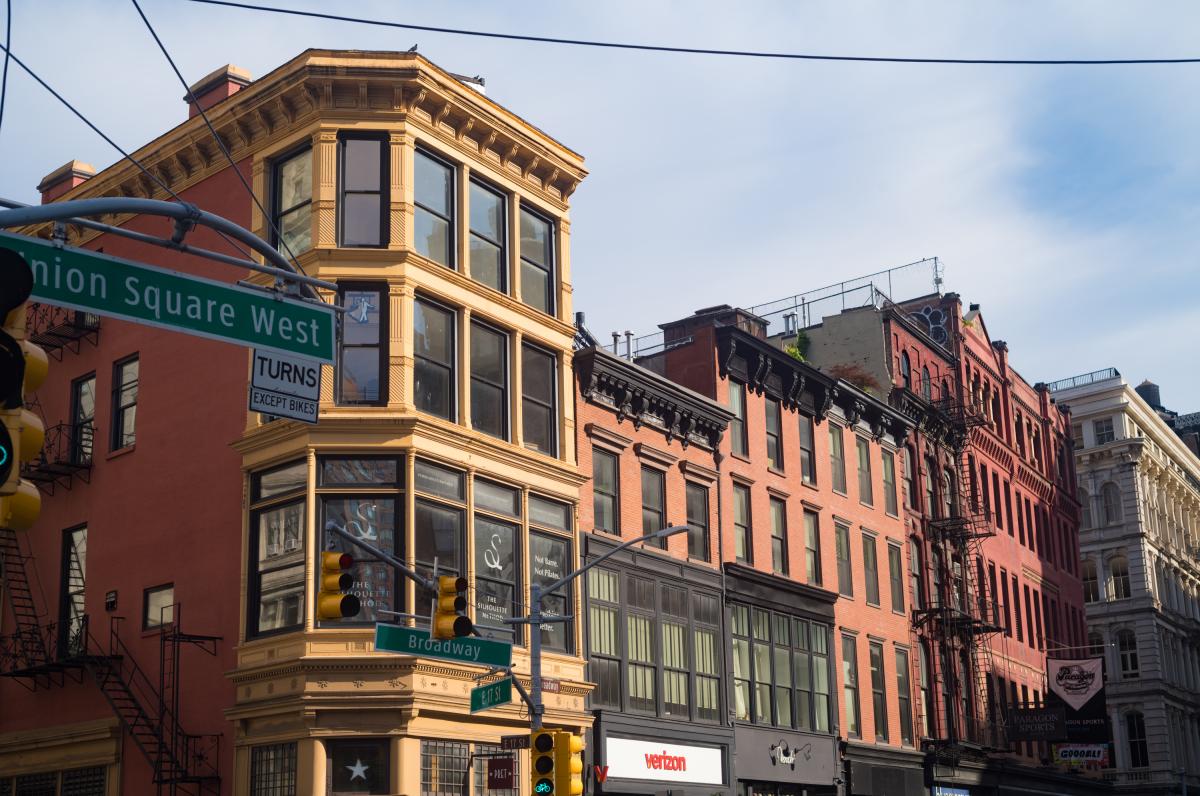 Looking north on Broadway from 17th Street, up the Ladies' Mile. The smaller, older buildings still have their decorative cornices.
 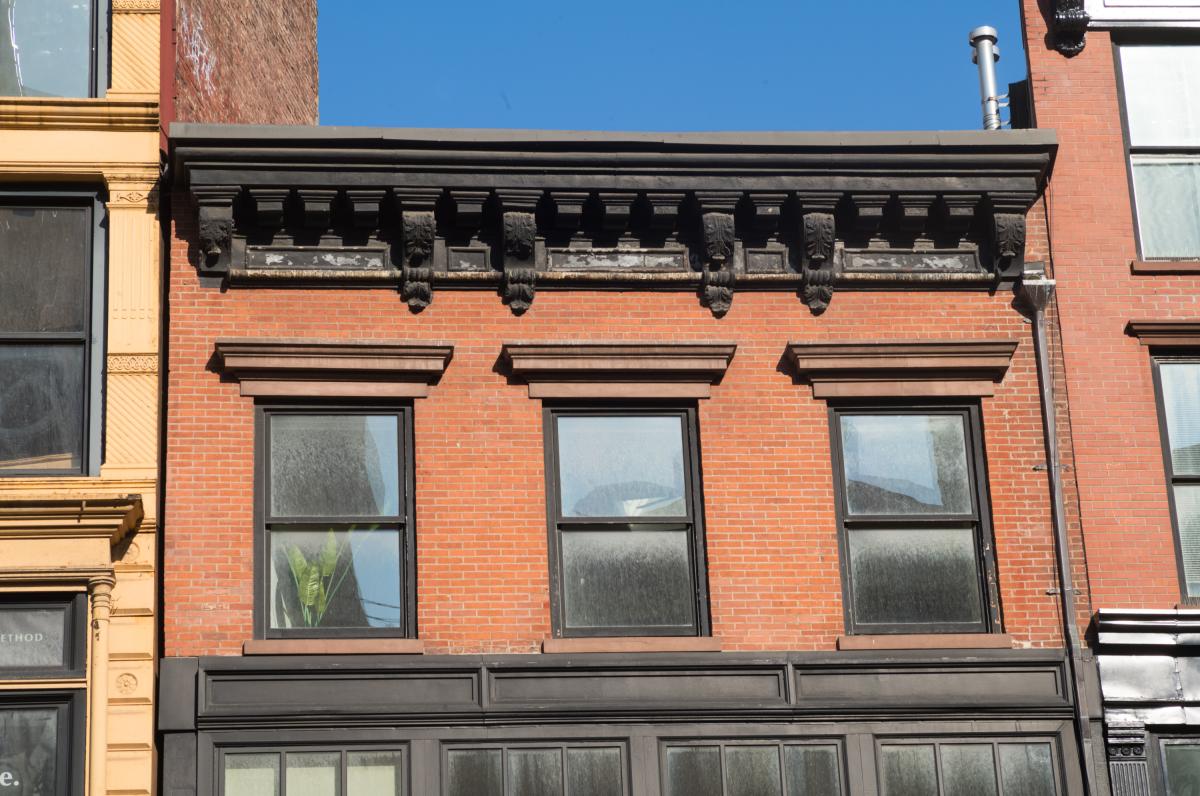 A closeup of one of the buildings from the previous picture
 Another closeup - simple, but it gets the point across. Now the longtime home of Paragon Sports, Manhattan's largest sporting goods store
 901 Broadway was built in 1870 as a home for Lord & Taylor. This remaining corner pavilion features a tall slate mansard roof in the the French Second Empire style.
 A tour-de-force of cornice carving! It's on the NW corner of 20th Street and Broadway.
 At the SW corner of 17th and Union Sq. West. I could not find much info on this awesome bit of decoration. Note the guys on scaffolding, doing work on the homely building next door.
 On the right is the Decker Building. Built in 1892, it was the home of Decker Brothers Piano Company. More famously, between 1968-73 it was home of Andy Warhol's Factory
shop clean up.......
No new project on the horizon but I have one hanging out in the back of the brain bucket. It is a stick chair - I have the patterns for a LAP stick chair. I don't have the stock for it but it is looking like the #1 project. When I was looking for the patterns/plan that I decided to clean up and organize the shop. At the end of the day I still hadn't found the plans and hadn't cleaned up and organized the shop.
 |
| hmm..... |
It has been a long time since my workbench was clear. I've been working on one small area around the face vise for over a month. It would be nice to have this down to bare wood before I start new project.
 |
| my first half blinds |
This is one box of two that I did that day. One box had 1 in 6 dovetails and the other 1 in 8. Not too bad for my first attempt at half blinds.
 |
| the other end |
I couldn't find the other box and I spent 20 minutes searching for it.
 |
| 1 in 6 box |
!4 years old and it is still together. I don't use this box to stow anything, it is just so I can look back and compare this to what I'm doing now.
 |
| working from the left to right side of the shop |
I remember being able to walk by this end of the tablesaw. It took me over an hour to clear out all the scraps of wood I had piled up here.
It was tough working in the shop today. We are in another heat wave but that was manageable. I had problems with all the dust I was kicking up. Even with a mask it difficult for me to work. I was getting short of breath and winded too easily. I spent almost as much time resting and catching my breath as I did cleaning things up.
After a couple of hours I said No Mas. I'm post surgery 6 weeks now but my stamina still isn't 100%. I'm probably only hitting around 70-75%. My wife says my breathing is shit (her words) so I know its serious for her to say it that way. But she also said that yesterday it sounded much better. Not sure if it is the lung surgery or the ILD, which the doctors haven't figured out yet. I'll get back to it tomorrow and do what I can.
 |
| the wife's work |
This is the reading nook that my wife wanted in the boneyard. I thought it would have taken up half of it but it only took about a 1/4. I'll tackle arranging the other 3/4 once the medical team clears my weight lifting restrictions.
accidental woodworker
little side project.......
 |
| huh? |
It is a moot point as the striker will go in but there is no spring pressure to cause it to leave a dimple. I tried adjusting the bottom spring and it did nothing. It isn't big enough to be a paperweight but I can't bring myself to shitcan it neither. Another dust collector for the shop.
 |
| hmm...... |
Yes this was an extra. I don't see the need to have duplicates, I can confuse myself without help from the peanut gallery. Tossed this one and made a new one.
 |
| driver caddy |
Decided to keep this and rearrange the drivers. The yellow one is a #1 Robertson driver. I have never seen a #1 square drive screw but it came with the set I bought from Lee Valley.
 |
| the fix |
I filled in some of the hole for the #1 so it was sticking up above the surface. All the drivers on the back row are L to R #1 to #3 for each type of driver.
 |
| Vix block #3 |
Three times is the charm and this is the proof. Made this longer L/R and spaced the Vix bits apart a wee bit more.
 |
| bottom |
I drilled all the holes for the drivers straight through. It is a Royal PAIN in the Arse setting the depth stop on my drill press. Gluing a thin piece on the bottom shuts the holes.
 |
| back home again |
I like these caddys for stowing things like this. Any empty hole tells me something is MIA.
I had a brain MRI today and it took up my entire PM session. It took almost 2 hours to do and the tech said that I didn't move and he didn't have to redo any of the scans. I have had several MRIs to date and this one was the most uncomfortable one I have had. My back was screaming at me for a while before it calmed down. Don't know why the oncology doc ordered it and I'll ask here about in on my first chemo fill up.
accidental woodworker
Beginning Tools – Part 2 Planning Tools

There’s no clear water from a muddy well.
-Patrick Rothfuss, The Wise Man’s Fear
Sawdust production is the essence of woodworking, but a little planning early in the process will always result in more efficient work.
In this article we’ll examine the four planning tools and documents critical to efficient woodworking, and which beginners to the craft need to know (whether they decide use them or not): (1) Design drawings; (2) Bill of materials or cutting list; (3) Cost estimate and; (4) Schedule, or programme.
Planning Tool No. 1 – Drawings
 A drawing of a 6-panel entry door. It needs dimensions and a cross-section, but as drawings go, it’s a good start. BTW, this style of door is also called a “cross and bible” door because the arrangement of rails and mullions in the top half create a cross, while the two panels in the lower half can be imagined to represent the Old and New Testaments in the Bible, three features that are said to prevent evil from crossing the threshold of such a door. Many say this is totally coincidental, but in light of the superstitions surrounding doors and entrances since ancient times, I think not.
There’s not enough time or space in this humble website to discuss drawings in any detail, but for purposes of solidifying your thoughts into a goal, and determining the objectives necessary to reach that goal, you will need a design, of some sort, recorded in a drawing, of some sort.
Without a drawing, even if it’s just a sketch on a paper napkin using a drinking straw and ketchup, you have no plan. And without a drawing, you lack the most important tool to maintain quality, cost and schedule. Do any of these factors matter to you?
For this purpose you would be wise to own the tools and develop the skills necessary to make simple technical drawings of your project including plan views, elevations (side views of all six sides) and cross sections. Isometric drawings are nice too, but not mandatory for most projects.
A computer with CAD software won’t hurt, but such expensive, complicated tools are not necessary unless you’re required to submit design drawings for review and approval by a paying Client, or perhaps She Who Must Be Obeyed. If a paying client, make sure you allow time in your schedule, and funds in you budget if you are paying a draftsman or CAD monkey, to revise and resubmit drawings. I strongly advise you to never begin making sawdust before your Client has approved (and ideally, signed) the design drawings, even if they’re drawn in Heinz ink.
For simple projects, such as furniture or joinery, dimensioned pencil drawings on plain paper will usually suffice. So you’ll need paper (mylar drafting paper is worth the cost for its durability), a board to tape your drawing paper to while you’re working on it, drafting or masking tape to secure the drawing, a square (a framing square will work fine), a 45˚plastic, steel or aluminum drafting triangle, and a straightedge to guide your lines, a pencil and eraser, a scale (e.g. 1/4″= 1′), a divider or two, and a drafting scale.
Planning Tool No. 2 – Cutting List or Bill of Materials
Once your design drawing is near completion, you can get started on making a Cutting List or Bill of Materials (BoM)
A BoM (AKA Materials List) lists all the pieces, parts, components and supplies required to fabricate the project. You may not need that much detail, but you will absolutely need a Cutting List. The following are the primary reasons for making a cutting list:
- Efficiency: Reduces guesswork and speeds up the build process.
- Accuracy: Ensures each part is laid-out, measured and cut correctly.
- Material Management: Helps you to accurately estimate the quantity of lumber needed, it’s minimum length, width and thickness, as well as its cost.
- Organization: Keeps your workflow structured, so you know what to cut and the most efficient order to cut each part.
- Reproducibility: Acts as a record should you want to recreate the project in the future.
A cutting list is simply a table, often written in MS Excel, Google Sheets, other spreadsheet software or even by hand on a paper notepad in ketchup. Professionals purchase or develop cutting list computer templates for the type of project they typically undertake, but this only make sense in production work.
List all the major wooden components in this table, including the name of each part, its location in the assembly, all its dimensions (length, width, thickness) and species of wood, if more than one is used, and its designation. If special surfaces treatments (e.g. roughsawn, hewn, adze, paint, stain, pink candy apple glitter with rhinestones, etc.)
Regarding the term “designation,” this is simply a non-permanent marking convention you employ at your discretion. Whatever method you choose, you need to be able to place this mark quickly, legibly and directly on each part, in pencil or lumber crayon. Indelible marking pen, for instance, is not good because it’s permanent and can bleed through the finish months after the project is finished.
A glance at any mark you’ve made should tell you exactly where it belongs within the assembly in an instant.
I use a version of the cabinetmaker’s triangle. Include these marks in the cutting table to describe each individual part. Please also mark this designation directly on the wood so there is absolutely no confusion.
Consistency is mandatory and care must be taken to avoid confusion. If you do a good job developing your marking convention it will serve you well for many years and many projects turning cursing and confusion to deep satisfaction. This is a big step in developing professional-level skills.
Dictum: Popwoodwork: FineWoodwork
Can you get by without a cutting list? Sure you can. But you save nothing by not preparing one, not even time, and can loose much. Moreover the process is excellent training that will give you confidence moving forward. It may improve your overall analytical capabilities too.
Planning Tool No. 3 – Cost Estimate
If Gentle Reader’s has bottomless pockets, such that the quantity and quality of wood available to you are unlimited, then a cost estimate may be unnecessary. But even then, I encourage you to prepare a cost estimate because, as a wise construction estimator named Warren (RIP) once told me, you can never truly understand a project until you’ve made a cost estimate. Why? Because to make a cost estimate you need to analyze the project in detail and list (1) all the materials and (2) the dimensions and quantity of the parts, calculate anticipated waste, estimate the time to make and assemble all the parts, and then multiply the quantity of materials (perform a quantity takeoff) required by the cost of those materials, and add the labor cost.
As you can see, a cost estimate is the natural expansion of a cutting list, which is a natural extension of a design drawing.
This may not be an easy job, but if you aspire to professional-grade skills, then the exercise is worthwhile even if the resulting accuracy the first few times is not stellar. Two steps forward one step back is still progress!
Planning Tool No. 4 – Schedule
Part of creating a final cost estimate, as in a commercial bid, is to breakdown the work required to accomplish the project into pieces and assign a time value and unit price to each, analyze the best workflow combining all the tasks, and then to insert this information into a document called a “schedule” in countries influenced by USA where the CPM (critical path method) schedule was first formally developed for planning and managing factory shutdowns and shipbuilding, or a “Programme” in the UK, or a kouteihyou (工程表) in Japan.
A schedule is the actual step-by-step plan for the build. Is it absolutely necessary to write one? No, of course not, but until you can write a simple schedule, you don’t have a real plan, just a SWAG (scientific wild-ass guess).
Computer programs are commonly used to write and manage schedules nowadays, MS Project, SureTrak (now defunct) and Primavera P6 are some your humble servant has used over the years. Such software is extremely convenient and even useful, at least they were until Oracle got involved. That said, I learned to write and manage schedules by hand long before commercial computer software was available, and continue to make rough schedules for even complicated construction projects by hand, so fancy software is not necessary, especially for hobby woodworking projects.
The key points to pin down when writing a schedule are to first plan the the project with drawings and cutting lists, and to then identify the various task or jobs it will take to get the job done, and time it will take to complete each. Then figure out which of those tasks can only be done one after the other, and if they can be worked on consecutively, what the timing of the work progression will be.
For instance, when making a door, the parts must be cut to size before the joints can be cut, which in turn can only begun after the wood has been procured, thickness planed and jointed. On the other hand, you can procure the wood, hinges and begin thickness planing before, or even at the same time some of the joints are being cut.
For example, your breakdown might include the following tasks, some of which you may perform directly, or you may subcontract out to others, finishing for example.:
- Produce drawings: 4hr
- Procure materials: 16 hrs
- Mark materials: 1hr
- Saw materials to approximate length and width: 8hrs
- Thickness plane and joint one edge of materials: 3hrs
- Layout: 1hr
- Cut joints: 8hr
- Test-ft & Glue-up: 1hr
- Cleanup: 0.5hr
- Finish sand/plane: 2hr
- Apply finish: 3hr
- Install hardware: 1hr
- Deliver/install final product: 6hr
- Invoice Final Payment: 1hr
In the case of hobby woodworking, a detailed schedule may be psychologically onerous, taking all the joy out of the project. On the other hand, it can help prevent simple projects and small cash investments from morphing into complicated, expensive projects. But you never know until you give it a try.

Conclusion
Gentle Reader may be off-put by these steps and document-prep because they seem like actual work, contrary to the spirit of woodworking as an excuse to drink beer hidden away from the flaming eye of She Who Must Be Obeyed. But please keep two absolute truths in mind: First, regardless of how or when or to what degree of detail you perform the tasks I’ve described in this humble article, none of them are busywork. Indeed, documents have been found (on papyrus, no less) that evidence that Pharoh’s project manager for the pyramids did the same.
Second, whether you realize it or not, in one way or another you will do every single one of these jobs before the project is complete, you just won’t realize you’ve done them until after the fact. And if you proceed without a plan, you will have done them in a disorganized manner, out-of-sequence, on the fly, inefficiently, and perhaps with haphazard results. Such is human nature.
While the planning and documents these steps require may seem like they will make the job take longer, the truth is it will go quicker, with better results, and with better quality at less cost. I promise.
Until we meet again to gather herbs and posies in the troll woods, I have the honor to remain,
YMHOS
 Translated title : Here is a piece of a troll herb which nobody else but me can find by John Bauer (1882–1918). From a tale written by Alfred Smedberg and published in the 1912 edition of Bland tomtar och troll (Among gnomes and trolls)
If you have questions or would like to learn more about our tools, please click the “Pricelist” link here or at the top of the page and use the “Contact Us” form located immediately below.
Please share your insights and comments with everyone in the form located further below labeled “Leave a Reply.” We aren’t evil Google, fascist facebook, or a Whitehouse staffer and so won’t sell, share, or profitably “misplace” your information. If I lie may all my sawteeth shatter.
Relevant Articles
little side project........
 |
| hmm....... |
This is the little side project. I am going to make a new holder for the new Vix bits I just bought and for the drivers too.
 |
| done |
Still haven't found the pics for the big frame on the right. I'm on the fence about the small certificate frame. The router wobbled while routing the profile and it left a few dips, hollows, and one divot on the top rabbeted edge. They aren't noticeable looking at the frame from a foot away but they are visible up close and personal. I am letting it be for now and if it continues to gnaw at me I'll make another one later on down the line.
I am rusty routing profiles with a corded router and I don't have a router table that would have eliminated the headaches with this frame.
 |
| hmm...... |
The hex drive on these bits are a frog hair over a 1/4". A 7mm drill bit leaves enough wiggle room to get the bits in/out of the holes.
 |
| huh??? |
There are doubles of these two Vix bits. Why? I looked at the pic and write up in Amazon and it has the doubles there for all to see. I didn't pay attention to it. I guess I was blinded by the shiny colors. I can't think of any reason to have doubles of these two?
 |
| toast |
The center punch ain't working. It would punch and then it wouldn't. I took it apart to check it out and found a burr on a headed pin. It was hanging up on a hole it was moving up/down in. I thought I had found cause of the hang up.
 |
| the culprit |
There was a definite burr on the end and it was dragging in the shaft it rode in when I checked it. It filed off easily and it no longer dragged or hung up in the shaft. The small sliver cylinder above the board is what this pin slides up/down in.
 |
| sigh |
Major hiccup happened. I took the center punch that came with the Vix bit set apart but I couldn't put it back together. There isn't much to this and I think I'm reasonably smart but nada. I felt like I didn't have the opposable thumbs required for dealing with this. I took my Starrett center punch apart and I was able to get that one back together again. Both the punches have the same number of parts but the Starrett has much better machining and quality. But the Vix bit center punch won't go back together as it should.
 |
| 2nd one |
The first block I did had a hole for the center punch. I don't have high hopes that it will ever go back together again. I have it on my desk so I can play with it at night. I added the Vix bit from my first set to this one but that may be an extra too.
 |
| my IQ is 129 |
Still can't figure this out. The top part will not screw down onto the bottom part. I feel like this part should be seated further down in the bottom part but it isn't. Did a part go south on me when I took it apart and missed it? This is putting my OCD into hyper drive and I'm having problems pushing down my urges to smash it flat with my 3lb sledge hammer.
I had to drop my truck off at the garage. My ABS and skid lights won't shut off. The garage mechanic said it was probably the speed sensor. I'm sure that will cost a bazillion dollars plus labor. I'll find out tomorrow hopefully.
accidental woodworker
two more frames pt VII......
I'm over the hump with the frames that morphed from 2 to 3. Got all the woodworking done on the last two today. All that is left to do with them is to apply shellac. I will easily get the two out to the Frame it Shop on wednesday. A lot of days between now and then with no new project tickling my fancy yet.
 |
| ta da |
 |
| hmm....... |
Three of the corners had no rocking but this last one has a teeny bit. It isn't much but I don't understand how 3 aren't rocking but this one is. Regardless I'm happy with how this came out.
 |
| wife's certificate frame |
I got lucky and the outside routed profile didn't play peek-a-boo with any of the dowel pins. Routed a small chamfer on the inside edge.
 |
| back done |
I didn't miter the back frame - used butt joints. The short sides hide the end grain ends on the long sides. The end grain from the short sides faces up and down and won't be visible if viewed from the sides.
 |
| final prep |
Set the nails and filled them with putty. Used alcohol to remove the layout pencil lines. One more frame to prep and the shellac party commences.
 |
| hmm...... |
Not getting a big warm and fuzzy with the profile. I like the chamfer as they helps to draw the eye into the frame. This profile doesn't match the profile of the first certificate frame I made in june of 2023. It is close and this frame is about the same size as that one. (about a 3/8" longer in the long direction)
 |
| came today |
I got this set mostly because of the centering punch on the far left. Pretty impressive set for $20. Not sure if I'll keep it in this plastic case or make a stand for it.
I got one coat on the two frames and a 4th coat on the first Declaration frame that is now repurposed for a family pic layout. The plan is to get at least one more coat on the frames after dinner.
I've been sleeping better lately. It is about the same now as it was before surgery. Still getting up for at least one toilet trot race but I able to fall back asleep afterwards. My middle night You Tube surfing has disappeared too. Feeling much better when I finally decide to roll out of the rack.
accidental woodworker
Kitchen Remodel – 1
Continuing on from the last post… with the old doma gone I could proceed with structural work for the kitchen. But before diving into that lets take a step back and look at some photos from when we first moved into this house, now nearly two years ago. The house when it was first built… Read More »Kitchen Remodel – 1
The post Kitchen Remodel – 1 appeared first on Big Sand Woodworking.
two more frames pt VI.........
 |
| after dinner last night |
I went back to the shop and got the 3rd and final coat of shellac on the back. That dried quickly so I got one coat on the front. Went looking for the pics I plan to put in this frame and nada. Couldn't find them and my wife said she didn't know where I had hidden them neither.
 |
| 3rd (and final?) Declaration frame |
Sawed the short leg miters on the right and the long legs on the left. Probably don't have to do it this way but so far it is working.
 |
| done |
I think I have figured out the how of the inside and outside lengths. The 3rd frame is spot on with how I want to display the Declaration in the frame. The blue tape denotes the up face of the frame.
 |
| hmm....... |
The Declaration has irregular edges all the way around. If I mat this they will be hidden and I will lose a part of the look of this reproduction. Instead I will ask Maria to mount it so that the edges will remain visible. I sized the inside of the frame (correctly) so that it is about a 1/2" wider R/L and T/B. There will be a small margin visible on all the edges.
 |
| had an oops |
The frame, miter wise, went together good. However, this miter was misaligned on the faces by a strong 16th. That is too much to plane and feather out. Filled in the first dowel holes and I'll redrill them after these have cooked.
 |
| hmm........ |
Found the culprit causing the misalignment. While drilling the new dowel pin holes, I saw the jig move backwards a frog hair. The thumb screw was loose and it hadn't occurred to me to check it. Tightened it down with help from the allen wrench. I'll be adding checking that this remains tight in future uses of this jig.
 |
| sigh |
Found two more corners that were misaligned, not as much as the first one, but more then 3-4 frog hairs. I glued dowels in the holes and redrilled them after waiting 30 minutes for them to cook.
 |
| done |
All four corners closed up nicely on the dry fit. None of the faces of the miters are off flush more then a frog hair. Worth the calories and rework to get this done right.
 |
| clamped and cooking |
Clamped it and took it out and laid it flat on the tablesaw. No rocking, Clamped it back up and set it aside to cook until the AM.
 |
| 3 coats |
I am really liking how this frame is popping with the shellac. I think this may turn into a Xmas present this year.
 |
| certificate frame |
I hate to say it, boys and girls, but I might have to make another frame. The blue tape says this is the up face but I am not sure of that. The dowels I drilled I had offset them so that they were a wee bit below center. I did that to leave more meat above them for the router bit profile to come.
 |
| which option |
The first option is to just rout a small chamfer on the inside and outside of the frame. Regardless of where the dowels are, I am fairly certain that I could rout the chamfer without any headaches.
The second option is to rout a 3/8x1/4 rabbet. Again I don't think the dowels will interfere with that. Even if they do it will be on the back side and not seen.
The final option is to rout the profiles on the outside and inside edges and use these thin strips to make a back frame. Of the 3 options I'm thinking of, I'm going with #3. I will rout the the outside profile first. Fingers crossed that the dowels don't get exposed. The inside edge will get a small chamfer that I'm not concerned about.
I'm now a month post op. I still have some fluid build up over my left side. I get winded more then I like but that is getting better each day. My stamina is improving a wee bit each day. I still can't lift anything heavier then a gallon of milk. If I do I feel a tugging in my left lung which tells me to put it down, whatever it is. My heart seems to have settled out - still higher then what it was pre surgery but it is cycling and fluctuating like crazy. Still don't know what the long term holds for me. Like AA, I'll take it one day at a time.
accidental woodworker
Expert Shows How to use Antique Plow Planes!
two more frames pt V.......
One step forward and then slam into reverse and go backwards at 80mph. Ran face first into a a huge boo boo, me-steak, brain fart extraordinary loud and stinky. Survivable and recoverable but it certainly let the wind out of my sails. It is upcoming.
 |
| certificate frame |
Flushing the corners with my #3. Cherry is such a sweet wood to plane until you run into squirrely, reversing grain.
 |
| happy face on |
No rocking from any corner. I expected it to be so but confirmation left me with a good feeling.
 |
| Declaration frame |
Routed a shouldered round over on the outside edge and a small chamfer on the inside edge. Penciled the corners square and chiseled the round square.
 |
| sigh (the boo boo etc etc) |
This didn't make me go postal or want to give the frame free flying lessons. I got the offset correct on the R/L but not on the top/bottom. I didn't add 3" to the inside measurement, I put it on the outside. That made it almost exactly the same as the T/B measurement of the Declaration.
It sucked pond scum to be this close to the end and come up $1.27 short. I'm sure that Maria could have made a mat for it but it would have been off on the on the R/L. There was no way to make it even that I could think of.
 |
| hmm...... |
This might have worked. I could remove the back upright and the frame would fit flat on the jig. Nixed doing it and decided to suck it up and make a 3rd Declaration frame. I have a use for this frame already. I'll use to make a family picture frame - the grandkids and their parents.
 |
| first coat of shellac |
I planed a small chamfer on the outside edge of the back frame. Set the nails and filled them and the gaps in the miters with mahogany putty.
 |
| finally dawned on me |
Most of my headaches and problems with miters are with the miters themselves. Looks like I have to add determining the inside and outside lengths too. This measurement told what I had missed on figuring out my lengths.
 |
| hmm....... |
Broken vix bit that I found replacements for on Lee Valley. They had replacement drill bits in more sizes then I have vix bits.
 |
| 5/64" |
This is the size of the bit in my #3 vix bit. I searched on line for my 'vix bits' and nada. I found a bazillion different vix bit sets and individual bits. However, none of them looked even remotely close to what I have. Given that these are over 40 years old I found a 10 piece set on Amazon for $20 that I am waiting to pull the trigger on. I'll add the 5/64" drill bit on my next Lee Valley order - S/H is more the cost of just the drill bit.
 |
| yikes |
This can leaks, it is a slow leak that left a big puddle of shellac on the cupboard shelf. So far the paper towel has worked at keeping it contained. Got the 2nd coat on the frame and I'll get the 3rd one on after dinner.
 |
| hmm...... |
The outside edges of this cherry board has straight grain. I can get a long and short side out of both sides and still have a good length off cut.
 |
| 3rd frame parts |
All four of these laid flat without rocking on the tablesaw. I will let them sticker here over night and in the AM I'll make the frame.
 |
| off cuts |
If need be I can get two long or two short frame parts from this.
I spent a couple of hours in the AM session in the shop but not in the PM session. After lunch I just vegged out at my desk. I had absolutely zero desire to do nothing except suck in oxygen and expel carbon dioxide. I did that well until I dragged my butt down to the shop at 1400 and sawed out the 3rd frame.
The Frame it Shop is closed until the 15th so there is no rush to get this or the certificate frame done. I'm thinking now of routing a 3/8x1/4 rabbet in the certificate frame as that is what I did on the other certificate frame. I'll have to wait and see which way the wind blows me in the AM.
accidental woodworker
two more frames pt IV.......
 |
| shaker knobs |
I got these quick. The top bag on the left has the largest knobs and they are ones that I don't use often. The top right bag has the size I use the most and they are cherry. I didn't realize that until I checked on the delivery and saw they were cherry. The bottom bag has small knobs with 1/4" tenons. After I eyeballed it, I think they are something I probably won't use much of.
I will check the site off and on to replace the cherry ones. I prefer maple or birch over cherry.
 |
| certificate frame |
Laid out the position of the dowels and drilled them.
 |
| dry fit |
No rocking which put a happy face on me. All the miters looked good dry fitted.
 |
| glued and cooking |
I did two dry clamps runs first before I glued it up. One corner froze on me and there were a few anxious moments before the clamps pulled it tight. There was a slight misalignment on two miters but they will flush up easily. I anticipate zero problems with them.
 |
| Declaration frame |
Got the back frame on the Declaration frame. I like this method because the framed object is set back from the front of the frame. It draws your eye into the frame to look at what is framed. I'll wash, rinse, and repeat this with the certificate frame in the AM.
Spent another day making multiple trips to the shop not spending more than 20 minutes a session. Yesterday was tough because I spent most of the afternoon having coughing fits that drained me of my strength. No fits today so far and I have my fingers and toes crossed.
It is looking like this is going to be my shop schedule for the foreseeable future. The coughing fits yesterday blew up the fluid to close the size it was when I left the hospital. I am also getting winded quick. Going up the stairs is not easy and once I'm up in the living room I have to sit and catch my breath and recover.
accidental woodworker
Rehabbing a Small Incannel Gouge
Back in February I got this small incannel gouge at a tool show. I cleaned it up and sharpened it at the time, but I didn't really put it through its paces until recently. When I sharpened it, I knew something wasn't right. I just couldn't seem to get a good consistent edge. It sat on a shelf until this week waiting for me to look more deeply into it.
 |
| New Haven Edge Tool Co. |
The curve of the gouge is part of a 9/16" diameter circle (9/32" radius). The cutting edge measures 7/16" corner to corner. The handle is clearly a user-made job, and it had come loose while I was working on it, so I made a new one.
When I tried sharpening the gouge, something wasn't right. The wire edge that forms would get too large and end up flaking off more metal than it should have. One time, when I finally got a good edge, I tried to cut some wood and the edge just crumbled.
 |
| Result of using the gouge lightly. Can you see the chip in the edge? |
I figured the tool had lost its temper somewhere along the line. So I annealed it by heating to cherry red and plunging into a bag of vermiculite to allow the heat to dissipate slowly.
 |
| My heat-treating set-up: two torches pointing at a steel can. The gouge is stuck in the vermiculite at left. |
After it had cooled, I hardened and tempered the gouge. This was the first time I tried to temper a tool by watching the color advance towards the cutting edge. When the edge got to a straw color, I plunged it into oil to stop the tempering.
 |
| You can see the colors here on the convex side of the gouge |
After cleaning up the blackened and discolored steel, I gave it a good sharpening. But I got an equally crumbly edge! I'm aware that when heat-treating an edge tool that has a sharp edge, the thin cutting edge can get overly brittle. So I ground back a couple of millimeters and re-sharpened it. This time I finally got a good cutting edge without crumbling. I tested it on some end grain walnut and finally didn't ruin the edge after just a single or even multiple cuts.
 |
| Testing on end grain walnut |
When I was satisfied that the steel was in good enough condition to warrant a new handle, I got a chunk of cherry, sketched a pattern on some cardboard and got out the bungee lathe. The shape didn't come out exactly how I had planned, but it'll be fine.
 |
| Showing the new handle and the lathe set-up |
This was my first time re-handling a tanged tool. To fit the tang into the cherry handle, I drilled successively bigger holes at successively shallower depths. I had to adjust the hole a bit to get the gouge to align better with the handle. I used the brass ferrule from the original handle, which had a 5/8" outer diameter and just shy of 9/16" inner diameter. It was very satisfying when I tapped the handle home up to the bolster.
 |
| New handle next to the original |
I gave the handle a single coat of BLO, which really brought out the color of the cherry. Another tool in the arsenal.
 |
| Completed |
Frederick Kiesler's Multi-Use Chairs at MoMA

I was pleasantly surprised that the Museum of Modern Art was open on July 4th, when it was a million degrees in my apartment and most other activities were closed for the holiday. I figured the museum would at least have good air conditioning. Evidently I was not the only one with this idea. The place was fairly crowded, with art lovers and natives and World Cup tourists alike.
One of the high points of the visit was seeing furniture made by Frederick Kiesler (18901965) an architect who immigrated to the US from the Austro-Hungarian Empire in the late 1920s. Although Kiesler didn't have much of an impact commercially in furniture design, he did design some important buildings and some landmark furniture.
The Kiesler work shown here are the original Surrealist-inspired "Multi-Use Chairs" that Kiesler designed in 1942 for Peggy Guggenheim's "Art of This Century" gallery in New York. The chairs are made of linoleum clad oak. The original materials bill was $9 each. Depending on how you flipped or stacked the chairs, each unit could also serve as a rocker, table, bench, sculpture pedestal, easel, or painting support. Kiesler claimed 18 distinct uses (which might be hyperbole, as the show included no official list). The idea is that depending on the gallery and the usage, you could reconfigure the same furniture for different uses.
How practical or comfortable these pieces are I have no idea - the museum did not welcome visitors to take a load off their feet. I don't know if the materials used - Oak and Linoleum - were chosen because of ideological commitment to the Bauhaus movement's veneration of common materials, or if Kiesler was being practical and frugal and therefore took some solid oak flooring (that looks like it was repurposed from something else) and some linoleum was just handy, fit the budget, and got his point about form and function across. Nine bucks for materials even in 1942 was not a lot of money. These days I would think the end caps would be fancy plywood, with fancy bent veneer instead of linoleum for the sides. And at a hundred times the cost.
The pieces are too modern for Ikea. (The market for really ground breaking shapes and forms is pretty small.) And they are certainly not what Ikea specializes in (cheaply made versions of Scandinavian / Mid-century modern) but I could easily imagine something like these pieces in a modern apartment. They'd offer a comfortable conversation piece, if nothing else. Unfortunately I couldn't find any drawings of how this thing is put together. AI bot Claude said that a 1942 original in the Brooklyn Museum (not at MoMA) measures 29 1/8" 30 1/2" 15 5/8".
What's important is that 84 years after their introduction, the pieces still look modern and avant-garde, and a striking departure from what most people imagine when you say the word "furniture." And more importantly: the work isn't an evolution of an existing design vocabulary, much less a stop on a recognizable tour of furniture design movement with Colonial, Shaker, Arts & Crafts, mid-century Modern/Danish modern/Ikea, etc. It really is a new approach. They are wildly original.
The lesson for all of us is that our design approach and what we build are always influenced by our training, budget, and history. Coming up with anything good that is also actually new is hard. But that doesn't mean you shouldn't try. But at the same time, recognize your influences. It is perfectly excellent to design something where you take a known design and push it into something you like, with better construction, materials, and more appropriate design for the intended space. But it's also worthwhile to occasionally go all the way out to left field, and pluck a design from space.
 You see what I mean about repurposed materials
 two more frames pt III........
 |
| much rejoicing in Mudville |
The Declaration frame has cooked and it is laying flat on the tablesaw. No rocking from any corner tapping.
 |
| new home |
This is where the hardware dresser will live for the time being. The empty hole to the right of is for the sanding block box.
 |
| sigh |
The lid for the sanding block box went south on me. I couldn't believe that I had done this because the screws hardly any purchase at all in the lid. I'll have to put new hinges on this.
 |
| stop hinges |
I like these hinges because they have a built in 90° stop. They will be surface mounted to the lid and the back of the box.
 |
| hmm..... |
Found an immediate use for the first Declaration frame. Dug the sapele frame out of the shitcan to serve as patterns.
 |
| wee bit long |
There isn't that much waste using these to make the certificate frame for my wife. Initially I was going to use a 5/4 cherry board but I'll use these instead. For some reason I thought that these were sapele.
 |
| couldn't wait |
I had to see how this frame looked after a quick clean up. Flushed the corners, front and back, and did a light sanding with 120. Happy with how it looks. The plan is to keep it simple looking with just chamfers on the inside and outside edges.
 |
| kept going |
This frame has some birds eye figure but not on each side. This face has 3 and the other has only two. IMO it is a crap shoot as to which one faces out. Most likely I'll go with the face that has 3 if I remember it.
 |
| temporary home |
I need a couple of more thin strips to make the back frame for the Declaration, the glass, and the mat. That will probably get done in the AM.
 |
| dutchmen |
I glued in shims to flush the mortises - I had to do that before I could screw through the hinge into the box/lid.
 |
| sigh |
The drill bit for my #3 Vix bit broke. I can't complain because I've had my Vix bit set for about 40 years. I got my money's worth plus more. I wonder if replacement bits are still available?
 |
| certificate frame |
I did some rearranging of the parts. One long side had cathedral grain while the other 3 are mostly straight grained. I want this frame to be seamless grain wise 360.
Had my oncology appointment where the RN explained to me what to expect with each treatment. There weren't too many surprises and everything looks to be manageable. She explained to me how important my white blood count and red blood count is before each treatment. If it goes too low I can't get the treatment. I'll deal with it as it comes - first treatment is on the 21st.
accidental woodworker
two more frames pt II.........
 |
| sigh |
Didn't get a pic of it but this frame was toast, as in burnt toast. The frame was badly twisted - 3 of the corners rocked. First time I had seen that. I was pissed and whacked the frame on the tablesaw and one corner opened up. Kept whacking it until all the corners came undone.
 |
| nope |
My first thought as to why the frame was so twisted was the miters
weren't square to the face. They weren't all perfectly dead nuts but
nowhere near being the cause of the twist.
 |
| yikes |
Checked the first one for twist and there was a ton of it. The thought to check the board before ripping out the frame never lit a bulb in the brain bucket.
 |
| 1 for 4 |
The three on the left are twisted, with the longest one the worse. The lone one on the right is twist free. I know understand how and why the frame was toast. The miters were all dead nuts 45 but 3 sides were twisted. When I glued it up I compounded the twist by gluing the sides into 90° corners.
 |
| 2nd sapele board |
The twist in this board is horrendous. It is beyond the 4 lines on the back stick. It didn't look like it was twisted - I thought it was cupped but not twisted. The board I ripped the frame out of must have been twisted too. I didn't feel any binding or the saw blade stalling when I ripped them out. Doesn't matter as the frame was tossed into the burn pile.
 |
| needs one more |
Never got the 4th and final coat of shellac on the dresser yesterday. Wasn't sure if I would get it today neither. I had already been to the shop twice, staying for less than 30 minutes before heading topside again. The swelling/fluid build up is driving me nutso. My wife thinks I am doing too much and I should be more sedentary and even spend time in the afternoons laying in bed. I'm trying the sedentary part but not the afternoon part.
 |
| Declaration frame |
Got the frame dry fitted and it isn't rocking. I checked each side of the frame for twist and there was none. I had to cut the dowel pins again, they were too long.
 |
| success |
On the 4th trip to the shop I glued up the Declaration frame. After I glued it up I took it out of the clamps and checked it laying flat again - it passed with flying colors. Clamped it back up again and left it to cook until the AM.
 |
| 5th and final trip |
Got the 4th and final coat on. I looked around the shop for a hole for this and nada. The only spot that looks promising is the sharpening bench. I'll have to rearrange some things but I might be able to squeeze it in.
accidental woodworker
Pages

Please Leave a Reply Cancel reply