
Hand Tool Headlines
The Woodworking Blogs Aggregator
“Glory to God in the highest heaven, and on earth peace to those on whom his favor rests.” - Luke 2:14
Be sure to visit the Hand Tool Headlines section - scores of my favorite woodworking blogs in one place.
General Woodworking
little shop time......
Left for my VA appointment at 0700 to get my blood work done. The blood draw waiting room was almost full. I guess the hurry up and wait mentality of the military never goes bye bye. I had the blood draw early so it would be done by the time of my oncology appointment at 0830.
That appointment went well. The doc said some people don't experience any side effects and others go over the deep end. I guess I'm lucky that other then some brief nausea I have had no other side effects. My blood work looked good with only my white blood cell count being low. The doc said that was due to chemo and it effects how well I can fight off infections.
I had my Rx for the nausea medication refilled and that took a bazillion hours of waiting before it got filled. It was a little after ten before I got it and headed back to the barn. On the way home I stopped at the eye clinic to get my eyeglasses fixed. That didn't happened and I had to make an appointment which is for this monday.
 |
| after lunch |
I didn't get to the shop until after lunch. I took one box out of the clamps and checked the fit where it will live. The segmented box in the front is one of two boxes that aren't as wide. Wasted space for debris to pack itself in.
 |
| all four |
I sanded the 3 boxes with 80 and 120 grit. No finish on them and I'm leaving them bare for now. I have spray shellac that I could use but I wasn't in the mood for it.
 |
| tenants signed their leases |
This will probably change as I use these. The only hiccup with them is they fill up with all the crappola I generate working at the bench.
 |
| came a week early |
My pic of the bumblebee orchid came today. It surprised me because I thought there were actually 3 bumblebees on this plant. The 'bumblebees' are the flowering part of the orchid.
 |
| checked the fit |
The margin for the mat is what I had planned. The hunt for the color of it isn't going to be easy. I thought I had one picked but seeing the green background of the photo against the off white frame has me second guessing myself.
accidental woodworker
Old Fashioned Milk Paint Tutorial
good shop day......
I am now in the 8th day post my chemo cocktail. Still waiting for even a hint of the side effects the nurse told me about. Other than a twinge of nausea on day 2 and 3, nada. She said I would lose my taste for foods I liked, I would be nauseous, sleep would change, and that I would feel tired. She stated the worse of it usually says hello in 7-10 days. Two more days left for that and I have an appointment with oncology tomorrow at 0830.
In spite of this, I had a great day in the shop. I went to the shop a little after 0800 and worked until lunch around 1130. Filled the pie hole, made a quick trip to the grocery store, and returned to the shop before 1300. Killed the lights at 1435. Been a while since I worked in so many hours in an AM session. I feel good, with nothing shaking hands with me or simmering away in the background. If my blood work is good tomorrow my 2nd chemo cocktail should happen on August 11th.
 |
| hmm...... |
Not exactly something you could shave from. I had already scraped off some debris - mostly glue. Underneath the router is my surface plate which I'll use to clean and smooth the bottom of the router.
 |
| 320 grit |
I didn't go nutso on this. I used 320 and 400 grit and the goal was to get the bottom smooth to the touch.
 |
| sharpening the iron |
It wasn't that bad doing the two irons. My fingers didn't cramp or ache before, during, or after. Which was a lot different from the last time I sharpened either of these. Used the coarse, fine, and extra fine diamond stones.
 |
| worked |
Stropped them both with this. Worked better than I expected.
 |
| hmm...... |
The inside of the frame at all four corners, was dead nuts 90°. Not so for the outside corners. All four were slightly off 90°. That was due to me planing the outside edges - I didn't attempt to check/keep the outside miters at 90°.
 |
| ditto |
The bigger frame was the same but the outside miters were not out as far as the little one.
 |
| hadn't planned on this, but..... |
The well I have behind my workbench had a couple of boxes there. Two of them weren't exactly user friendly - one was too small and the other too big. So I decided to make three boxes all the same size and ones that fill up the well. The bigger boxes will be easier to get the crappola I keep in them in/out.
 |
| sigh |
The width is a wee bit more than the length of the end. Two of the boxes will be the same size and this one will be exactly 3 frog hair shorter in the width.
 |
| ready for glue |
Dry fit had some fits that I had to address. I had to trim each of the bottom panels before the band clamps pulled the miters tight.
 |
| hmm...... |
I had to make one poor man's miter box by hand. This one has only one miter and one 90. The idea is this will be the jig to make a quick miter or a square end cuts.
 |
| hmm...... |
I would give these two cuts a 92 out of a hundred. The 45 is just a frog hair high on the heel. I wonder if the old masters had these problems.
 |
| sigh |
The vertical cut sucks. That is way too nuch light. The vertical saw cuts on the jig looked to be square when checked with my 4" Starrett square. The stock was square all around when I checked that too.
 |
| hmm...... |
Easily squared it with two strokes with a chisel. Squaring the heel also helped with the 45.
 |
| the fault |
I knifed a square line parallel to the heel cut. The tapered saw cut has bit me on the arse again.
 |
| small saw didn't work |
Don't know what I was thinking using the small carcass saw first. Used the big saw and the 90 sawing aid. No problems and the saw cut looked good after I did it.
 |
| nope |
Did two 90 saw cuts and both were the same. It was two frog hairs off.
 |
| how long |
My last poor man's miter box lasted about 3-4 months. I will put the one I just made in the vise for daily shop use and reserve the other two for making mitered frames.
accidental woodworker
Painting "Block" Holder
My wife has recently gotten into watercolor painting, and the paper she uses comes in a thing called a block. There are times when she would like to have the block not flat on the table, but at an angle. So necessity being the mother of invention, I made a block holder with adjustable angle. It turns out that the "adjustable" part was a bit tougher than I thought it might be.
 |
| The completed project |
I had some spare spruce/pine/fir from the potting bench project, so I used that. The block is 9" x 12" and I'm making this thing 12" x 14". I had remembered a book holder project that Matt Estlea did on YouTube and I thought I'd make something similar.
The two frames are half-lapped together. The top one will get a horizontal member that holds the adjustable "kickstand" and the bottom frame gets a third front-to-back stile that has notches cut in it to receive the lower end of the kickstand.
 |
| Front frame partially done |
 |
| Half-lap joints |
The kickstand cross-piece has to swivel to allow different height positions. So I experimented on some scrap with an integral round 3/8" tenon on one piece going into a 1/2" deep, 3/8" diameter hole in another. This seemed about right, so I went with it.
 |
| Prototyping a swiveling part |
 |
| Here's the real thing - parts connected with a bridle joint and round integral tenons shaped with saw, rasp and file |
The piece in my hand in the above photo is actually hollow. I made it by plowing a 1" wide, 5/16" deep groove in a 6" x 1 1/2" x 1/2" piece, then gluing on a cover. This hollowed-out piece houses a 5/16" thick inner piece that slides in and out to adjust the angle of the project. I had experimented with a sliding dovetail mechanism for the kickstand, but wasn't happy with it.
Before gluing up the two frames, I mortised the bottom pieces for hinges. It was much easier doing this when the parts were more manageable.
 |
| Hinges ready |
The lower frame was straightforward - two rails and three stiles half-lapped together. But I did add notches to the center stile to accept the kickstand.
 |
| The lower frame ready for glue-up |
 |
| Gluing up - you can see the notches in the center stile |
Some further touches included gluing on a 1/2" x 1/2" piece as a ledge to support the watercolor "block", drilling some holes in the inner kickstand piece, and making a small pin to keep that inner piece from retracting into the outer piece.
 |
| Here's the ledge that will support the watercolor "block" |
 |
| The pin (made from a bamboo chopstick) and prototype hole |
 |
| The pin in place showing how it prevents the inner piece from retracting |
And here it is all together showing the range of angles it can be set to. With four notches and three holes in the inner member of the kickstand, there's a lot of adjustability.
 |
| Maximum setting is 45 deg |
 |
| Minimum setting (other than sitting flat) is about 15 deg |
 |
| And of course, when not in use, it can fold flat for storage |
I gave this project three coats of shellac, followed by a coat of wax. I also added little vinyl feet on the the bottom frame so that it won't slide on the work table.
The tough thing about this project was trying to figure out where in the top frame to put the pivoting kickstand, and how long to make the kickstand parts. To do this, I hinged together the two frames while they were dry-fit, the top frame with the pivoting arm not yet in place. I clamped a 45 deg triangle between the frames to set the maximum angle and sort of looked where it might be best to place the pivoting arm. I was really just guessing here, but it seems to have worked out.
One last thing. The extending part of the kickstand has a chamfer top and bottom to create a point at its end. Because that point enters the notches in the bottom frame at different angles, I cut those notches at different angles. They're not perfect, and I didn't try to make them so, but they hold the kickstand nicely.
 |
| You can see the point in this photo |
That's it. For a simple little project, it sure had me thinking a lot.
poor man's miter box(es) done.........
 |
| outta the clamps |
Flushed the corners, front and back, with a plane. All the miters are still tight and gap free and I couldn't break it apart with my hands.
 |
| nope |
All four corners held when I whacked it against the lally column. I was impressed because every mitered frame I've made before this was toast (without some reinforcement). I can't think of any that survived me breaking them with my hands. This survived both tests.
 |
| kind of done |
Pleased with how this looks. The finish is smooth with no streaks or 'non shiny' spots. This paint is a semi gloss enamel and it can be tricky painting but the rattle can excelled.
 |
| 2nd miter box |
Came up short using my usual (small) carcass saw (had to try it). I needed another 1/2" or so more saw plate.
 |
| old poor man's miter box |
Broke it up and this will give up two cleats that I'll glue to the miter box bottoms. That is what will hold the miter box in the vise.
 |
90° test cut |
The face cut was dead on but the vertical one wasn't. I thought the cut was toast but it was the stock. It wasn't square which was a relief.
 |
| yesterday's 90° test cut |
The test miter I made with dowels is what I used to saw a couple of 90s. Dead on the face and vertical.
 |
| hmm.... |
I've found with the dozens of these I've made over the years that the fence with the saw cuts in them go south quickly. There isn't any support for them and they slowly move, opening the saw cut making the miters worse. To help delay that I am going to glue a thin piece of pine to the back to span the saw cuts and strengthen it.
 |
| glued and cooking |
The pine I glued on the back was a few frog hairs shy of 3/8" thick.
 |
| done |
It doesn't span the entire saw cut and I didn't see any need for that. I believe most of the help is needed at the bottom between the platform and the fence.
 |
| test cuts |
Wee bit disappointed with the test cuts. The 90 was dead on but the miters were off. Both the right and left miter heels were a frog hair high. If I pushed them into Mr Starrett they looked good. Pushed in loosely, the heel was high. Maybe I'm being too anal about this because the R&L miters went together at 90°.
accidental woodworker
Driving the Work - Lathe Tailstock Centers
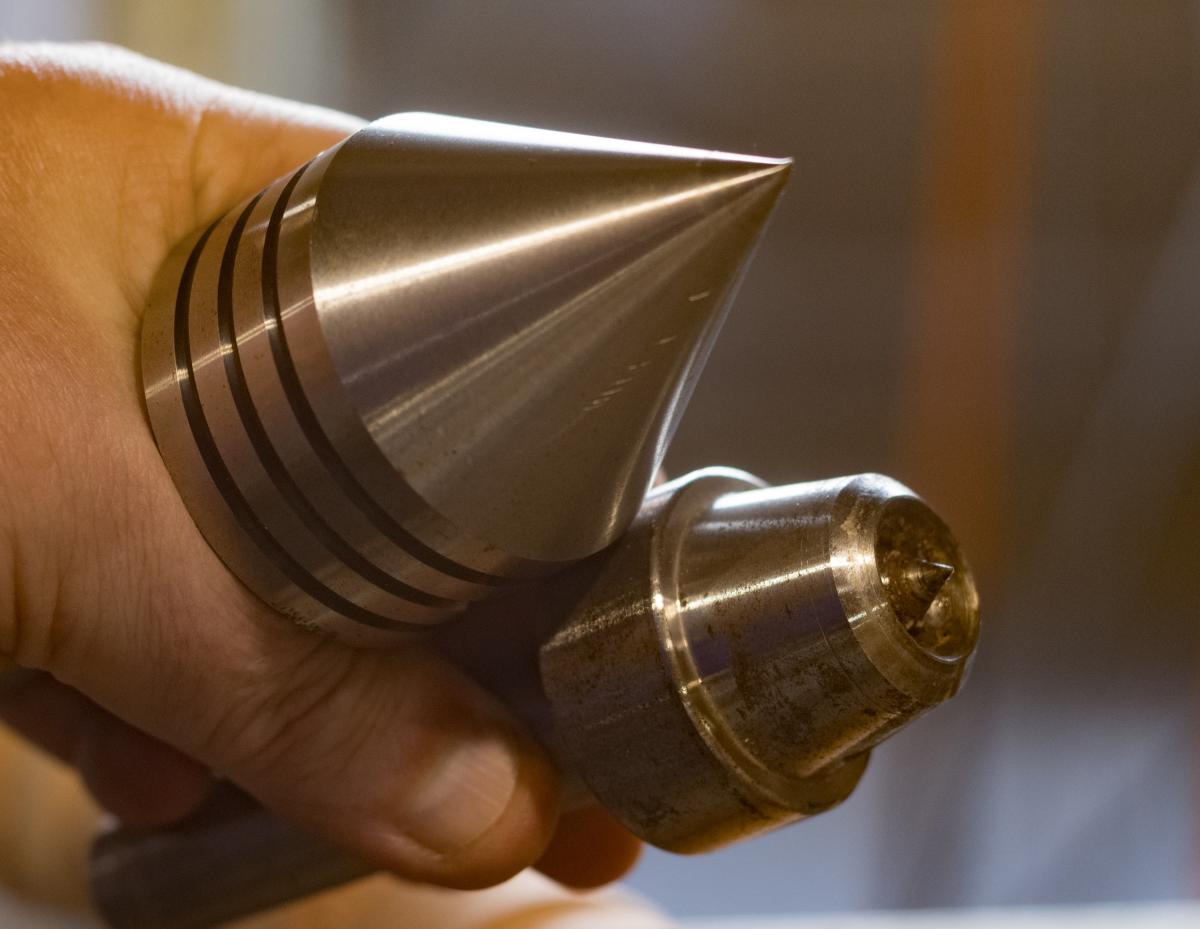 Left: 60 live center. Right: live cup center
I have previously written about the drive centers used on a treadle lathe. Today it's the tailstock's turn. The tailstock support does two things: the first is obvious - it keeps your spindle work from falling out of the lathe. The second, which is important even if you're using a chuck to hold a material, is that it prevents the end of the work from bending away due to tool pressure. In thin stock, this is very obvious that you want to support the material so it doesn't bend away from the tool as it cut. With large work held in a chuck, support from a tailstock center will help prevent the work from spinning out of the chuck if there is a catch.
The most primitive tailstock center is just a pointed bit of metal that the work can rotate around. Such a center is called a dead center, and is typically a steel rod coming to a 60 point. You can just put dead center in your tailstock and it will work. But in general, this isn't done anymore. The problem is that unless you keep the dead center continuously lubricated, the turning work creates a lot of friction and therefore heat, and you lose energy that could otherwise go for keeping the work turning. Before ball bearings became inexpensive, the aptly named dead center was a pretty common way of supporting work. I don't have a dead center for my treadle lathe - there is no point. I do have one for my metal lathe, but I've never used it.
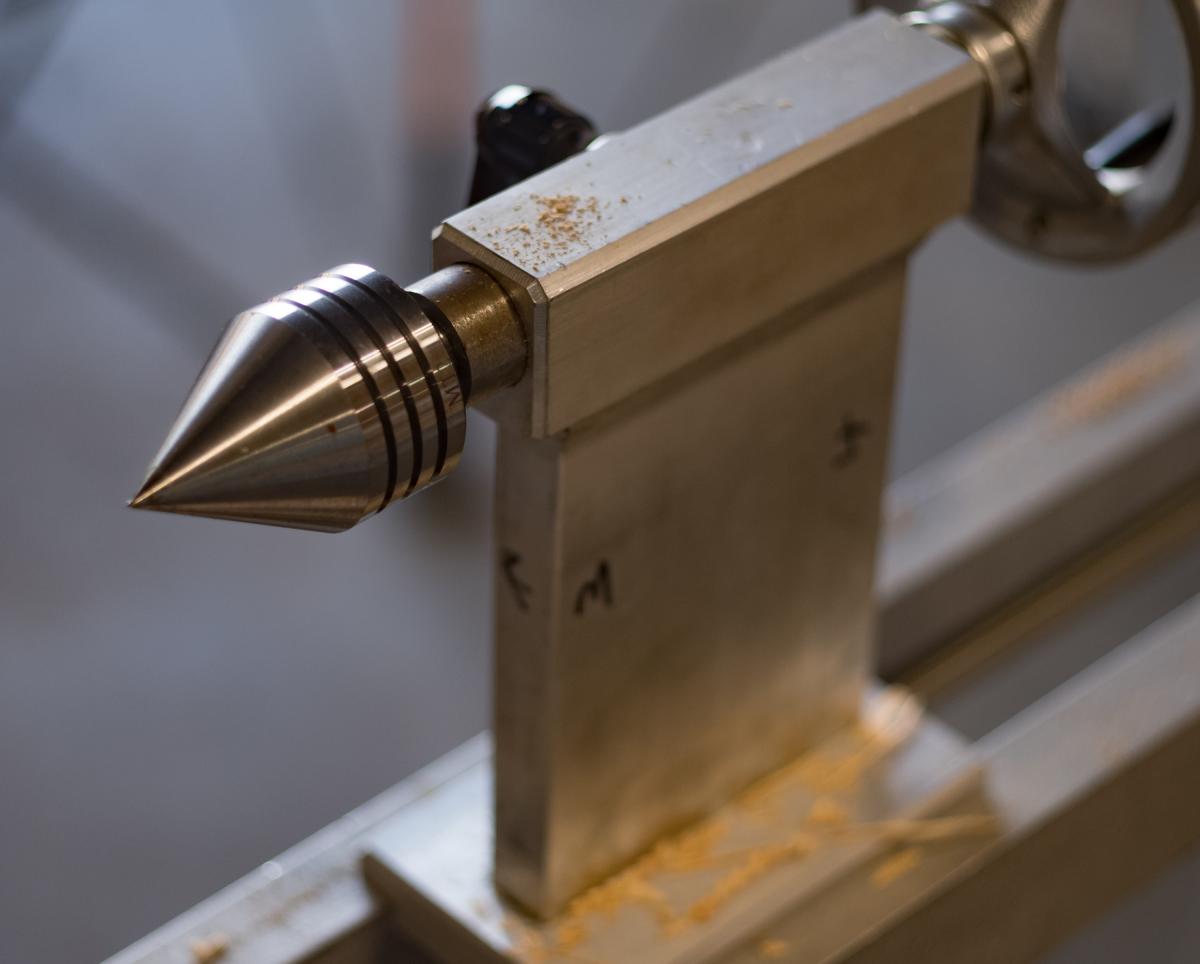
Once the 60 live center with a rotating cone was invented and became affordable, there absolutely was no reason to use a dead center. The typical live center is a 60 cone that spins. All you do is drill a hole at the end of your work, with or without an additional countersink, and the cone supports the work. Works like a charm.
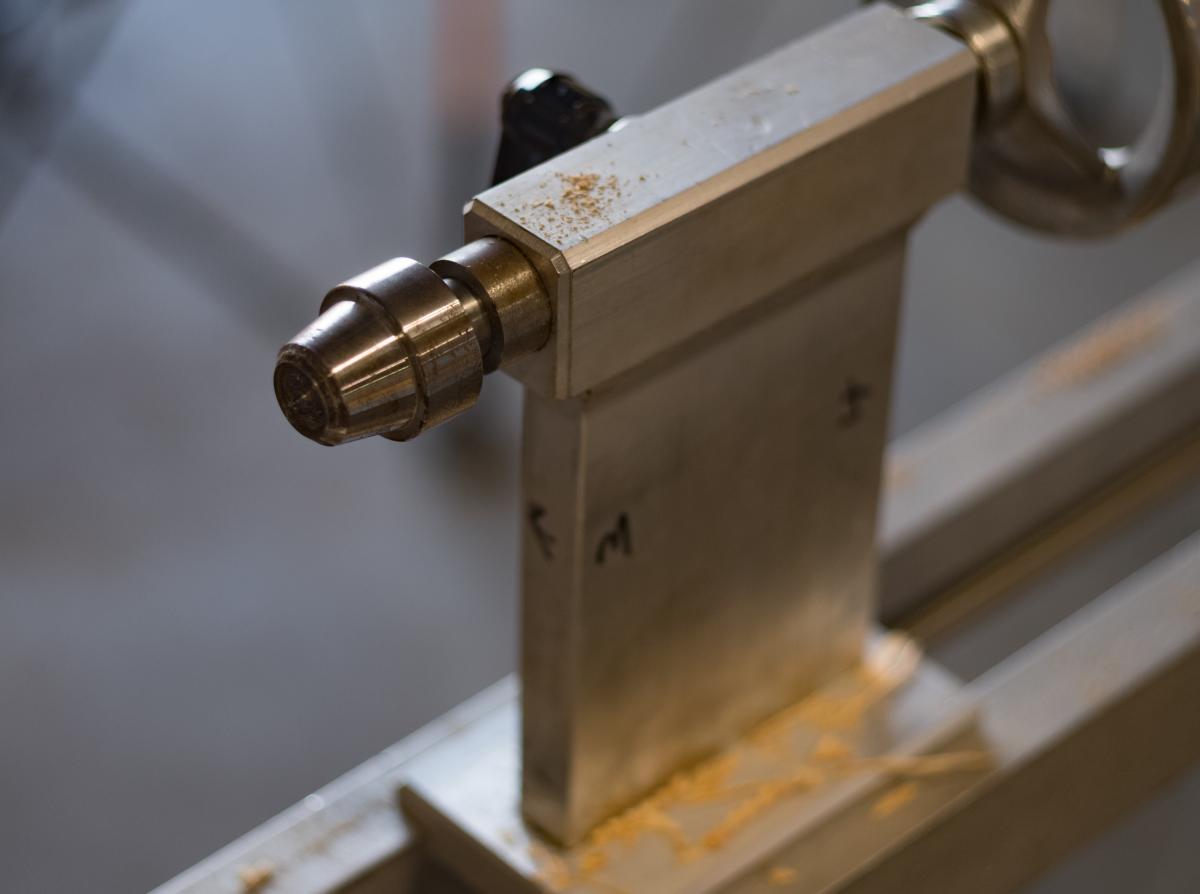
I don't use a 60 live center much either. The reason is that you have to drill a hole. Cup centers are more recent invention. That's what we supply with our treadle lathe. To use it, all you need to do is lay out the center location with a punch mark. The pin in the center of the cup registers on that mark. When you tighten up the tailstock, the sharp ring of the cup grabs the wood and holds it solid. That's it. No drilling. And it rotates along with the work like any live center so there's no friction problem either. I can't think of a reason not to use a cup center - except for two situations. First, if you're turning anything with a hole at the end, you can't locate a cup center. In this case, a regular 60 live center will just center itself on the hole just fine. This is actually pretty important when you're turning handles and other things that get drilled before you actually do the turning. The second case: if you're turning something that has a very small end. Our cup centers are 5/8" in diameter. This means if you want to turn the end of your work smaller than 5/8", you simply don't have the clearance. A typical approach is to leave a little waste at the end. But depending on how deep you put a center hole, a regular live center allows you to turn smaller at the end. The only problem I have with cup centers is that I find over time the ring wears in on the work and gets a little loose. So periodically I find myself having to tighten up the tailstock a little more.
One important advantage of a center - either style - is that it's repeatable. If you take work out of the lathe and put it back, the tailstock center ensures that the work will be aligned that same way as before.
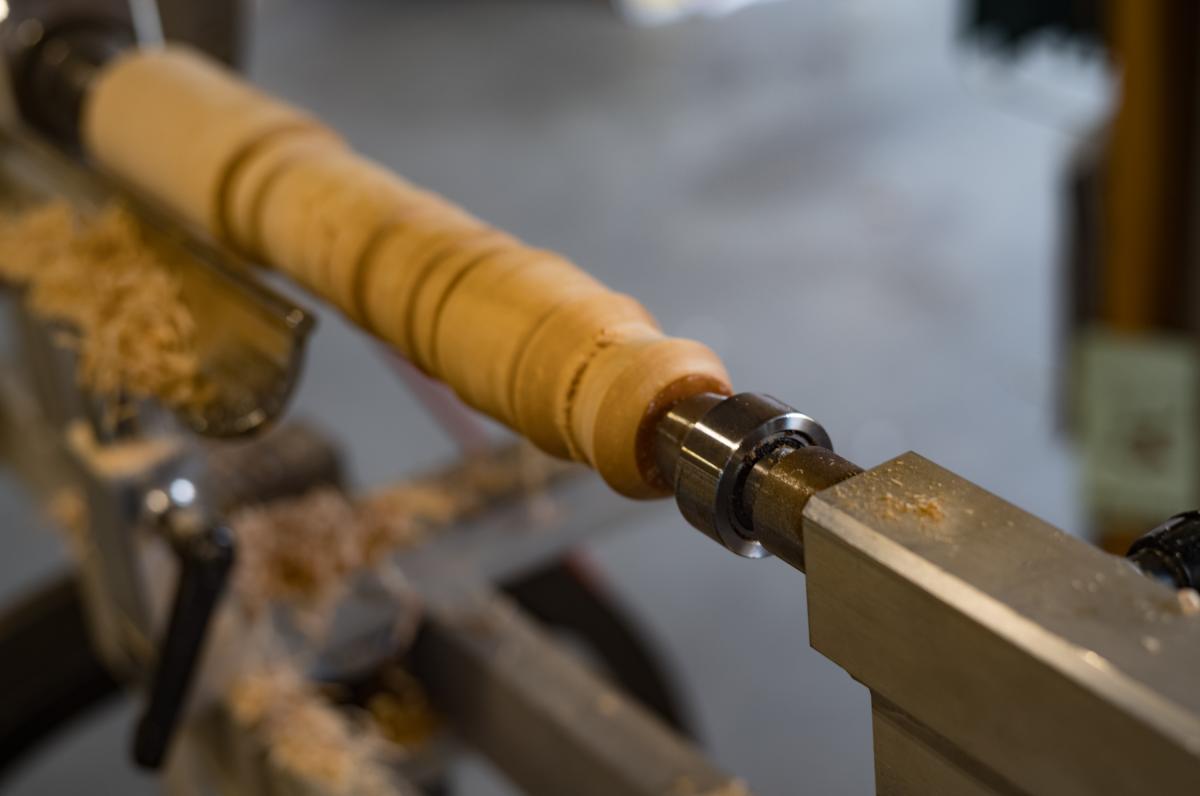 The cup center installed and in use
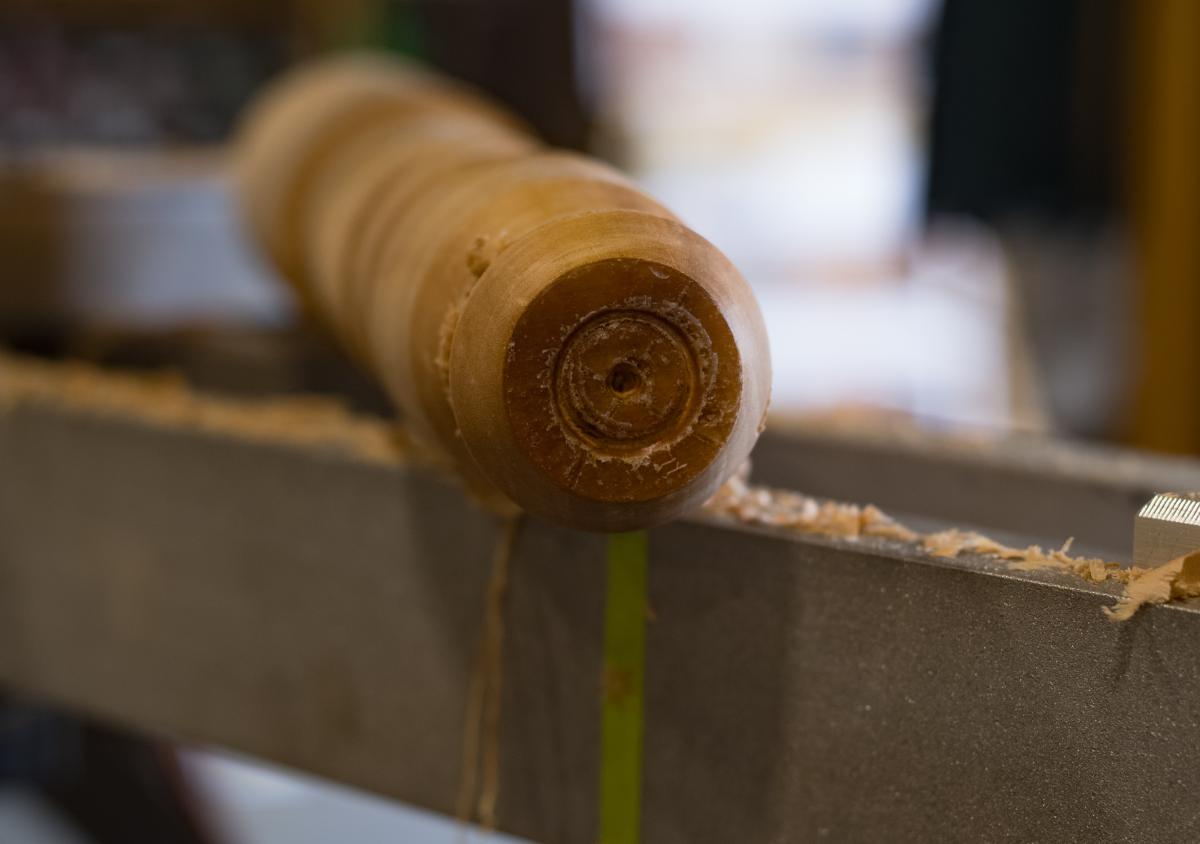 The ring cut in the work by the cup center. This particular stock was coated in wax - which is why the cut is so smeary
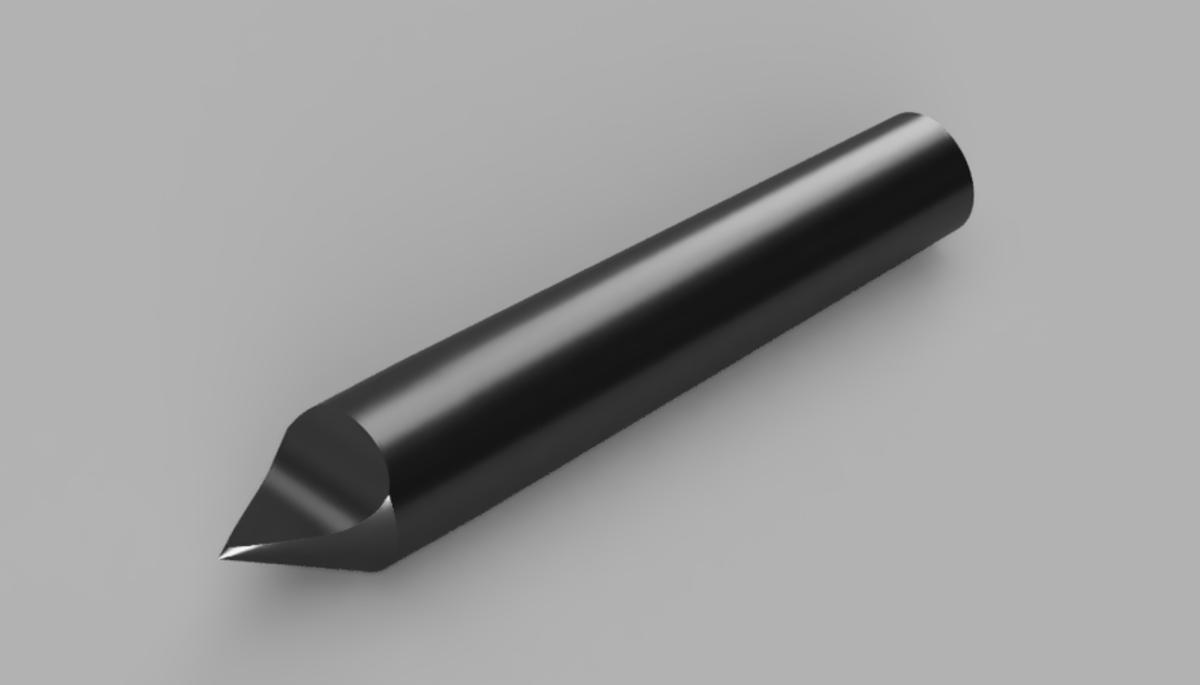 A rendering of a 1/2 center
This leads to a final type of center which I don't own. It's a half center. It's a dead center, so there's always that friction issue. You might want to avoid using it - except when you have to - but it has the top half ground away so you could actually turn right up to the center of the work without hitting your tool on the steel center. This is handy for small work. I would call this a specialty tool, and I haven't seen much commentary about it, but some vendors still stock them.
poor man's miter box(es).........
 |
| hmm....... |
Liking the look of the finish so far on this frame. One spot that isn't cooperating is the flats on the beads. I had to tilt the the frame to get coverage in there. It took 3 coats to barely cover it.
 |
| painting is done |
I'm calling this pic frame done, paint wise. It was still sticking to the blue painters tape so I'll let it hang out on the dryer for a few days. Once it isn't sticky anymore I'll spray on a couple of coats of shellac.
 |
| poor man miter box stock |
Going to try something different this time. I will start with making two boxes with 1/2" oak plywood and a scrap of 5/8" pine. I have a couple of 1x12 pine boards but I'm holding them for later. If these two work, I will make at least one more box with it.
 |
| first box |
Glued the back stop to the platform and clamped it to the tablesaw fence. It is dead nuts 90 between the two. I let it set in for 15 minutes and then screwed the back to the platform. The fence was long enough to clamp both boxes to it.
 |
| another jig |
This is a sawing aid for 90° vertical cuts. Made it out of an off cut of a 2x4 and pine scraps. One of my continuing headaches with making boxes is I (so far) can't saw a 90° vertical cut. This should ensure that I get that saw cut dead nuts.
 |
| change of plans |
Instead of using the newly made 90° jig I used a 1 2 3 block. Clamping the jig to the box and then securing the box in the vise wasn't working. This set up worked. I used my biggest carcass saw to saw it - there is plenty of saw plate under the spine.
 |
| 45 sawing aid jig |
This 2x4 has been hanging out in the shop for at least a year and it should be done with stupid wood tricks. If not I'll whack out another one. Sawed the the 45 on the tablesaw with my Osbourne miter jig. Wasn't expecting this to come out dead nuts on 45. The plan was to saw it out rough and sweeten it on the miter shooting jig.
 |
| hmm....... |
It was looking like I needed two 45 jigs - one for the left and one for the right. I didn't try to over analyze it but I couldn't see an easy way to make one 45 to do both R & L.
 |
| sigh |
I like this miter gauge a lot. I had bought it because Norm had one so I
had to have one too. That aside, since I've had it, whenever I saw an
angle when I set it back to zero it will be off. Will not a saw a 90. It
is relatively easy to adjust and set but it is an annoying PITA. BTW
the miter gauge has preset stops for 90, 22.5 and 45.
 |
| dead on 90 |
When I adjust the miter gauge for 90 I start with narrow piece of scrap around 6-8". Once that is square I confirm with wider scrap.
 |
| upcoming |
Both of my large routers need their irons sharpened, especially the closed throat one on the right. That is the one I use the most too. It wouldn't cut and make a shaving on the dadoes I made in the 90 and 45 sawing jigs. I'll deal with these two in the AM, not that I'm looking forward to that finger cramping, aching feeling.
 |
| my biggest non electric screwdriver |
I put two #12 FH screws in 90 and 45 jigs to secure the clamping board in each jig.
 |
| test time |
Try as I might I couldn't get the 45 jig and the miter box secured in the face vise. Clamped the 45 to the back and then secured the box in the vise at an angle. The 2x4 has a large registration face for the saw to bear against. Sawing at an angle wasn't issue as long as I kept the saw plate up tight and personal against the 2x4.
 |
| test frame |
No problems sawing the 45s R&L. Both looked good with no obvious hiccups. I sawed a test frame out of scraps I dug out of the shitcan. Based on this first frame I don't see this miter box having any longevity - it is just a frog hair above flimsy feeling.
 |
| dry fit |
So happy with this that I could wet myself. All four corners fell into each other naturally. I didn't have tug and pull any of them in close the miters.
 |
| glued and cooking |
I'll find out in the AM how well this behaved. Based on the ease of it clamping up I don't expect any headaches.
 |
| 2nd box |
Forgot to snap a pic of the 90 practice cuts. I checked both boxes for that and both were dead on 90. I'll saw the 45s in this one in the AM. I'll use my current miter box to saw out a couple of strips to glue on the bottoms to have something to clamp them in the vise.
accidental woodworker
bit the bullet.........
Last night after dinner I started a coughing fit that lasted off and on until I hit the rack. When I got up for the toilet trot races, I would cough trying to hack something that never came. The fits suck because there is no warning and the duration can go on for minutes. Still not bad because since the chemo the coughing has decreased to almost nothing. Today so far I coughed a few times but nothing like last night.
 |
| happy with this |
This looked 90% better with no streaks. However there were still light spots so another coat was necessary. I sanded it with 240 and 320 and fingers crossed, that I can call it done after this.
 |
| latex enamel rattle cans |
I couldn't get a semi or gloss oil based enamel in a rattle can so I settled for latex. I had to buy a quart first and then that was used to make up the rattle cans. I got 2 for $13 each plus the cost of the quart - total was $60. And he told me they could get about 12 rattle cans out of one quart.
 |
| hmm...... |
Started on the back because this was my first time applying a rattle can finish to a project. it didn't come out in a fine mist and I got a few blobs here and there. I smoothed them out with a small artist brush. Coverage wasn't full even with two light passes. Based on that I'm thinking 4-6 to cover the back. Might be more on the front because of the beading.
 |
| welsh stick chair |
I am impressed with the quality of this cherry wood. The seat (two pieces) are dead flat and they zero sapwood. This most have came from a big ass cherry tree. I got it in the living room sitting on a ottoman for now. I think it will live here until I'm ready to work it. Jack Nicholson quote -"nice packing...."
 |
| hmm...... |
I think the back is done. I couldn't see any bare pine anywhere. I got 4 coats on it and it looks good. I'll look at it again in the AM before I sign off on it.
Went for a walk today, the weather was decent. It 80F - 27C with a light breeze with no humidity. The walk I went on was less then half of what I was doing pre surgery. It was 4 times as long as the few walks I did post surgery and before the heat waves started. It took me less than hour and I didn't get winded nor did I have any coughing fits. The plan is to keep at this level and slowly build back up to the walk about I was doing pre surgery.
accidental woodworker
rough day......
 |
| hmm....... |
I don't have any clear shellac mixed so I used spray instead. I had 5-6(?) coats already but it didn't look like 3 brushed coats. No hurry for this and it dries super quick so I can get a bazillion coats on before I hit the rack.
 |
| better |
I brushed on a coat with the big brush on the bench and it look streaky. The coverage wasn't that good neither considering it was the 4th coat. I went behind it with this small brush and I liked the results. Streaks were gone, no waterfall drips, and the coverage was pretty good. Wasn't expecting such good results with a small piss ant brush.
 |
| bumblebee orchid frame |
I'm not making the same me-steak with this frame that I made with the green one above. I sanded this one with 120, 150, 180, finishing with 240. Baby butt smooth no matter where I checked on the frame. Still don't have a warm and fuzzy about painting this. I would like it to be an enamel - latex enamel IMO sucks pond scum for brushing.
Tomorrow I'll go to the local paint store and see if I can get a rattle can of oil based enamel (or latex enamel). I have seen rattle cans ordered there before but I've never asked for one. Will there be joy in Disneyland in the AM?
 |
| happy with this |
Laid down the paint with the big brush and then went over it with the small one. No problems with that even though it is only a 1/2" wide. And it didn't take much longer to do the frame with it vice the bigger one. Coverage is better than I expected too. There was a lot of light spots that are gone now. I will probably have to put on one more coat in the AM.
Spent a lot of today molding my butt cheeks into my desk chair. I was a lot more tired today then the previous couple of days. Got lethargic before lunch and I had trouble keeping the peepers open. The oncology nurse had told me that I would feel like this around 7-10 days out.
The nausea I felt yesterday is gone. It turns out that I was supposed to take a nausea pill twice a day - I was only taking it once in the morning. Feeling nauseous is an uncomfortable feeling that I can't work through. I can't work around the tiredness so I made several 10 minute work sessions in the shop today. Killed the lights for the day before 1400.
 |
| stick books |
These two books are from LAP and they are intense. They are everything
you wanted and didn't want to know about stick chairs. I've been
slogging through them for a couple of days now and it ain't easy. I
don't do well with printed learning, especially so with woodworking.
I'll be biting the bullet and getting Chris's vid on making a stick
chair. I do much better learning through visual anyways.
accidental woodworker
Kitchen Remodel – 2
Continuing on with the kitchen remodel on our 120 year old Japanese home. The site looks pretty messy in these pictures, but that’s what you get when you’re trying to live in a space while renovating. Every morning and evening I would open and close the blue tarp which became the only barrier to the… Read More »Kitchen Remodel – 2
The post Kitchen Remodel – 2 appeared first on Big Sand Woodworking.
an oops?..........
 |
| the bumblebee orchid frame |
This is ready for finish. What the finish will be I haven't decided on yet. I'm leaning in the direction of a rattle can finish. The thoughts on that is it will lay flat and look better then a brushed on finish. I was going to buy a few cans at Wally World but they keep everything locked up now. Besides the color palette sucked and the paint available was mostly metallic and for metal or plastic.
Made a 2nd run to the neighborhood paint store and that had infinitely more options but I didn't buy anything. I will wait until I get the orchid photo before I pick a color for the frame.
 |
| oops or a brain fart |
I don't remember if I had sanded or planed the frame before I made it. I think that is why it looks like a dirt country road after a rain storm. I spent most of the morning session sanding the frame, front and back, starting with 120 and ending with 320. Definitely looked better and felt smooth when I dragged my finger tips over it.
 |
| hmm...... |
Miters and the banding are sawn to rough dimensions. I worked on them one at a time started with the first long side and working CW to the last short side.
 |
| done |
Used yellow and super glue to secure the bandings. I rounded over the outside edges with a plane and sandpaper. The inside edges just got the arris knocked down.
 |
| one more |
I don't intend to go nutso on the back of this. There is some light spots still showing through but I am only putting on two coats and calling this side done.
 |
| cherry welsh stick chair |
This box is heavy. Even if I didn't have a weight lifting restriction, this is still heavy. I'm going to drag it into the living room and let it acclimate before hauling it to the shop.
It will probably be a while before I get around to this. The chemo cocktail is slowly saying hello to me. For the past two days I have had a faint twinge of nausea off and on with heartburn after I fill the pie hole.. Also feel just a wee bit out of sorts - not sick but not feeling tip top neither. I have run out of gas two days in a row now around lunch time. I don't feel dog tired fatigue, but I do feel like taking a nap. I'll spend this time reading the stick book and watching the video.
accidental woodworker
beaded frame pt II..........
 |
| confirmation |
Typing this blog last night I thought the back frame was too small and this AM it shook hands with me. Before I could make a replacement I had to make a road trip to Lowes.
 |
| not the first time |
I made the back frame to fit between the toes - wrong way. I should have aligned the heels of the miters with the layout lines. Like the caption said, this wasn't the first time I had brain farted doing it.
 |
| back to the shooting board |
The little gizmo I was using to square the miters wasn't working. I had kind of figured out a way hold the stock in the gadget but the results weren't that good. The 45 was ok but the face wasn't square. I still sawed the miters by hand but shot them true on the shooting board.
 |
| hmm....... |
This is the first back frame and it is still square within a 16th on the diagonals. Unfortunately I don't see any use for this for so I'll hang on to it until it gets in my way and I'll shitcan it. I had whacked this frame against the lally column and surprise, it held. I whacked it on all four miters twice and it held. I hadn't expected it to survive even the first one.
 |
| replacement back frame |
Glued and cooking. After this had set up for an hour I glued and nailed on the new pic frame.
 |
| not happy with this |
The paint is streaky and IMO, it looks like crap. I want the paint to be smooth and flat. Sanding it did diddly squat making it smooth. I'm going to have think about what to do with this because I can't put anything in this frame as is.
 |
| my desk glasses box |
This is the box I keep my desk glasses in. Lots of wiggle room and easy in/out with no headaches. Happy with the box but not how it fits here. There is another post at the back edge and the box barely touches/spans between them. It annoys me to no end when the box moves in falls in between them. Time to address and fix this.
 |
| new eyeglasses box |
Made this box long enough to span the top of it (what would you call it). I'm going fancy with it banding the top edges of the box with cherry.
Ran out of gas just before lunch and I nodded out. Not sure if it was because of the chemo cocktail but I went with the flow. One good thing I noticed is my coughing has gone down to almost nothing. Still getting winded with mild exertion but some things are changing for the good.
My desk kit came today and my wife struggled getting it onto the porch. I started to lift if and my body twinged immediately. I'll have to unpack it on the porch and bring the wood to the shop a few pieces at a time.
accidental woodworker
one more pic frame......(but something new this time)
I bought a photo print of a bumblebee orchid for my SIL's birthday which is the same day as my wife's. I doubt I'll get it finished and to him by that day but it'll be close. That is what I got whacked out today post one day from my chemo cocktail. It hasn't hit me yet and I'm taking it one day at a time.
 |
| done |
True to my word I got four coats total on the inside and top edge of both boxes. Still can't recall what I wanted to put in the smaller box but it won't go to waste with me.
 |
| yikes |
There was a puddle in this corner. I scraped it and it went back down to bare wood. Three coats on and it'll need another one just for this.
 |
| the frame for the SIL |
I'm going to try something new with this frame. I'm going to mold a profile on the outside and inside edges. I don't want a chamfer but a bead. First step is straightening and squaring two edges to rip out the sides.
 |
| hmm...... |
I molded a 3/8" bead on the outside edge. I didn't want the same size on the inside edge because the width isn't wide enough. I molded a 1/8", 1/4", and 5/16" bead on scraps and decided the 1/4" bead looked the best.
 |
| getting confused |
The print size is 12x16 and I want a one inch mat border so the length (outside) of each side needs to be roughly 4" longer. Started laying out the length and ran head long into La La Land babbling to myself.
 |
| hmm...... |
The length of the miter is 1 5/8" which is well within the 4" I allowed. But laying it out initially I was doing something wrong because the sides were coming up short. It almost got to the point of me making two new pieces - the longest sides would have been used to make the short sides.
 |
| new layout strategy |
Thought about it for a few and pulled my head out of my arse. I was confusing myself with the inside and outside measurements. The new layout strategy was to start on the inside edge and layout 1" from the heel of the left miter, measure 12" from that mark and add 1" to that for the mat border at the right miter. That is the inside length to the heel of the opposite miter. More then enough room. Don't understand how I missed it on the first go around but I finally solved it. Wash, rinse, and repeat for the 16" sides.
 |
| insurance |
Ripped a 12x16 inch piece of plywood to match the print size. The 12" side is spot on including the 2" allowance for the mat border. FYI - this is the crappiest plywood I have ever bought. Super light with paper thin ply veneers with only a wee bit of stiffness. Not even good enough for drawer bottoms and totally useless for a quick mitered box. Cheap and IMO useless but good enough for this purpose.
 |
| double, triple checking |
Used it to make sure the other side matched the results of the first one.
 |
| first dry fit |
The miters look good and the frame came together without any hiccups. The beaded corners aligned better than I hoped they would. I didn't have any chipped beads or blowout. When I sawed them I did them painfully slow and it paid off.
 |
| the proof |
The test piece says it all. The border is about a16th over one inch on all four sides. I had purposely sawed the lengths of the sides a few frog hairs longer for just in case.
 |
| test drilling |
Before I committed to the real frame, I drilled a couple of test holes. One was to check the depth and the other was the spacing/clearance.
 |
| first check is okay |
The spacing is good. I have clearance too - the dowel is well clear of the beaded profile. The depth was off. It was too deep and blew through to the other side. I had to drop the depth a 1/4" more to avoid blowing through again.
 |
| yikes |
Not quite a blowout but a frog hair away from it. I soaked it with super glue twice and fingers crossed it will hold.
 |
| 2nd dry fit |
Toes and heels aligned with no hiccups. Tightening the clamps can easily pull the heels and toes pass each other. The key for me to tighten one corner slowly, continually checking, and go to the next one. Don't do the final squeezing until all the corners are set and aligned.
 |
| glued and cooking |
After ten minutes in the clamps I took them off to wipe out the glue in the beads at the corners. Flipped the frame over and wiped off the squeeze out on the face of the miters. Clamped back up again paying attention and making sure the toes and heels were still aligned.
 |
| back frame |
I don't have any stock to make a poor mans' miter box so I decided to try and free hand saw the miters.
 |
| hmm...... |
I had to trim the heels on two miters to get it to close up gap free. I don't use this gadget that often because I find it awkward to hold/clamp the miter in it and still be able to trim the miter. For whatever reason, no headaches this time. I could see that I had sawn the miters a frog hair off plumb.
 |
| three times was the charm |
This corner needed extra love and attention. Finally got the miter to close up.
 |
| glued and cooking |
Happy with this considering I did it free hand. All the miters from the top are gap free. Can't see the bottoms because of the clamps.
 |
| less than a 16th off |
I think that is pretty darn good for my first free hand sawn miter frame. Just realized that this frame is toast. Happy with how it came it out but I screwed up and the frame is too small. I should have measures for the heels R/L and Top/Bottom but instead I measured ffrom the toes. Sigh. I'll be making a new one in the AM.
 |
| spoiler alert |
I was doing one final check on the miters before I set it aside to cook. Looking down on the face of the miters they were all tight and gap free. However, this corner when viewed from the edge had a gap. No problem closing it up with an assist from the bar clamp. The two frames will cook until the AM.
My cherry welsh stick chair kit has shipped but no arrival date as of today. Lee Valley got back to me and they are looking into the pricing for a replacement blade for my crosscut gents saw. Once I get that I'll send the current dull one out to be sharpened - I hope that is something that is possible. hmm.... maybe I should email customer service again.
accidental woodworker
The Art of Noise
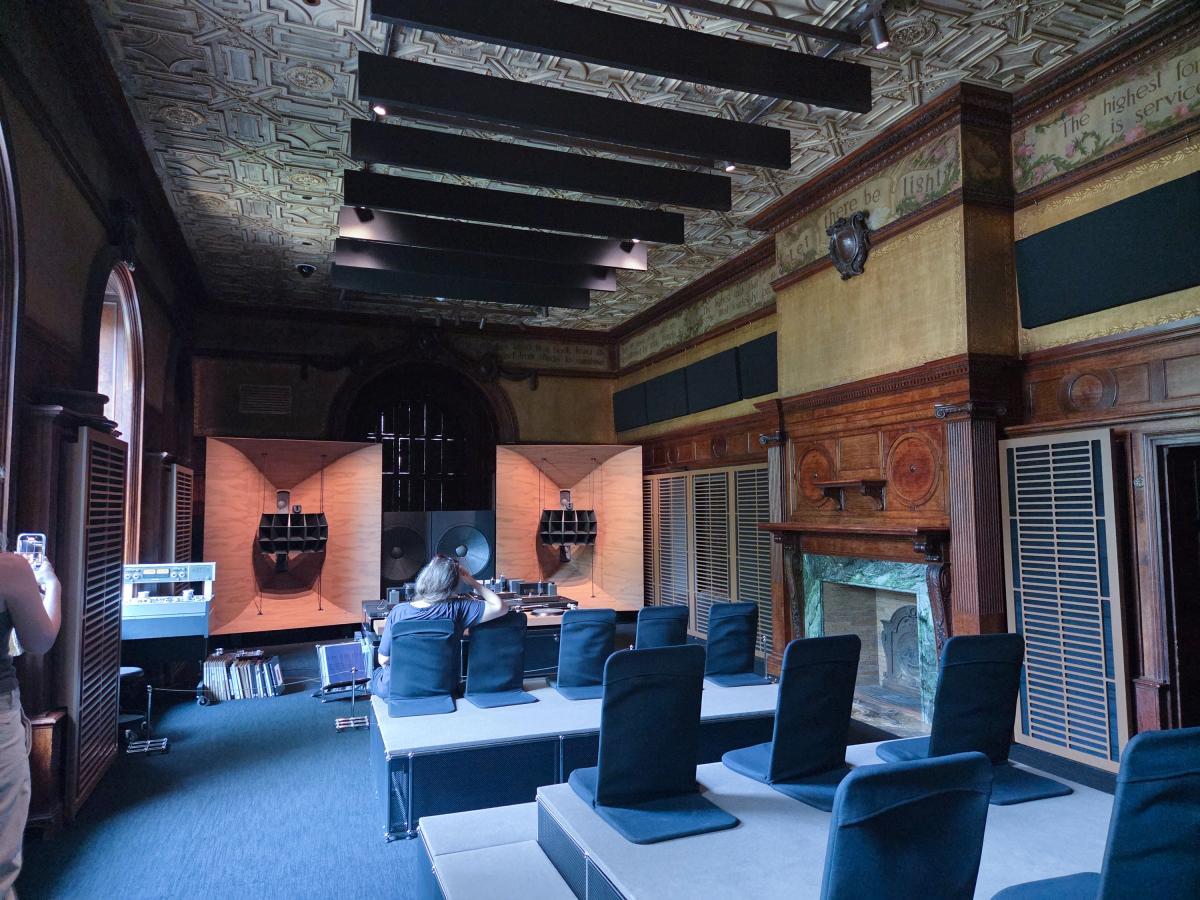 "HiFi Pursuit Listening Room Dream No. 3"
I just heard a spectacular sound system that was set up as part of an exhibit, The Art of Noise, at the Cooper Hewitt Museum a Smithsonian museum that focuses on design (above). The exhibit "HiFi Pursuit Listening Room Dream No. 3" by Devon Turnbull is a state-of-the-art listening system set up in one room of the spectacular Andrew Carnegie mansion in which the museum is based. The sound is powerful, crisp, with an articulated bass that I have never heard before. It was awesome listening to it. The room was totally subjugated to the requirements of the sound. Baffles were hung from the ceiling; sound absorption cushions were hung covering the awesome carved paneling that I could have spent hours looking at. The seating was nondescript although comfortable enough. The front of the room had two giant woofers; I'm not sure how the rest of the stuff in the middle works. This is a system costing many of hundreds of thousands of dollars. And yet - in a typical failure of design that we see in so many audio systems - the beauty of the room was hidden and the records, the heart of the system, were on the floor leaning against a soundboard.
The first floor of the museum included furniture pieces as exemplars of great artifacts of design. But "The Art of Noise" drew the bulk of attendees because furniture is increasingly something most people don't care about. Furniture has become a disposable purchase. It's something most people don't pay attention to (with rare exceptions, perhaps including you). This is why Ikea is so successful. Their furniture is intensely practical at the cost of elegance and longevity.
What we do care about is gizmos. The television was a very important one, with whole rooms designed around a giant screen. But as The Art of Noise documents, beginning in the early in the 20th century, and reaching a height in the 1970's and '80's, sound systems became important elements of the home. People set up phonographs, radios, and speakers in their living rooms and dens.
The exhibit has some of the more interesting stereo systems of that era.
When you design something, it's usually pretty important to figure out before you start what features are important. In the system by Turnbull, it's pretty obvious that the system was designed purely for the best sound, nothing else. Sound quality in the systems shown below took a back seat to convenience, modern elegance, and looking high-tech and expensive. (At least this was my perspective. The museum described the exhibit as "designed to envelop the listener in sound that is as rich in texture as it is in emotion, [so] visitors will experience realistic, natural sound from Turnbulls sculptures and a chance to slow down and engage deeply in listening.")
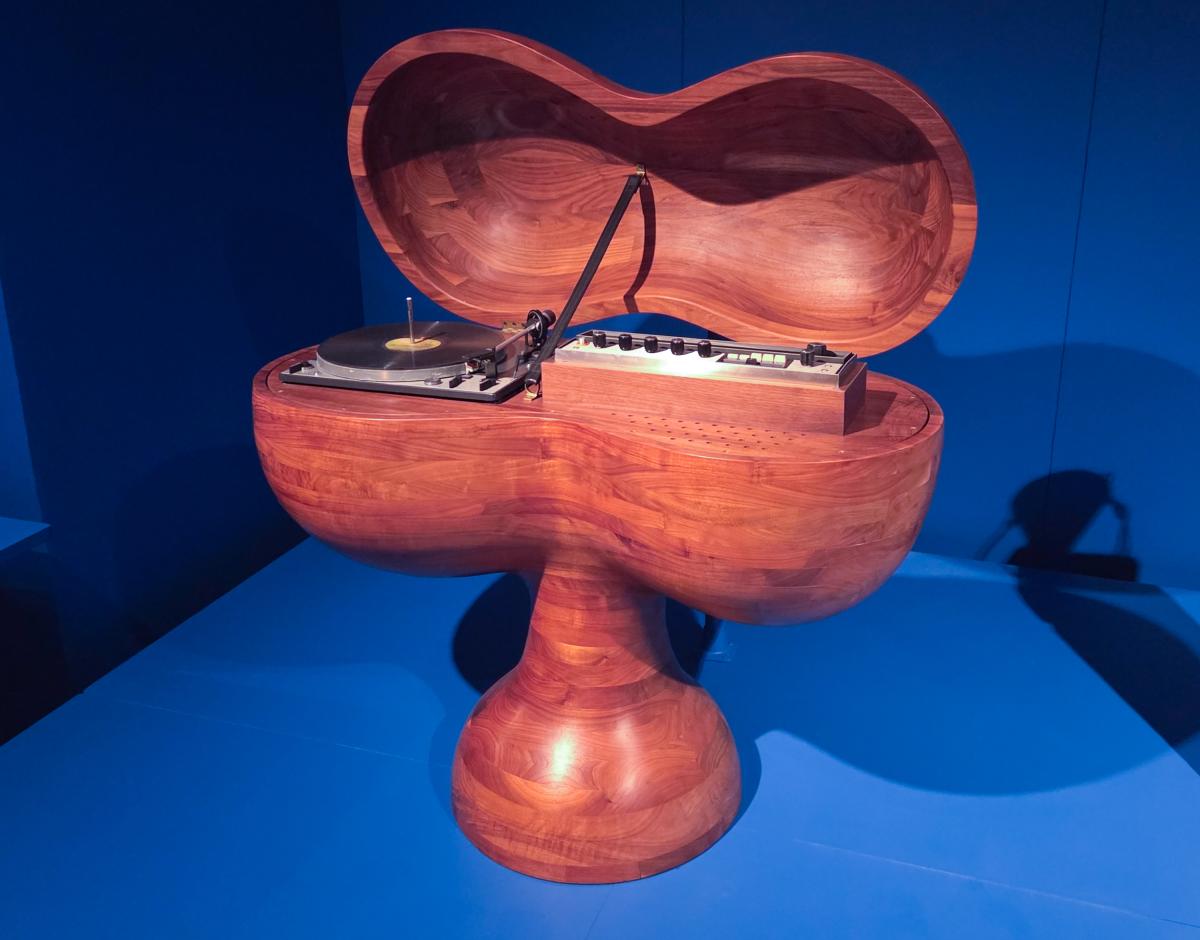 "Stereo Chest"
Most of the equipment shown below were by international manufacturers of audio equipment, but two boutique systems stand out. The walnut "Stereo Chest" (1973) by Wendell Castle fits right in with the rest of his work at the time, but it's not really about "sound" per se. When closed, the chest even conceals its purpose. To me it looks like a drinks cabinet that someone converted for audio.
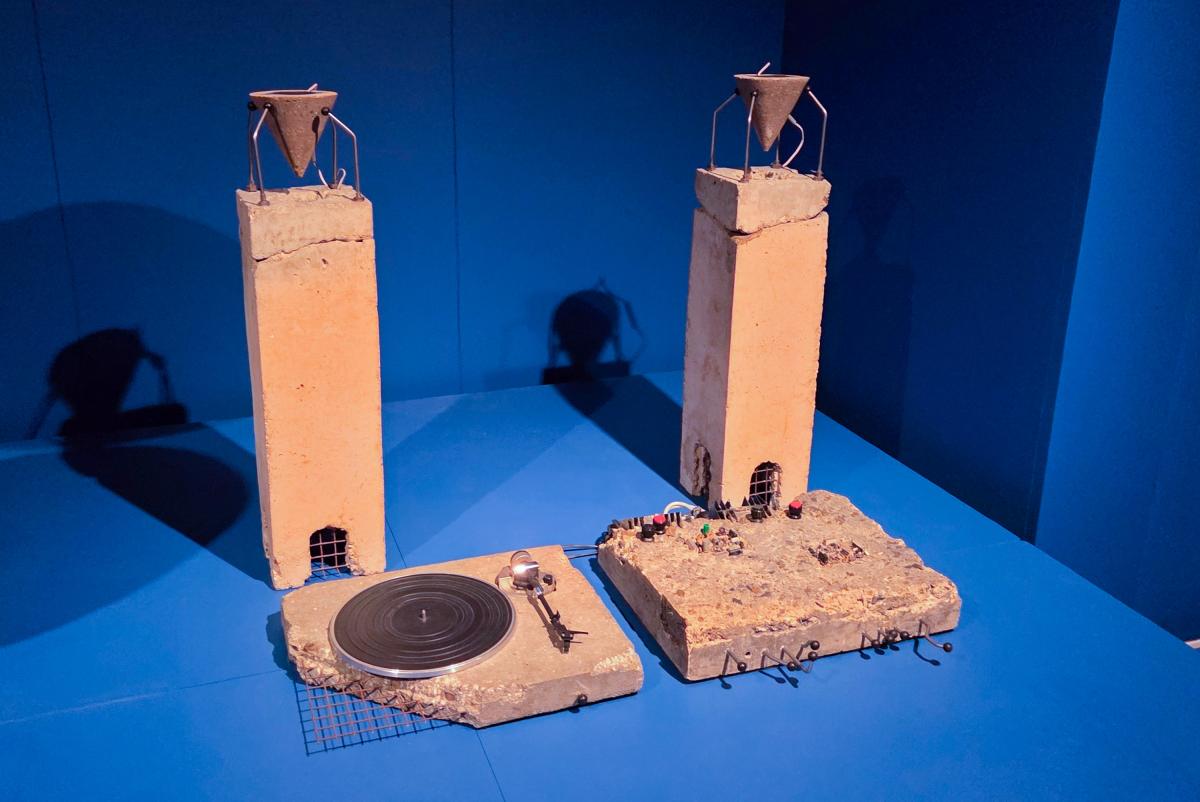 "Concrete Stereo"
Next door to the Castle chest is "Concrete Stereo" (1983) by Ron Arad. The setup includes a turntable, amp, and speakers. Again the artwork seems less about sound than visual interest. While it's not to my taste I think it's pretty cool.
The other images of these sound systems are more futuristic than what most people had, but I find them compelling. In general these packages do not sound as good as audiophile systems of the time, where the emphasis was on sound, rather than looks or convenience.
 "SoundSticks"
The SoundSticks from 2000 are a fun stopgap between then and now. Designed by the Apple Industrial Design Group for Harmon Kardon, it was one of the cooler attempts at smaller "bookshelf" systems for people without the floor space for a full-sized system.
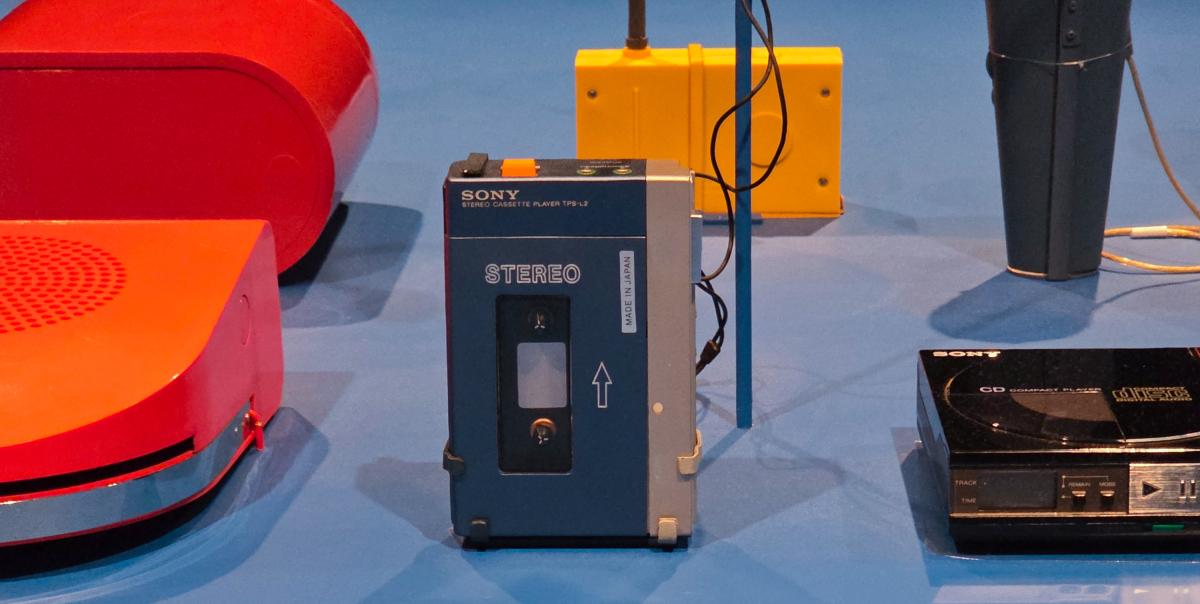 TPS-L2-Walkman
The death knell for common sound systems first rang in 1979. Inventors had tried to make music portable since the 1930's, but the introduction of TPS-L2-Walkman and headphones made portability a reality. Sound became personal, and that changed everything. Music didn't need to tie you down to a specific room or location: you could bring it with you. And because the format was a cassette, you could mix and match your own music. What you listened to became yours and yours alone. This phenomenon was the tip of the iceberg. Later came the Ipod and of course phones. While I still prefer listening over speakers, and the Turnbull installation shows how involving that can be, most people listen to music as a portable, personal experience.
The exhibit included a vast range of portable music devices in addition to the Walkman. The exhibit also had a room with some wonderful concert posters reminding us that live music is still awesome. This collection included some very memorable posters - I know I won't soon forget the poster for a James Brown at the Apollo that featured the astonishing assertion that the show was suitable for all families.
I mostly rate art by whether or not I want it - how willing I am to wallow in covetous feelings. I own a decent stereo system, and I have a lot of records I don't play anymore now that I stream. I didn't really covet anything in the show except I wish I'd gone to those concerts listed on the posters. Even the awesome system on the first floor: I can't imagine turning a room into something like that. The equipment's just too big. But everything was fun to listen too, and see.
The show was supposed to close over the weekend, but has been extended through August 16, 2026
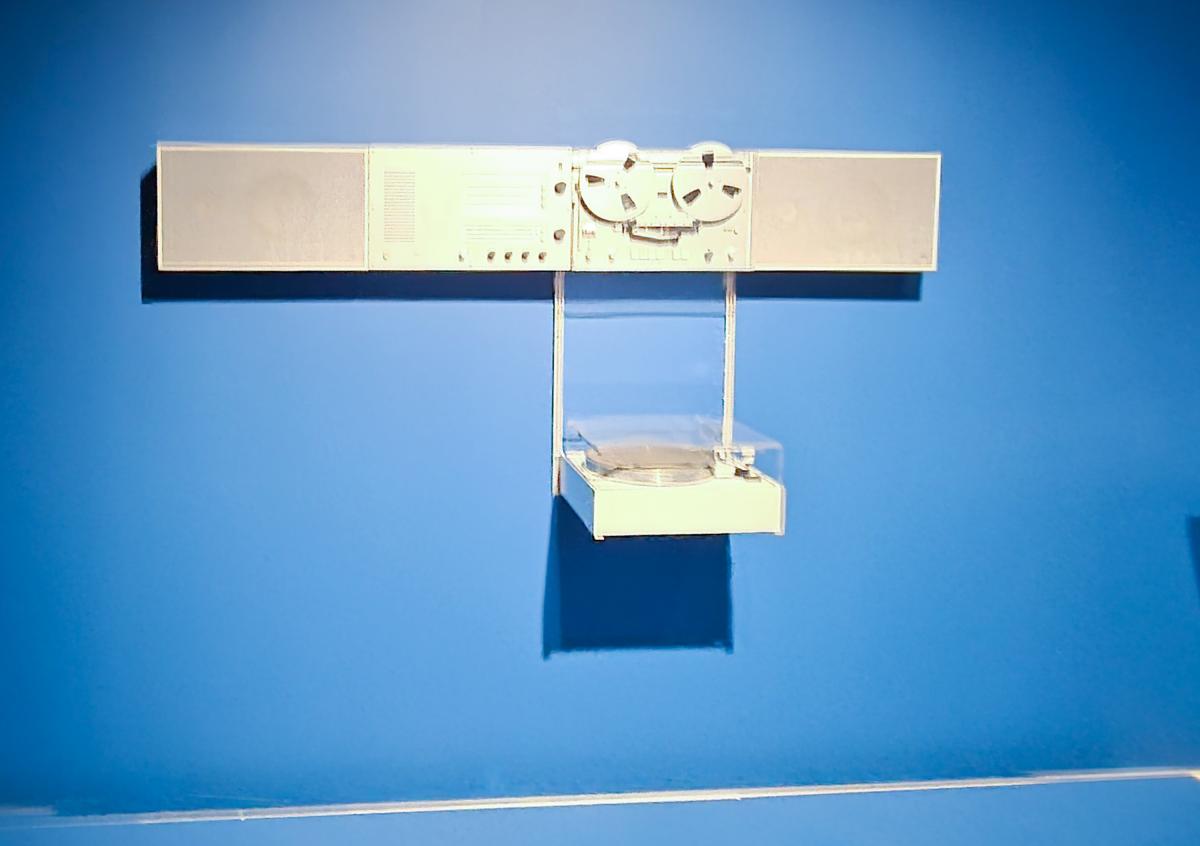 Designed by Dieter Rams, 1962-1965, and manufactured by Braun AG
 Center: RR-126 Radio - Phonograph 1965, by Achille Castiglioni and Pier Giacomo Castiglioni. Manufactured by Brionvega S.p.A. Right: Vision 2000 Cassette Player and Radio - 1971 - Thilo Oerke Manufactured by Rosita Tonmobel - Audiorama 4000 Speakers 1972 designed and manufactured by Grundi
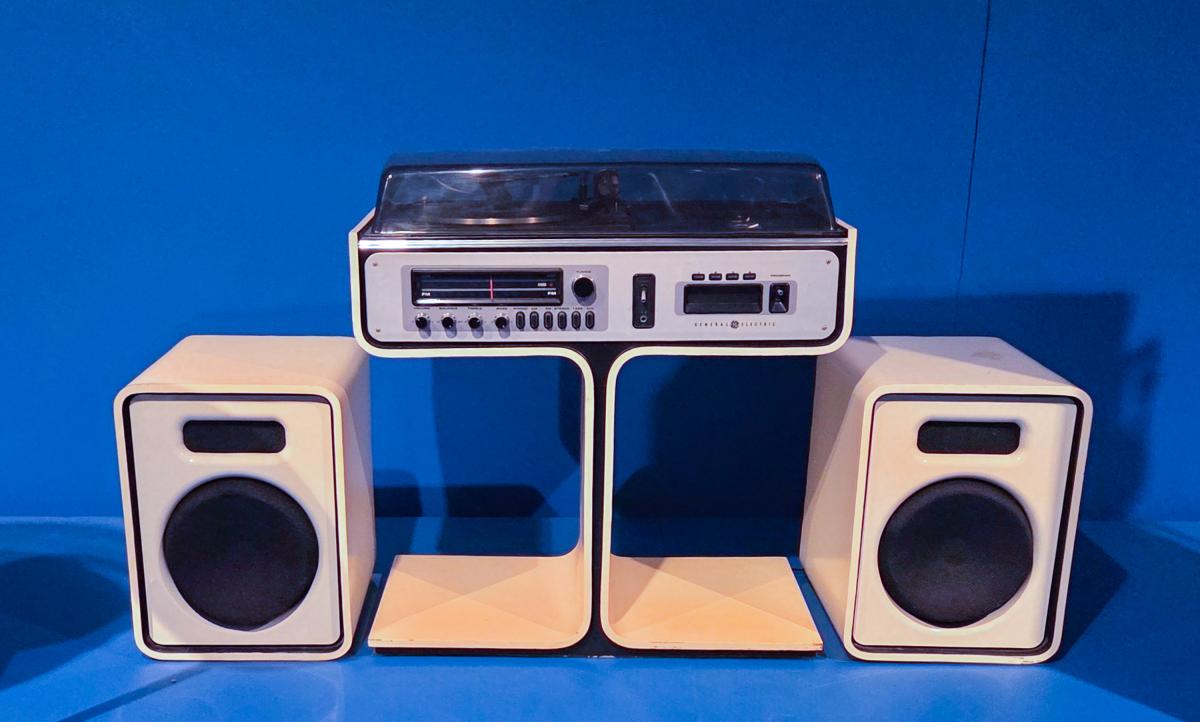 SC7300 Stereo System 1973 designed and manufactured General Electric Company
 The wonderful main hallway of the Cooper Hewitt Museum, formerly the Andrew Carnegie Mansion
 needs a 3rd coat.......
 |
| nope |
The hole in the arm doesn't line up with the hole on the frame. The screw had come out at an angle when I unscrewed but I didn't give it a second thought. Still don't know if the screws are imperial or metric, but the one I picked out screwed down in the right hand arm with zero headaches.
 |
| an hour later |
I couldn't get the screw started in the left hand arm at all. I tried filing it but it was slow, careful going. There wasn't much metal that I could file off and it was a bit awkward maneuvering the file to remove what metal I could. Gave up after an hour - I couldn't get more the 1/2 of the two holes aligned. How did the person who assembled this get the screw installed?
 |
| hmm....... |
After dinner last night trotted down to the shop and steel wooled both of the boxes. No headaches with that. Both boxes came out smooth to the touch and the amount of steel wool dust was about what I expected to see. Slapped on a third coat and trotted back up the stairs to my desk.
 |
| the green frame |
This had the slightest bit of tackiness in a few spots - all where the paint looked to the heaviest. I scraped the inside/outside bandings and the tops of them with the card scraper first. I was careful painting this but there were still spots with waterfall drips. Scraping is quicker and gives better results over using sandpaper or steel wool. I also used the scraper on the flat part of the frame before using 320 sandpaper to smooth it all out.
 |
| much better |
Yesterday when I used 320 on the back it didn't look like this. There was so much green it was hard to see the brown underneath it.
 |
| needs a 3rd coat |
I can still see the grain under the 2nd coat of paint. I'm not going for a wash look, I want this to be a solid green. I'll let to set until tomorrow. There are thunder boomers rolling through this PM along with high humidity - that effects how this will set without being tacky.
 |
| done today? |
Got 4-5 coats on the bottom and the sides. 3 coats on the inside and one on the top edges. The plan is to get 2-3 more coats on it today and call it done by the AM.
Had my first chemo cocktail today. It took over three hours and consisted of two infusions. The first one took 10 minutes and the other took 40. The total time expended was due to ordering and waiting for it to get to me.
I have about 7-10 days before the chemo kicks in and really introduces itself to my body. Nausea and fatigue are the two side effects (of a potential boatload) I'm most concerned about. The nurse said the fatigue will come in about 7-10 days and that I should stay out of the shop and rest. She said to listen and obey what my body is telling me.
I have blood work on July 30th to baseline my blood for the first chemo treatment and the 2nd chemo cocktail party is scheduled for the August 11th. That is dependent on what my blood work is on that day. Before the chemo the doc reviews the blood work and that drives whether or not I get the cocktail.
The brain MRI came back normal and I forgot to ask the doc about why it was ordered. Maybe on the next appointment. The shortness of breath is still saying hello and I had way fewer coughing fits yesterday and so far none today. My heart rate continues to stay in the normal range with excursions in the low 90s (with exertions) for about two weeks now. The 'blister' on my chest is slowly getting smaller and it is sure taking its time going bye bye.
accidental woodworker
good shop day.......
 |
| not last night |
After dinner when I checked this it was still tacky. Got the 2nd (and final) coat on it this AM. I tried to sand it with 320 grit and that didn't go well. It wasn't tacky to the touch but the sandpaper grabbed and stuttered like it was. I'll have to let this set up for while before I try that again.
 |
| found the MIA center punch |
I spent almost an hour sifting through the shitcan trying to find it. Got this sent out this AM. I still don't think it is worth to try and fix it but he is willing to try doing it.
 |
| a protector |
Drilled a scrap of cherry for the pointed business end of the punch. I mailed this in a padded mailed and I didn't want it poking out during transit.
 |
| new box |
This is for my eyeglasses. The black framed ones that will call this home are as long as these are.
 |
| they fit |
I made the box longer for extra wiggle room. Thinking of putting some felt on the bottom. I have some red felt somewhere in the shop but ........
 |
| hmm....... |
The box the eyeglasses are in now was for something else that I forgot what I had made it for. The glasses fit diagonally but there is little wiggle room. New eyeglass box is wider and longer than it.
 |
| prepping the box |
I let the box cook for a couple of hours before planing and sanding it smooth.
 |
| still viable????? |
This shellac is almost a year old. I stirred it with the stick, wiped the excess off and it set up and dried within a few minutes. I wasn't expecting it to be good but based on this I'll slap 4-5 coats on the two boxes.
 |
| stopped working |
I can't reset the breaker on this plug. I tried it in 4 outlets, all with the same result. Nada.
 |
| WTF?????????? |
The screw heads are triangular. I have never seen a triangular screw head before. I tried to use my smallest screwdriver set and a torx set to unscrew it and nothing worked. Rather than trying to fix this, it became dumpster food.
 |
| so far, so good |
The first is on and appears that all is well is Disneyland. It is dry and rough to the touch which is what I expected the first coat to be. I'm curious to see what happens when I steel wool it after the 2nd coat.
 |
| ready to do battle |
I had two poor man miter boxes that are toast. The cut across the top is good but the vertical/plumb cut is toast. It tapers and wanders off on towards the bottom final third. I filled in the errant cuts with veneer and soaked it with super glue. Laid out two new miters and sawed them.
 |
| crash landing |
I gave it free flying lessons courtesy of RJB airlines. I sawed the vertical and the saw wandered off the vertical line on the bottom final 3rd. I tried like crazy twisting the saw blade to track it on the line but it had a mind of its own. It was going out into La La Land and nothing I did would stop it. That earned it a first class ticket trip to the wall.
 |
| hmm...... |
The left miter came out better. I still didn't get a plumb cut, it wandered off into La La Land further down, closer to the bottom. The miter wasn't bad but it wasn't 45 neither. The heel was a few frog hairs high.
 |
| this sucks |
The front saw cut split the line perfectly but the back threw a hissy fit. I know I can saw better than the results I'm getting. I'm taking my time eyeballing the line and when see it wavers and I try to correct it but no joy trying that yet.
 |
| the best one |
This is the best miter I have gotten off any of the miter boxes I have made. Not a dead nuts 45 but within a frog hair or two. I always saw the left miter better than the right ones.
It isn't that big of a deal because I sweeten the miters after sawing them on my shooting board. However, there have been times when getting a miter directly off the box would have been easier to deal with. Doing the back frames for the picture frames would be good example of off the miter box.
 |
| finding the cause |
Used my small Starrett square to saw the vertical. It helped but I couldn't use it to do the entire vertical saw cut. The bottom wandered off of course but in the final 1/8".
 |
| better |
It is a little less then a frog hair off. This was encouraging and it dawned on me that maybe it isn't me but the saw. Saws will wandered as the dull and I've had this one for a few years.
 |
| dozuki saw |
The backside of the cut is off the knife line a wee bit. However, Mr Starrett said that this and the off cut was 45°.
 |
| 2nd saw |
This is my LN carcass saw and again, Mr Starrett said both cuts were dead on 45.
 |
| another carcass saw |
This is the LN tapered carcass saw. I rarely use it and I bought it when my other LN carcass saw was out getting sharpened. Same results according to Mr Starrett.
 |
| LN dovetail saw |
This was making me feel a lot better. I knifed the top and the front and back vertical and sawed out on them. Mr Starrett says I have a very bright green light on this one too.
 |
| Lee Valley rip gents saw |
I wasn't expecting this but Mr Starrett said there were zero gaps and no light peeking through. I thought the rip saw would have left a rougher kerf but it didn't. The higher TPI definitely helped with that.
 |
| Blue Spruce dovetail saw |
All are sawing 45s and no wandering at all with any of the saws so far.
 |
| LN rip carcass saw |
This was eye opening for me. All this time I thought it was me and having to deal with parallax errors and saws I couldn't saw plumb with.
If I counted right, I used 9 saws. The Lee Valley crosscut gents saw was the only one that failed to saw plumb. The other 8 saws I used all sawed dead nuts 45 miters. I emailed Lee Valley to ask if they sold replacement saw blades for the gents saw. Glad I tried this and I'll be making another poor man's miter box with one of the 8 good saws.
 |
| hmm...... |
2nd coat on and dry within 5 minutes. I'll come to the shop after dinner, steel wool this, and slap on a third coat.
 |
| lights out delayed |
I was killing the lights when I noticed this corner was misaligned. I had to fix so I planed it and sanded it with 120 grit.
 |
| sigh |
Two other corners were off a little too. Planed and fixed them and applied another coat of shellac.
 |
| came while typing the blog |
This is not too bad of a deal for $10 bucks. What are the odds that this has the screw I need. I think these are metric but I'm not 100% sure of this. I don't recognize the sizes printed on the lid of the screw box.
accidental woodworker
day of rest.......
 |
| last step |
120 grit to flush the putty on the back frame. The next batter was picking a paint color.
 |
| nope |
These are the powdered dyes for milk paint. I thought of mixing up a batch of milk paint but the frame was all I had to paint. Most of it would have been wasted.
 |
| the final three |
Black was my first thought but I nixed it. Instead I picked green. That had been choice for milk paint too. I picked chrome green and for whatever reason it wasn't the color I expected. It was green but the 'chrome' part didn't materialize. I had expected it to be shiny like an enamel paint but it wasn't.
 |
| sifting through the garbage |
One of the readers of my keyboard diarrhea offered to fix the center punch that came with the Vix bit set I bought. As usual, I couldn't find it. I look in all the obvious places first and nada. Looked every else and settled on the shop shitcan. I don't remember what I had done with it but I went through the shitcan thinking maybe I had shitcanned it. I transferred from the right shitcan into the left one. I filled that up 4 times to a weight I could pick up without feeling it. So far I hadn't found the MIA center punch.
 |
| no joy |
I made sure that I sifted all the shavings through my fingers so the punch wouldn't slip by unnoticed. Clueless as to what had happened to it. I'm sure it will pop up when I'm reaching for something totally unrelated to it.
 |
| hmm...... |
It has been more then 3 hours (closer to 4) since I put the first coat on and it is still tacky. Today was nice, temps in the high 70s F - ~25C with low humidity. The can says recoat in 2-4 hours. I'll check it again after dinner and if it isn't tacky I'll get the 2nd coat on. If not then in the AM. I have the time because another project hasn't grabbed my limited attention span yet.
 |
| Grrr.......... |
The glasses fell off when I put them on. Where the screw is, is a mystery. I had tightened both of the frame arms screw a couple of weeks ago. None of the screws in the eyeglass kit fit. I'm glad that I have spare glasses to use in the shop. I need them for close up work. I ordered a kit of eye glass screws from Amazon and I'll have them tomorrow.
These are reading glasses and I prefer to use them in the shop. The replacement glasses I'm using in the interim are bifocals which are ok but they are delicate wire framed set. Not something that can withstand the abuse I heap on my eyewear in the shop.
I took it easy today because I was feeling bone, weary tired. Plus I was having coughing fits off/on through out the day. For no reason I could discern, I would cough feeling like I wanted to hack up chunks of my lungs. Makes for doing absolutely nothing a ROYAL PITA.
Other then the coughing fits, I still have the blister, blob, bump, or whatever it is still on my left chest. It doesn't look or feel like it is getting any smaller nor wants to. But on a brighter note, my left boob/nipple isn't as tender/sore/achy. There were a few weeks that my shirt brushing on it could make me almost cry. Healing is taking a longer time than I thought it would.
accidental woodworker
coulda, but didn't......
The forecast for today was partly sunny and cloudy with thunder boomers possible in the PM. The morning was overcast giving way to some sun with no rain before lunch. I could have made a run to Gurneys Sawmill. This is one time when have a cargo van would have been worth its weight in gold. Fingers crossed that next saturday will be sunny - I need project wood.
 |
| my A2 iron set up |
I've had this red bin for over 40 years. It was one of the first things I bought from Lee Valley. The water stone holder for it is rusted and unusable so I made a wooden one that I brushed on penetrating epoxy from Total Boat. The bin to the right has the water stones soaking - 220, 1000, 4000, and 8000.
 |
| 5 1/2 done |
Got RML shavings on the first try. Barring the bevel chipping again soon I'll be good for a while.
I am not a fan of A2 irons. It is a PITA setting the stones to sharpen them although it isn't any more difficult to use them vice other sharpening mediums. However, and this is just my opinion, I find the bevels on A2 irons to be more fragile than O1. They fracture and chip easily.
Lie Nielsen doesn't make 01 irons anymore. I'm lucky that I have O1 irons for my 4 1/2 and my 51 shooting board iron. The big difference between A2 and O1 irons is A2 tends to stay sharper longer. O1 sharpens better and to a finer edge and it is what I prefer.
 |
| clean up |
This one thing about water stones that I dislike a lot. I have to flatten all the stones after I'm done. And depending upon how much I use them while sharpening, I have had to flatten while in use.
 |
| a wee bit short |
One side of the back frame was short by about a 1/8". I didn't want to use the one long pine board I had so I used some scraps. This is the back and won't be readily visible but it was making my OCD go into hyper drive.
 |
| fixed |
Used my 5/8" shoulder plane to flatten the proud side flush with the other ends.
 |
| almost done |
Set the nails and filled in the set nails with putty. All that is left to call this done is to paint it.
 |
| oops |
Forgot the nails on the outside banding. I used pin nails that are supposedly invisible. Well boys and girls, I have zero problems seeing them. Set and putted them too.
accidental woodworker
Vimeo on demand videos: get ’em while you can
I wrote about this on my substack blog the other day but realized I should put it here too, just in case. I got news last week that Vimeo on Demand is going to shut down. I have several videos posted there – so if you have bought any of those – first of all – thanks, those videos were/are a lot of work, but also a lot of fun. And I appreciate the support I got from readers who bought them…helped me keep my head above water. Once they disappear from Vimeo, I’ll still have them – and I’ll try to find a new way to make them available. BUT – this part’s important – IF you did buy them (or if you do before Sept 21, 2026)- download them before they vanish. That deadline is Nov 20th. Here’s what their email said:
Starting on September 21, 2026:
- Customers won’t be able to make new purchases or start subscriptions
Between September 21, 2026 and November 20, 2026:
- Your existing VOD content will remain available to customers who already purchased it
- Your seller account will remain accessible
On November 20, 2026:
- Vimeo On Demand will be phased out completely
- All VOD listings will be removed
- Customers will no longer be able to access previously purchased content
This link is to a page on my website pointing to a number of the videos – https://www.peterfollansbee-joiner.com/videosondemand
That page links to several videos – two on carving – one about strapwork patterns and the other about S-scrolls that come from Dedham, Massachusetts
 strapwork pattern
There’s also furniture projects; the joined chest with a drawer and two chairs – one the Jennie Alexander chair and the other an Alpine/German/Swiss, etc “brettstuhl”.
 Braintree chest w drawer, 2022
There’s two videos that came after that page was created – one about carving this pattern:

Here’s the link to that one – https://vimeo.com/ondemand/honeychurchpattern
And most recently, a work-in-progress, about the cupboard that’s the subject of my newest book from Lost Art Press – The Essex County Cupboard

I have at least one more video to add to that set – but the collection isn’t so much a how-to of every step of building that cupboard, but a view into many of the individual steps – right now, there’s 10 “chapters” totaling almost 5 hours of video.
https://vimeo.com/ondemand/504407
All right. Just a heads-up. Nothing lasts forever…
maintenance day........
 |
| sigh |
There are two miters that slipped by each other. This corner is the worse and the one I had noticed yesterday. It would seem that using my fingers to keep the bottom flush didn't work worth diddly squat.
 |
| almost perfect |
This scrap of pine was left over after making the bandings. It is one frog hair below the lowest misaligned corner. I used it to to plane the height of the inside bandings down to it.
 |
| outside bandings dry fitted |
No hiccups this time - got all four bandings on and fitted the first time. I didn't have to make another one as an oops.
 |
| glued and cooking |
I did the outside bandings a different way this time. Usually I take all the bandings off and glue (nail or clamp) them back on one at a time. This time I left the first 3 bandings still clamped and I glued/nailed the last one I fitted. I then unclamped the 3rd banding I dry fitted and glued and nailed that one. Washed, rinsed, and repeated it for the last two. I will do bandings like this the next time. No surprises with open miters or one banding (usually the last one) being short.
 |
| #3 iron |
The 3 planes I use the most needed some love. The #3 and #4 had chips on the bevel edge that I had to fix. I started with the #3 because it had several small and one large chip. I had to break out my water stones because these 3 Lie Nielsen planes have A2 irons. Diamond stones will sharpen A2 irons but nowhere as well as water stones do. I am no longer a fan of water stones - they are messy and water gets all over everything.
 |
| #3 is done |
This one took a while to do. The large chip was being a PITA trying to
remove. The 220 water stones will hog a lot of metal off but not as fast
as 100 grit sandpaper does.
 |
| #4 done |
Got the RML shavings out of the #4 on the first try. Got RML shavings on the first try with the #3 also. It was 1516 when I got the #4 done. The 5 1/2 will get done in the AM.
I ordered the wood for the LAP welsh stick chair. I picked cherry because next to pine it is my favorite wood. Don't know when I'll get but the S/H was $62 - can we say ouch together?
accidental woodworker
Pages
