
Hand Tool Headlines
The Woodworking Blogs Aggregator
“Glory to God in the highest heaven, and on earth peace to those on whom his favor rests.” - Luke 2:14
Be sure to visit the Hand Tool Headlines section - scores of my favorite woodworking blogs in one place.
Hand Tools
night stand pt VIII................
 |
| bearers done |
I was a good boy and after supper last night I glued on the two short bearers. I got one screw in the middle and I'm thinking of adding 2 more. One each close to the ends, R/L,
 |
| hmm....... |
These rasps can't be used in either direction. There are arrows on them that point in the direction of use. They don't hog a lot of wood with one push neither. They are coarse and fine but IMO opinion both are 'fine'. These are detailing rasps for refining etc etc.
 |
| a lot of work |
Made a hollow with the convex rasps and tapered the end with the straight rasps. They left a smooth surface, both the coarse and fine ones. IMO these are for fine smoothing, almost like using 320 grit sandpaper. Not so sure now that these will be any help in making the stick chair.
 |
| working the bearers |
Had to flush 3 of the 4 of them.
 |
| passed |
All four bearers are square to the outside apron face.
 |
| prepping for shellac |
Planed both sides removing all the pencil lines. Planed poplar doesn't really leave a smooth surface. It was kind of smooth but I added an assist by sanding the top face with 220 grit sandpaper.
 |
| chamfer time |
I am not putting a back stop thing on this. Since this is a bedside night stand a back stop isn't needed IMO.
 |
| inside corner layout |
I dislike rounded inside chamfered corners. I extended the lines and I chiseled the inside corners next.
 |
| one down, three to go |
This is a much better, presentable look then leaving it rounded. If it was a larger corner it might have been acceptable but nothing of this size.
 |
| step one |
Used the chisel to define where the two chamfers met in the corner. A light tap on the chisel to break the cross grain fibers.
 |
| hmm........ |
This helps with getting a clean chip when chiseled into the corner from the left and right chamfers. Getting a errant chip out here ruins the look.
 |
| cleaning the corner out |
Take small sweeps with the chisel going into the corner. Small bites yields a crisp, clean corner at a 45 that is sloped. Of course having a sharp chisel is a no brainer. I ran the chisel on my strop before I did each corner.
 |
| sneak peek |
The top is not dead flat but I know that once I screw it down it will be. I will apply shellac to the top and bottom shelf first and then I'll install them.
 |
| end grain work |
I had sanded the end grain of the top and bottom shelf and I had to sand the chamfer after routing it.
 |
| hmm...... |
I got lucky that Lowes still sells this. $16 and that is the same price I saw on Amazon. If I had to order from them it would have been a while before I got it. I used the spray shellac on the slats.
 |
| ouch |
I missed a couple of pencil marks. Easy to correct as I only sprayed on one coat. I wiped the pencil marks with an alcohol soaked rag. That removed the shellac and the pencil marks. If it hadn't I would have scraped/sanded the marks off.
 |
| got two coats on it |
I always start with the bottoms/backs first. 3-4 coats there and 5-6 on the tops.
 |
| wow |
I wasn't not expecting this from the shellac. A couple of spots on both the top and shelf felt like 60 grit sandpaper. The grain had raised up into a miniature mountain range. I first used 2-0 steel wool and it did nothing to knock those areas down. I had to use a card scraper to smooth it.
The shellac was a wee bit gummy too. I was not expecting that at all. It is a little on the cool side and I thought the shellac would have been dry and ready for another coat after almost 2hours. I had to do some errands while it dried.
 |
| no problems |
The spray shellac behaved. I saw and felt no hiccups with it when I hit the slats with the 2-0 steel wool. I set the top and bottom shelf aside to set up more. I'll check on them after supper tonight to see how the feel. If I don't like it I'll let them cook until the AM.
 |
| can you guess what is coming? |
I don't want these rasps rattling around in a drawer so I'm going to make a box to keep them in. Using leftover 6mm and1/8" birch plywood.
 |
| miters done |
Made a groove for the 1/8" plywood in the sides on the tablesaw. The 1/8" plywood I have I had to plane/sand a small bevel to get it to fit the groove. This batch of plywood is the first that didn't fit the groove made by the 1/8" thick saw blade.
 |
| done |
Glued, clamped, and cooking. I'll let this set up until the AM. Then I'll saw off the lid, make some type of a holder thing for the rasps, and keepers for the lid. I can the hear the oohs and aahs now.
accidental woodworker
night stand part VII.................
 |
| thinking cap on |
Started to think about this last night at my desk. Chopping the 8 slots for the table clips wasn't that appealing. Thought of gluing a bearer at each corner and then screwing up through it into the top holding it down. Should work, shouldn't it?
This is all I got done in the AM session. I had my final chemo cocktail party today and I am now in the monitoring phase. Every 3 months I'll get a CT of the lungs and have it reviewed by the oncologist. Fingers crossed that is a long time before 'it' returns.
On a brighter note the 'who is one first doctor routine' was figured out. The oncologist told me she does chemo and nothing else but she was a good friend with a pulmonologist. He came during my treatment and gave me some pills to help with my cough. Prednisone and azithromycin antibiotic for the nodules. And he told me to call the clinic right away with any problems. The bombshell, the original pills given to me he said don't work for the cough. I'll be thinking happy thoughts while I take those pills.
 |
| final iteration |
Decided during my chemo to use a full length bearer vice smaller blocks just in the corners. To my thinking this will be stronger as it will glued across the full length of the apron along with a couple of screws. BTW the last cocktail party lasted almost 5 hours. Yikes!
 |
| first two glued and cooking |
I will let these cook until after dinner. I'll return then and glue on the last two.
 |
| hmm....... |
Originally I was going to notch the short bearers at the corners. Instead I sawed them to fit between the legs. The screws are still fairly close to the legs and will pull the top down tight to it.
 |
| why I'm waiting |
This bearer is a wee bit proud of the top of the apron. I'll plane it flush before I do the last two bearers. The opposite side I got dead flush along the entire length.
 |
| done |
Got the 5/8" tenon cutter finished. I think I finally understand what the two screws underneath the iron are for. They set the height/depth of the iron and this big screw on the top secures it in place. Makes sense to me.
 |
| the two screws |
The iron is laying flat on the top cross piece. It was here that it looks like by adjusting these two up down, the iron's position will move up/down slightly.
The PM session was cut short because I had to address a banking SNAFU. It was my fault and I finally figured it out. When I opened a new account at the credit union down the street from me I had switched a deposit from another credit union to this one. Forgot all about that little detail and chased my tail for over an hour researching it. All is well again in Disneyland until the next crisis wants to shake hands with me.
accidental woodworker
One Last Rodeo – Handworks 2026
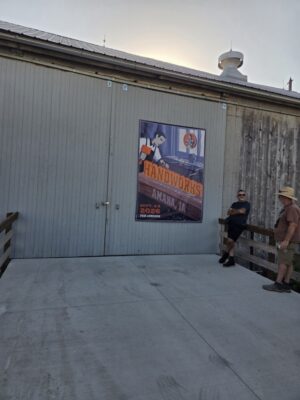
In what will almost certainly be my last long trip unrelated to family matters, Mrs. Barn and I hit the road for a Labor Day weekend toolapalooza in Amana, Iowa, for the fifth (?) convening of Handworks, a mondo gathering of hand woodworking enthusiasts. The trip was very long, two full days of driving each way (I took a full-to-the-brim truckload) and even though the gathering of several thousand friends old and new is a delight, it is just too much for us. Part of the problem is that Mrs. Barn’s CR-V is excruciating for me to ride or drive; it was not made for linebacker-sized folks. My large pickup is a perfect fit but Mrs. Barn hates driving it. Oh well. I still get many invitations to travel to speak and teach but at this point I decline them all. The Wood and Shop school fits my needs just perfectly as it is two hours away from Shangri-la. That I can do easily. Two days each way? Not so much.
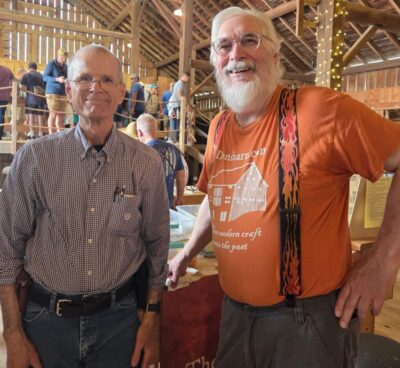
We were joined by dear friends Mr. and Mrs. Ripplin’ John.
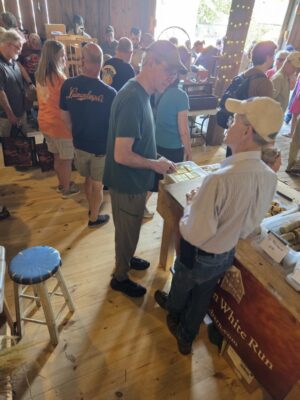
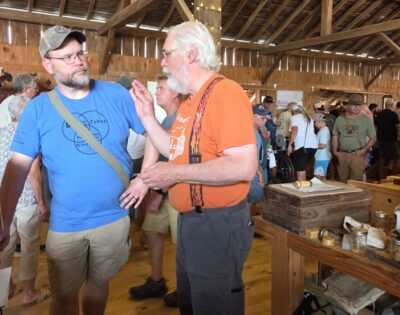
John was with me side by side throughout the event as multitudes of folks wanted to ask about historical wood finishing and we were delighted to explain and demonstrate. While we were doing that the Misseses were out and about doing gal-pal stuff.
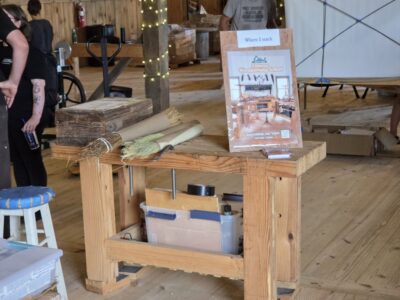
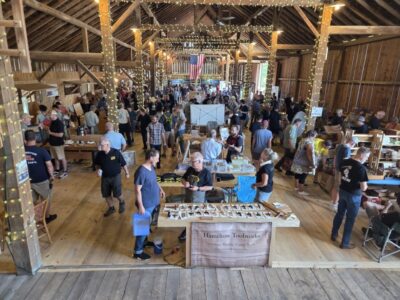
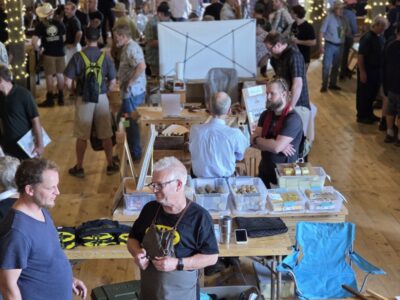
We were among the first to set up, near the center of the giant Festhalle. I brought two of my smaller workbenches to use as display and demonstration space. Soon the place was filled with enthusiasts of every stripe. I was glad to see that the demographics of the attendees was becoming broader and especially younger. It gave me hope for the future of the skill set.
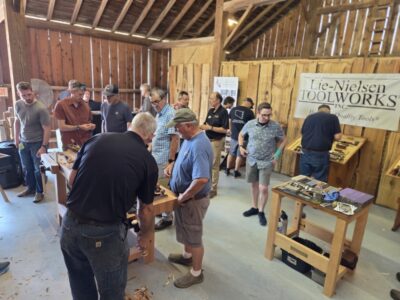
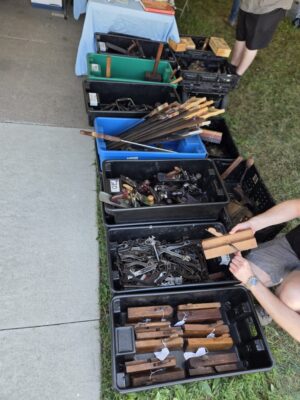
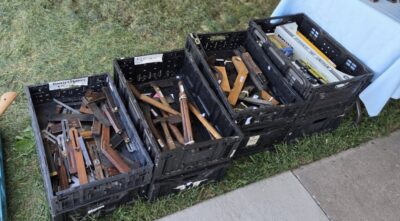
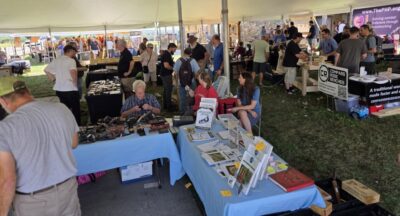
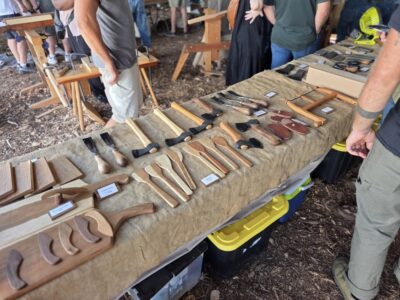
The Festhalle was only one of many venues for the event, I think the total this time was seven. They were all filled with a bajillion tools, old and new. I only managed to get pictures of about 10% of the goings-on.
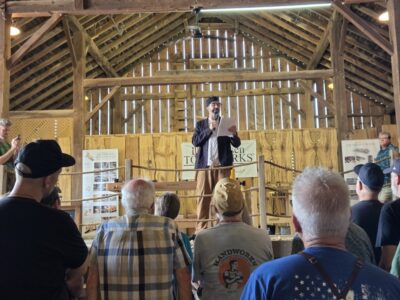
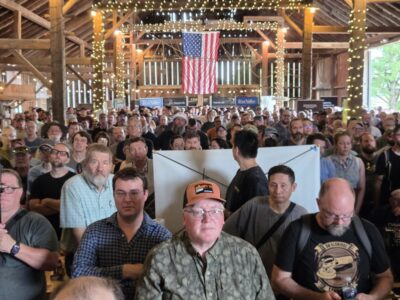
On the second morning the packed house was regaled first with a stirring rendition of The Star Spangled Banner magnificently presented by Mike Siemsen followed by a recitation by Chris Schwarz of some old-codger-ish correspondence between a Welsh Stick Chair maker and an American host regarding some workshops. Very entertaining stuff.
One final note is a comment on the weather, which was a stark counterpoint to the first Handworks. At Handworks 1 the weather was absolutely frigid, a very cold and rainy Memorial Day weekend fifteen years ago. This year the air in central Iowa was stifling, temps in the mid 90s with a choking level of humidity. With every handshake, two hands stuck together. They day after the event was much cooler. Oh well.
night stand pt VI.........
 |
| done cooking |
I was a good boy last night and after dinner I went back and glued the two other sides. I didn't feel like it - I was feeling tired and if I sat for more than ten minutes I nodded out. I did it so I could keep working on it in the AM first thing.
 |
| flushing the tops |
I used the scrub plane first to knock down the majority of the proud. Found the LN big boy plane (60 1/2) was easier and quicker than using the #4.
 |
| hmm...... |
There was a wee bit of daylight under Mr Starrett that I couldn't shut out. It was flat and straight across the legs so I left it as is.
 |
| no twist |
I checked this across both the long and short sides. Both agreed that neither way had any twist.
 |
| sigh |
The top was rocking so I knew the sticks wouldn't show me their happy face. There was twist again with the front left and back right being high. The underside was kind of ok. It had a teeny bit of twist and I dealt with that first. Then I attacked the opposite face.
 |
| slow going |
I don't like the grain orientation between the top and the bottom. Originally the top grain was running R/L giving a 1/2" overhang all around. Aligned the top and bottom grain (F/B) with a new overhang for the top. The overhang now on the top will be a 1/4" front/back and 3/8" R/L.
 |
| frustrating |
I did these dance steps yesterday with it helicopting on one diagonal and not the other. Played with it for seemingly a bazillion years before I got it rock free on the tablesaw table.
 |
| I didn't forget |
There are no slots for the table top clips on the top or bottom aprons. I didn't do them before hand with the router because I confused myself. I thought that the clip slots would be where the slat mortises were. Here at the top that wasn't the problem.
 |
| the bottom was the problem |
The clips would poke into the slat mortises on two sides of the bottom aprons.
 |
| found them |
I wasn't looking for these but they shook hands while I was looking for something else. I didn't find that but I will stick these in the brain bucket so I can forget where they live again.
 |
| first one done |
I thought I would have more room to swing a chisel then I had. I am going with one clip per side for the bottom shelf. If that isn't sufficient, I'll chop more slots and add more clips.
 |
| no help |
Went searching for a 1/8" chisel that was shorter then the 1/8 bench chisel I was using. I found a 3/16" chisel that I was going to shorten to a stubby 3-4" length to chop the slots with. Rather then hack sawing the blade I thought of sawing off a portion of the handle and nixed the whole idea. I'll suffer through chopping the slots with what I have and rethink the stubby chisel idea.
 |
| last bottom one |
Finished the bottom clip slots and awaiting me are the eight slots for the top. I am putting the slots close to the legs so the clips will pull down the corners tight to the tops of the leg. I'll be doing those in the AM.
 |
| 2 out of 3 against |
The stand is rocking on the workbench and not rocking on the tablesaw. The sticks are telling me there is no twist between any of the legs. I'm on the side of 2 and I'm calling the bottom good as is.
 |
| back order came today |
These are japanese rasps - 2 coarse and 2 fine (flat and convex). I got them for the chair build. I haven't forgotten about that. It is just that I only have one bite at the apple and I don't want to screw it up. I've been thinking of making one out of 2x12 lumber first?
 |
| I had to buy it |
I am attracted to miniature tools and the LAP small books have embedded their hooks me too. Always willing to see and learn how someone else builds something.
 |
| how did they know |
I've been thinking of cut nails for a while. I have two the nails show here and both have kicked my arse and I have split wood using both. For what ever reason these nails are like kryptonite to me. I don't achieve consistent results with them, it is hit or miss with miss in the majority. So I'm always on the search for anything written about them.
 |
| shop library bookshelf |
Besides I have lots of room for more small books. My OCD goes into overdrive every time I look at this and see the empty space.
I had my audio/video link up with West Roxbury VA this morning. Got some clarification on the results of my last lung x ray and CT. There are nodules on my lower right lung. I had the cancerous tumor removed from my left lung. But the doc said that the x rays and CTs have been consistent don't show changes.
The doc was helpful and explained every question I threw at her and I had a bagful to unload. Because I'm going through chemo right now, the oncologist is my lead doc. I am going to ask her about my coughing because she rules my case for now.
The coughing was gotten steadily worse and I get winded a lot after some coughing fits. I had one today that went on for 2 minutes (timed it) before it stopped. I quit the shop early because of it. I felt like a wrung out wet dish rag and I wanted to lay down and sleep until next thursday. The West Roxbury doc thinks it (the cough) might be treatable with antibiotics but that call will be the oncologist doc's call. I'll find out in tomorrow when I atttend my final chemo cocktail party.
accidental woodworker
Handworks 2026 in Amana, IA
Well, I got back to the Handworks event in Amana, IA on Sept. 4th and 5th. And it was awesome again. Two days full of hand tool immersion. The event is put on by the proprietors of "Benchcrafted", the company who sells crubber, the leg vise "criss-cross" thing, workbenches and other stuff. And other than getting there and staying somewhere, the event was free to attend - though I did add to the donation jar.
 |
| One of the outdoor tents |
 |
| This open-air timber-framed structure housed Pete Galbert, Jason Lonon and many others |
 |
| The main barn, with Lie Nielsen at the far end |
 |
| The main barn on day 2 during Schwarz' presentation |
Man, it was hot, hot, hot! And humid! Each day was about 95 deg with a "feels like" temperature of 97-98. And many of the vendors were wearing long pants. I felt really bad for them. But if you focus on the tools and the woodworking and the comradery, it was easy enough to forget the heat for a while.
I wasn't looking for anything in particular this time. But I did come home with two items. There's a guy from Chicago named Slav who sells new "old stock" files and I bought some from him three years ago. He was there again this time and just in passing I happened to see something on his table that I'd been looking for for a long time - Skroo-zon file handles in the #3 and #4 sizes.
 |
| Number 3 and 4 Skroo-zon file handles |
 |
| These will add nicely to my #2, 5 and 6 |
If you've never used one of these, the handle "screws" onto a file's tang and holds it really firmly. I know I can make (and have made) my own file handles, but these things are great.
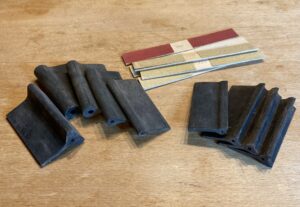
Even though I didn't really need any new tools, it's always good to see what's out there. One thing I might be interested in if I ever get around to making some more planes, is these tapered molding plane iron blanks. The molding planes that I made years ago were with Lie-Nielsen (non-tapered) blanks. But the way they were made 150 years ago was genius! Opposing wedge action with the tapered iron and tapered wedge gives great hold and adjustability.
 |
| These are from New Heritage Woodworks |
It was a really great event. My thanks to the Abraham brothers and their staff for putting this on. I can't imaging how much work it is, but I'm certain it is WAY more than I might realize.
nightstand pt V..........
 |
| first replacement slats fitted |
No hiccups getting this set fitted. Wasn't sure that I would have room to move the apron up/down on to align the dowels.
 |
| hmm...... |
I tapped the slats down fully in the bottom apron. On the top one I set them in part way. I then use the mallet to tap the apron up/down until the dowels in the legs aligned with the dowel holes in the aprons. Yesterday this was dicey as the slats would pop out before I got the alignment set.
 |
| checking the 2nd set |
I had 9 slats to chose from and I started with checking the slat fit in the mortises. I had to reject 2 slats because they were too thin.
 |
| 6 slats |
I had to reject a 3rd slat due to it being short on the R/L. It was the same on all 10 mortises which surprised me. I thought it would have been good on at least one or two of them.
 |
| Houston, we have a problem |
I couldn't get the the top to align. Mallet work did diddly and I even tried clamping it. That failed too and the conclusion was I made these 5 slats too long (or just one).
 |
| almost a 1/4" |
Laid the first set on top of the second and the second one was 3/16" longer.
 |
| confirmed |
Took one of the slats from the first set and checked it against the 2nd set. Not quite a 1/4" difference. There was no way this would align as is. I sawed off a 1/4" off on one end of all the slats and started over at square one.
 |
| something is amiss |
Got the 2nd set of slats fitted with no hiccups and zero cussing. However, I put the slat assemblies on the wrong faces of the legs. My triangle ain't a triangle. Back to square one and redo it.
 |
| correct |
I marked the leg faces that get the slats with a piece of tape. I don't want to find this in left field after glue up and see I made a me-steak.
 |
| prepping for glue up |
Planed the arris on the legs and then planed the faces removing all the pencil marks and smoothing them.
 |
| short aprons |
Planed the long faces and I'll do the top/bottom edges before I glue them up.
 |
| glued and cooking |
It was just before 1400 when I got these two glued, clamped and set aside to cook. I'll let them set up until after dinner and I'll glue up the short rails. I should have this done and oohing and aahing about before the weekend.
I opted for no glue in the mortises. I had a good snug fit with all of them and the length was spot on this time. The slats are captive and without glue I didn't have to deal with glue squeeze out.
accidental woodworker
night stand pt IV.........
 |
| first set |
I had to replace the two outside slats, #1 and #5. I had to replace them due to gaps and fit them again.
 |
| 80 and 120 grit |
I sanded the rough side of the ten slats needed for the night stand.
 |
| extras |
Sanded these for back ups in case I have to say oops.
 |
| first side dry fitted |
I clamped it to ensure that the aprons got closed up tight to the legs. Washed, rinsed, and repeated for the other side.
 |
| hmm...... |
This shelf fit yesterday, I have photographic proof.
 |
| stinky mind fart me-steak |
I sized it for the wrong side. Totally missed this when I did it. This is toast and I'll have to make a new shelf.
 |
| hmm...... |
I hadn't wanted to notch the shelf but I don't have a choice now. I sawed out the notches on the bandsaw. I noticed that the cuts weren't plumb. That led me to spending a few frustrating minutes squaring the table of the bandsaw to the blade. Maybe this is why I am getting tapered resaw cuts on the bandsaw?
 |
| nope |
This shelf is too small R/L for this purpose. The front to back is ok but I need the R/L too. The gaps are too wide between the legs and it looks like crappola.
 |
| a gap |
Noticed this while fitting the shelf and marked it for replacement. I also replaced the #4 slat for a gap that I didn't like.
 |
| 2nd shelf |
All the notch cuts were plumb. I've been looking to do more machine work lately because of my breathing issues. I still do a fair bit of handwork and I'll continue this way until I can't do either one.
 |
| too tight |
I had to saw the notches twice, on the first go around it wouldn't fit at all. It fits after the 2nd saw cut but it is way too tight. There isn't any allowance for expansion and contraction. I sawed off another 1/8" on each side (R/L), front and back. I also sawed off another 1/8" of the R/L against the slats. I left the cross grain part of the notches as is because they don't move.
 |
| not sure |
Plenty of room for expansion and contraction. Might be a wee bit too much as winter is coming and the gaps at the front/back may get larger. I'm not sure how much poplar shrinks but I'll guess I'll find out.
 |
| bandsaw marks |
Tried to clean up the bandsaw ripples with a chisel first and it was tough going. Used this large and smaller modeler's rasp to clean the two bandsaw cuts.
 |
| replaced |
Ugly looking gap gone. With my experience with doing slats I have found that the mortise walls shrink and tighten on the slats. The short ends don't change much so gaps there usually stay.
 |
| done |
I had to replace two slats but it was worth it. No gaps on any of the slats, top and bottom.
 |
| sigh |
Got the ugly feeling that I made the slats too short. While assembling them a couple of them popped out. Can't have that boo boo happening.
 |
| measuring the length with sticks |
I had measured the distance between the top and bottom aprons, added 3/4" for the depth of the mortises, and subtracted 1/8". The sticks remove any errors from measuring with a tape.
 |
| hmm...... |
This is what is above the tops of the legs. I thought about removing it on the tablesaw and nixed it. I'll do it with planes after the nightstand has been glued and cooked.
 |
| too short |
I now know why the slats were slipping out. The slats are 5/16" shorter then the what the sticks say is the length. That means with the slats fully seated in the bottom mortises there is only about an 1/8" in the top ones.
 |
| new slats |
I had a lot of slats left over from yesterday but I can't use because I had sawn them to length already - too short to use on round #2. I have five on the left ready to trim and fit. To the right I have enough to get the five needed for the other side. I'll do this in the AM.
 |
| nice ray flecks |
accidental woodworker
Making a Bass Bridge
About a year or so ago, I built myself a short scale bass, inspired (aesthetically) by the Kay EB-100 that I had previously restored. I play this bass pretty much daily: it’s set-up with flat-wound strings and I love its smooth richness of tone. However, having recently restored the Westone Thunder Bass which has a long-scale and round-wound strings and spent some time playing it, I have found whole new range of tonal possibilities, which contrast and complement the short scale.
So, whilst having a brief breather from mandolins, I thought that I would make a bridge for a bass guitar which I intend building at some point in the future!
MY Work of Art

I admire the insight and sensitivity of D H Lawrence in this:
"some old things are lovely, warm still with life ... of the forgotten men who made them." which comes from his short piece "Things Men Have Made"
Things Men Have Made
THINGS men have made with wakened hands, and put
soft life into
are awake through years with transferred touch,, and
go on glowing
for long years.
And for this reason, some old things are lovely
warm with the life of forgotten men who made them.
I live in an age of unmakers. My work is the making of things hand made, and I know my craft well simply by the doing of it. Artificial intelligence adds nothing to my work of any value and though I do use computer design technology here or there, my personal prized drawings come from pencil points of graphite and dip ink pens only. Drawings the way I do makes me look in a way that forces me to see. This high-demand artwork embraces my involvement to the nth degree. My pen inks in the blanks indelibly, both on paper and in my brain. It's non-erasable. Until you have drawn it, you haven't seen it. Unless you have drawn it, you haven't seen it. Drawing makes you look and see.
This plane is a most remarkable work of art. The wooden version, made to cast several times in sand alone, is a work of art designed and made to create secondary art. Each plane made from pouring molten iron into flasks filled with oiled sand will make a hundred thousand surfaces smooth and true and square. I'd like to see the insides of the metal but never will. But the fineness of the woodworking relating so precisely to the metal curves, the seating of it, expresses the handwork so exemplary of the 1600s, when the finest woodworking in history came without any machines in sight. What is it that I am saying? Well, plastic was two-hundred years away, three-dimensional printers three-hundred. These inventions would replace the men's hands, their eyes and their brains. And what of AI?

My woodworking world expanded exponentially when I decided not to machine wood too much in my life again. Remember I went from mass-manufacturing production work in a midlife crisis when I all but lost my woodworking coordinates. It became less like woodworking and my first love waned with the extraction unit for dust and wood chips attached with suction capability to every machine.

I believe I could make the plane myself. Create the form in the body of the plane, shape it with a handful of hand tools, bend wood, taper it to come loose from the sand flawlessly and even develop enough heat from coke to melt the iron. If I used bronze that would be lovely too. The ancients in the Caucasus region of the Middle East gave us bronze 3500 years BC. It was the Chinese who gave us cast iron in ancient China and also the first throes of sand-casting too. They were well attuned with the development of sand-casting techniques and methods by the 6th century BCE. Even so, the patina on my plane strikes me as a remarkable gift to my art. And then look too to the shaped holding positions. Surely, we embrace such loveliness willingly. This is not engineered work as we know it. There was no 'sending' or programming taking place. But it is endangered by obsolescence now. An evolution that dismisses the need for skilled workmanship.

My pen here, the one I write a thousand words a day with, is a remarkable invention though it knows no hand work beyond the mere tapping of keys. It is most likely the most remarkable pen I have ever owned simply because of the precision by which it was machined into being. Each fill of my refill chamber seems to last me about week of my daily writing perhaps five hundred words minimum, really, double and more if I'm on a roll, which I mostly am.

I now own three of these specific pens and have yet to find one of them faltering when I pick them up to write though with one or the other it could be a week, so I touched it. The pen itself has no plastic to the outer and the only plastic on the inner is in support of the nib and the filler unit that fits and works snugly. I have yet to have one of them leak on me though faulty filling with too much will cause a slight spill if you're not careful. The pen is far from flimsy and I find it well-balanced in my hand for writing. I never really liked roller ball pens particularly but I do favour a particular roller-ball pen for book signing if and when i have a lot to do.

night stand pt III..........
 |
| first mortise chopped |
The width is a snug fit with the slat. The R/L is several frog hairs over but I knew that. What I wanted was the width to be snug or slightly undersized too. I made the depth of the mortises 3/8".
 |
| dry fitted |
I like this trim and fit step. I get to control how tight and gap free the mortise is with the slat.
 |
| almost made a me-steak |
I had all four of the long aprons but I was missing one of the short ones. I was holding it in my hands without knowing it. I was looking for the mortise layout on them and that was the almost me-steak. The short aprons don't need mortises because they don't get any slats. Worked in my favor because instead of 8 aprons to chop, I only had to do four.
 |
| oops |
This apron had the one and only split I got from chopping the mortise. I glued it and set it aside to cook.
 |
| hmm....... |
Went back and ran the mortising gauge again defining the walls. With them deepened I could run the marking knife in them making a wee bit deeper. That made it much easier to define the edges when I chopped them with the chisel.
 |
| before lunch |
Still going out for fish 'n chips every friday and breakfast on monday. I added another breakfast on wednesday. Breaks up the week nicely for me.
 |
| step one |
Chopping the mortises went quickly and easy. There was only one hiccup that resulted in a split. Back to step one - chiseling the outline of the mortise.
 |
| step two |
Outline done and that keeps the top crisp and clean. Step two is chopping the webs between the drilled holes. I didn't do this on the mortise that split on me. I thought I had enough empty space that chopping the walls straight down wouldn't cause a split. I was wrong and didn't repeat it.
 |
| last step |
Chop straight done doing the ends first, then the long walls.
 |
| done |
Potential headache to deal with. The dowel, on both ends, sticks into the mortise a wee bit. Decided to notch the slats (top and bottom) to account for the dowels intrusion into the mortise.
 |
| ouch |
Made a bone headed me-steak. I laid out the mortises on the aprons with them all in the same orientation. I should have laid them in sets, with the top and bottom mortises laid out with marking gauge from the outside face. At least all them came out the same and I just lost the 1/8" set back I had.
 |
| hmm...... |
Not a deal killer and I'm not making new aprons. I should have done the mortises on the edge facing up above the legs. This is a minor hiccup to address and I got my 1/8" set back too.
 |
| the notch |
I was generous with the notch to clear the dowel. This would bite me on the arse and draw blood in a few.
 |
| fitting the slats |
First I rasped a chamfer on all four edges of the slat top/bottom. Then I planed the width until it fit. I didn't have to plane the width at all. I will have to address the rough sawn side of each slat. I think I'll hand sand them because I can do that and stay away from the portion that fits in the mortise better then I can if I use a plane.
 |
| yikes |
I put a bandaid on the arse to stem the blood flow. It seems that I made the notch a wee bit too big.
 |
| dry fit was good |
I don't know what it is about slats, but I can't deny the appeal they have over me.
 |
| double whammy |
Both the top and bottom notches are too big, on both of the end slats. These two are toast and I'll have to replace them.
 |
| hmm....... |
I got 3 sizes of the metal rule - 12", 18", and 24". Don't use them for measuring much and they mostly get used as a straight edges. I prefer the wooden rule, it is double sided with eights on one face and sixteenths on the other. I find the metal rules to be too busy and difficult for me to measure with. The mortise to mortise length is 16 1/4" and I made the slats a 1/8" shorter to allow for the glue.
 |
| change of plans |
Decided that notching the slats ain't a good idea. Instead I'll saw the dowel short. I will only have to do for 8 of the 24 dowels.
accidental woodworker
night stand pt II................
 |
| aprons |
I had two small scraps of 7/8" thick poplar that I used to get the 8 aprons for the nightstand from. The short side aprons are only an inch shorter then the long sides. That is because the top is 15 and change by 14 change. Not quite a square and barely a small rectangle.
 |
| hmm....... |
The red paint skimmed over - it had a skim coat on it yesterday too when I painted the first coat. What is underneath that seems to be viable and the 2nd coat covered and looks good. I'll find for sure in the Am.
 |
| good to go |
The black looked good but still needed a 2nd coat in spots. Happy with the 2nd coat coverage and I'm calling the black done.
 |
| dry fitted |
The base dry fitted. No surprises or hiccups and all the joints closed with hand pressure.
 |
| oops |
Drilled from the wrong end of the jig. I'll fill these in before I glue the aprons.
 |
| what to do, what to do |
The top has a 1/2" overhang all the way around. The bottom shelf is what was occupying my attention. How do I get it fitted between the four legs? Initially I thought to notch the four corners to go around the inside of the legs. Changed my mind on that because of the slats on the two long sides.
 |
| finalized |
Decided to place the shelf so it was just inside the legs front to back. After seeing this pic I realized that maybe I should have run the grain front to back instead of R/L. I'll have to plane the outside edges of the shelf so that there is about a 1/8" clearance between the legs and the outside edge of the shelf. The shelf overhangs the front and back aprons by a 1/2" matching the overhang of the top.
 |
| about a 16th |
I'm pretty sure that I can pull this down tight to the legs/aprons with the table top clips. However, that won't make the cup go away. A top should be flat and straight in all directions right out to the ends. I had to flatten at the top.
 |
| sigh |
One headache with these dowels is that they are snug. This dowel through a hissy fit and broke off when I tried to remove it. I had made the egregious me-steak of putting the dowel jig away too. That is a no no and shouldn't have been done until the aprons were glued, clamped, and cooking.
 |
| ouch |
I tried first to chisel out the dowel and got nowhere with that. Drilling it wasn't working much better neither. Other than making a inverted cone in the dowel, it wasn't drilling through it. For whatever reason when I pulled the drill out the dowel remnant came with it.
 |
| slat mortise layout |
Still thinking on how to best chop these. I don't have a chisel that matches the width and I also don't have a forstner bit that matches the width neither. Chopping wasn't happening today so I have until the AM to figure out a game plan.
 |
| hmm...... |
The top is cupped/bowed along with some twist. Flattening this is going to be an adventure.
 |
| hump side |
Doing this was a PITA. I used 4 planes to flatten/remove the hump. Missing in the pic is my #4 and a little later on I also used the #3.
 |
| hmm......... |
This diagonal is playing helicopter. The other one is flat and straight. Getting this diagonal to be the same took a boatload of calories with me sweating out 43 gallons of sweat and soaking my shirt. I got a little winded but it didn't slow me down. What did me slow down was a coughing fit that went on for several minutes. I got winded more from that then I did planing.
 |
| still rocking |
Two corners were being stubborn and trying my patience. I think it took me about 30 minutes to finally get this rocking free. I would plane the high corners diagonally and check it. It took a bazillion plane and checks before it laid flat and rocking free on the tablesaw.
 |
| wash, rinse, and repeat |
After the down face was done, I repeated the same dance steps for the top. I made no attempt to get the faces parallel - I was shooting for flat. I'll check it before I screw the top down to the legs and aprons.
 |
| done |
I'll let this relax and let it work out any stupid wood tricks it might have hiding up his sleeve. Fingers crossed that it behaved when I check it in the AM.
 |
| multiplied like rabbets |
I was able to saw the slats in half and got two out of each one. Lucky for me that the wife's project slats were so long. This gives me than enough for any oops.
 |
| hmm....... |
I didn't center the slats on the top of the aprons. I hope that I did this right. The plan was to have the short width side facing into the interior. I'll find if I laid this out from the correct face when I do another dry fit. Updates and pics on the 11 o'clock special news edition.
accidental woodworker
Latest Conversation
My most recent conversation with long-time friend, broadcaster Brian Wilson, is now posted on his Substack, Brian Wilson Writes. If pungent conversation about the state of the culture it might not be for you.
How to Nail Furniture without Splitting the Wood!
5/8" tenon cutter and a new project.........
 |
| needs to be shiny |
The after on top and the before on the bottom. Chucked it in my drill and ran it on 220 grit sandpaper. The action not only shined it, it also removed the burr on the slot sides.
 |
| hmm...... |
Not quite done with the screws. Got the heads and slots cleaned and shiny. I cleaned up the threads on my grinder with a brass wire wheel. I had a steel wire wheel but I found it to be too aggressive and it left scratches that made shining up harder.
 |
| first coat |
I might be able to get away with one black coat but it ain't happening with the red. 4-6 hours before recoating but I'm going to let all of it cook until the AM.
 |
| 2" thick oak |
This is the start of a new project. I am going to make a night stand for the grandsons. It will be painted gray to match their respective dressers and bookcases. I hate to paint the oak because two faces have quarter sawn faces. But I don't have any other stock thick enough for the legs. And I don't like gluing up thinner stock to make thicker stock.
The two boards underneath them will be the top and bottom shelf. I went back and forth about a drawer and for now it is toast. That may change as I get into sawing out the aprons and the wind blows me in a different direction.
 |
| wasn't easy |
The tablesaw had trouble sawing this oak. It was bogging and stalling when I tried to saw it out in one pass. Instead I had to saw it half way, flip it, and finish sawing it out. Planing the sawing marks wasn't an issue. Pushing the plane kicked my ass. I would do 3-4 strokes and have to stop to catch my breath. By the time I got to the 4th leg I was able breeze through with the planing without getting short of breath. I had to take shallow cuts too.
 |
| ouch |
Instead sawing the legs off to the right of the blade, I sawed the legs off to the left of it. I didn't want to chance the blade kicking a leg back at me sawing on the right. Because of that the legs each came out a wee bit different in thickness.
 |
| hmm..... |
Got the legs within a frog hair or two in thickness. Now I had to address the humps in the legs. Three of the legs had humps and 2 of the had their ends high (bowed). Got a little winded but nothing that made stop what had to be done.
 |
| hmm....... |
I guess I wasn't done because I was doing one last check when the bottom (or top) leg was doing its helicopter routine. I did one last plane/check with each of the faces that were opposite each other.
 |
| slat layout |
I am going with 5 slats on each side with none at the back. Did a layout on some scrap to get a visual and for how many slats to use.
 |
| I have 11 and need ten |
There are off cuts from the slats I made for the project I just finished making for my wife. They are a frog hair under 3/8" thick and one inch wide. I would have liked the thickness to have been a bit more then 3/8" but I'll use and deal with what I have.
accidental woodworker
Fundamentals = Foundational

Thinning things down these last few months, probably a year since we decided to build the workshop studio at the end of the garden, didn't yet take care of everything. Currently, much of our equipment, furniture and hand tool gatherings are in a 40-foot container or in my house kitchen where for three months we have been keeping our work a living entity as we continue videoing and making in a slightly more confined space. Outside, Mario is currently laying the paving blocks and it's a big job. The blocks allow any rainfall to reach the ground below so that it does not enter the water systems as run-off. It still gets there if it's an excessive rain day but it does so more naturally.
My recent post covered some of what I saw in the four men building my workplace. These skilled men work with what's to hand and then reach for lasers to pinpoint levels digitally and measure square-footage and distances that need accurate calculation. Even so, they still reach for spirit levels, which historically go back to the late 1600s when the French scientist gave us the liquid in a slightly bent glass tube that allowed a bubble to rise into the high point in the tube to check on site for level. Imagine that, 400 years of spirit levels, and we still use them because, well, they are often far more convenient and accurate is many working areas of our lives. But then so it is with hand tools. To be honest, the reason my work comes together so quickly and efficiently is because I have nothing with a digital readout connection to steer me and my dovetails need no jigs or guides because at my age my hands don't falter or tremble, and my eyes still gauge distances within fractions of a millimetre. Frankly, too, a machine would only speed up wood stock prep but equally frankly, my body needs exercise all day long and not muscle from gym work that would be absolutely useless, useless to me. More than that, I need the brain power too. My hand work is high-demand mentally and physically. Those of you going into the illusion of retirement might best be taking on a new career working wood. It's never too late. Oh, and by that, I don't mean machining wood.

Rising to different challenges can come acceptably in later life. I was in my late fifties when I started serious writing and drawing. I hadn't touched a computer before then. It didn't mean I left my handwriting out, it came alongside it in tandem. I still write a paper page of text every day with a fountain pen I fill once a week from a bottle of ink and then write on my computer into the future of woodworking so that nothing dies with me. Remember it was around the start of the last decade when we filmed making a damned good workbench in the garden of my house. This one act of videoing worked as a bridge between training and developing the confidence to make by hand rather than always machining the stuff of wood. Our amateur video efforts changed the lives for a million woodworkers who thought they needed half a dozen machines at least to simply become a woodworker. When they saw this very radical move on our part, it was Joseph and I and two inexpensive camcorders, they suddenly went, "Wow, I can do that!" The black and Decker workmates came out unembarrassingly to plane wood on, bumped up against a laurel tree. Some of you have been with us through thick and thin since then. Some of you planned your future into woodworking as an engineered intent, bought a handful of hand tools and built a workbench from construction-grade wood with knots and twists and cups in it.

Since that time, I have designed a few hundred pieces of machine-free furniture and woodwork and progressively, progressively, moved towards 98% elimination of the machines I once relied on. Of course, no longer holding classes for hands-on students meant I no longer needed 500 to 1000 pieces of wood for the classes. The half a dozen boxes I made in the last few weeks came from my handsaws, planes, square, chisels and a chisel hammer. Making a tray to slide inside took me half a day and whilst I was doing that, Mario was outside laying almost three square metres of paving by hand too.

I noticed how Agnis and Mario worked in the ground to get the foundations and drainage of my new building and the paving that's currently going in. The foundations were meticulously detailed, and no corners were cut. If I know anything about building, the foundation is perhaps not the prettiest work and is often very tedious, but you must get it right. Everything that goes from there on relies on detailed accuracy that takes place in the foundation. So it is with woodworking and all other skilled crafts. The fundamentals of all things craft are critical in the beginning work. That's why we taught saw sharpening and plane initiation right off. We talked about chisel bevels and bevel-edged or mortise versions. You've never seen me use mortise chisels in any of my videos even though they are boxed in a chisel tray somewhere. No one's asked me why and that's because they see what I use works. And none of my planes are retrofitted with thick irons or special steels. My fundamentals take good care of all that artificiality. And what about low-angle bevel up planes anyway?

So here is another word we rarely consider too deeply: foundational. This word needs a little explaining to gain the full value of it. In Latin, the word foundational comes from fundamentum, meaning, guess what, foundation. The root of it is bottom or base and from this we get basic too. In our recent English we might refer to it as primary and original so foundation and fundamental come together. I just created a box (above) I call my Dovetail Sampler Box. This is now a fundamental course in foundational dovetailing and the first episode in training on dovetails will be out as I type. It is not my first online training, there are dozens and dozens of projects with dovetails that I have put together. My goal in this was to get the foundation right and record it for posterity.

Though still running my own business, still making and delivering on target to provide for my family, It was in and around the early 1990s that started to invest in the lives of others. Oddly enough, mixing in Christian situations, it was the ones I worked closest with that ultimately stole from me in one way or another. This really took me by surprise and the reason I am aware of it now is that I recently finished my autobiography to recount my work-life since my young days of woodworking. Most of my apprentices and trainees ultimately stole and deceived my in one quite serious way or another. My writing has always sustained me as much as my woodworking. My hands-on classes, writing for US and UK woodworking magazines, such like that came ever more naturally to me hence my two books on foundational woodworking and hand tools. This earlier work would undergird my future as an artisan maker teacher. Today, building what will be my last workshop studio, comes from my foundation work in both creating to sell and then advising others to take on their vocational calling no matter their age. Becoming anything is not hinged to age or retirement, but it is hinged to altitude and self belief. Thankfully, because \i have taught so many in hands-on classes and workshops, apprentices and so on, I believe in you. Just plan on some investment in real-time woodworking to train yourself and discipline yourself into your future.
See you soon.
A little sanding help
5/8" tenon cutter........
 |
| pic from the past |
This shaker step stool had been on my A list to do for a bazillion years. I finally made this one (my first) about 11years (?) ago. I gave it daughter #2 and she uses it as a plant stand. That aside what interested me about this pic was the back wall. Not only doesn't it not look like this anymore, the workbench has changed too.
At the back right is where I first kept my drill press. The left side of the workbench has the remnants of a back tool well. I didn't like it and I took out the bottom of it. Kept the rest because it extended the front/back depth for projects.
 |
| what it looks like today |
The wall has exploded over the years as I accumulated toys. It blows my mind when I think of what I had back then and what I have now. I may not use all of them every day, but I do use a good percentage of them daily.
 |
| hmm........ |
When I first took this out of the Simple Green I thought it hadn't worked at all. The body was black but 90% of the japanning was history. There were the obligatory spots in the nooks and crannies that held some stubborn bits still. Overall I was happy with how well the Simple Green worked. I had missed checking it on monday.
 |
| wire brush |
The wire brush work got 99.9% of the remaining japanning. After that I spent seemingly a bazillion years with a file cleaning up the casting boo boos. The only spots I couldn't do were the inside of the vertical flutes.
 |
| done |
Spent the entire AM session getting the cutter to this point. I thought I would have started on the painting but it didn't happen boys and girls. Before I paint this and the adjustable tenon cutter, I will scrub the both of them with acetone first.
There wasn't a PM session. I started getting a wicked headache before lunch and it was full blown before I finished filling my pie hole. I wasn't sure if I could take Tylenol so I didn't. I spent the next 4 hours sitting at my desk with my head in my hands. By 1630 it was gone and hopefully tomorrow I can get started on painting these two cutters.
accidental woodworker
Doing With Intention
 Konrad Sauer and his 911
Recently I was asked to critique a photographer's portfolio, and at some point I learned that all the work was shot on film. I asked the photographer why he shot on film and he said that it was because each shot was a commitment. You have to photograph with intent. The cost of film made each push of a button important and required thought. He didn't get that with digital photography, for which the marginal cost of another picture is zero. This technique helped him focus and make intentional decisions.
I write with a fountain pen. It helps me think. Or maybe more accurately it trains me to think. Ink doesn't erase so I have to approach the page with the intention of getting it right. I need to visualize the words and the spelling and the shape of the letters beforehand. It helps me focus and it trains me to think about my intentions whatever I am doing, including designing tools and making things. I also find the entire process as complicated as it is very satisfying.
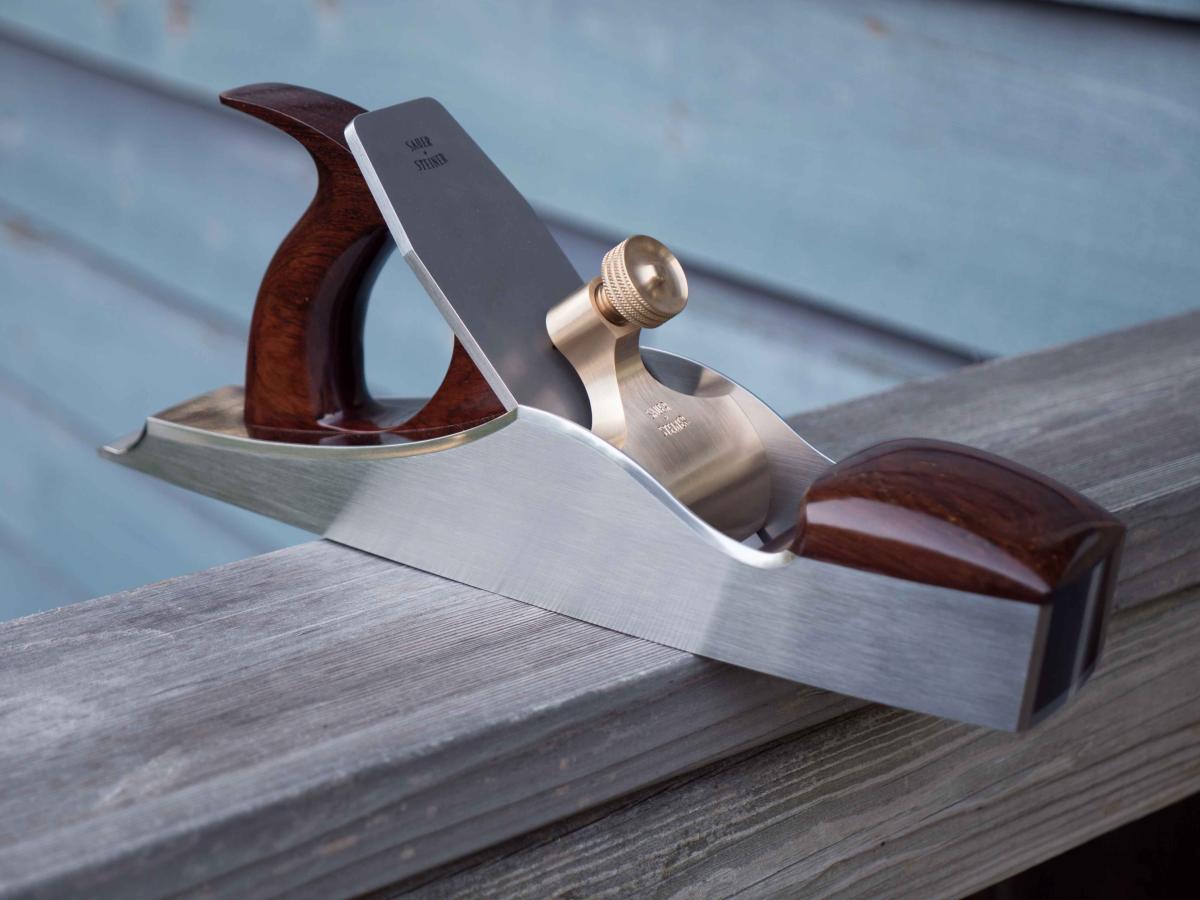
Konrad Sauer, the plane maker, drove to the Handworks show in Amana this year in a 1981 Porsche 911 SC Coupe. This is a choice. It's not a trivial car to drive. Konrad can't put the car in cruise control and sit back. He has to actively listen, feel, and pay attention to the engine, shift gears as appropriate, and generally be a participant in the actual act of going to from place A to place B. This is intentional. The reason Konrad makes this choice is because participating in the physicality of driving this car is fun. But there's more to it. Makers and designers are deeply involved in the work they do. We have to make decisions all the time, about color, shape, function, materials. And the thinking is coupled with hand operations. Thousands of small decisions and movements go into making a single one of Konrad's planes. Practicing working with intention helps make other decisions in all areas easier. And by the same token, designing (in Konrad's own case) a plane with all its decisions is the type of work he likes to do. Driving a manual car is an extension of that fun, just in a different realm.
I think that the process of making decisions coupled with physical action is extremely satisfying to humans and that's the reason Porche 911's, manual cameras, and fountain pens are still popular with a lot of people, especially makers. For me, the constant, instantaneous decisions I have to make when writing in ink (especially as a lefty) help train me and make all the choices and effort I need to exert when typing easier. The process is as important as the result.
This blog post came out of discussion I had with Konrad at Handworks and so I shared a draft with him. He wrote,
"Using manual things, cameras, manual transmission cars, fountain pens, hand tools, they force us to take a deep breath and slow down. The stakes are higher - something could go wrong and something could be ruined - there is more weight behind the activity. It requires careful thought and deliberate action on our part. We are engaged on a different level - it requires that we pay closer attention. There is an element of the workmanship of risk behind it. Developing the skill of being deliberate crosses multiple platforms and areas of interest - they all inform one another and are cumulative. Driving an old manual car helps me use a manual camera which helps me make (and use) handplanes." - Konrad Sauer
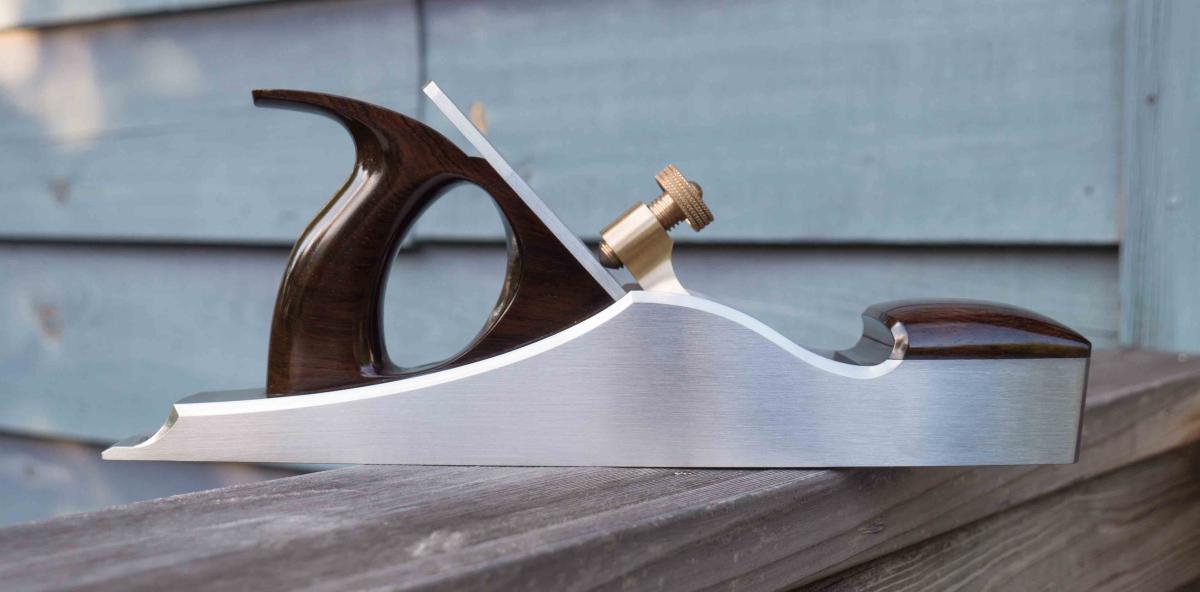
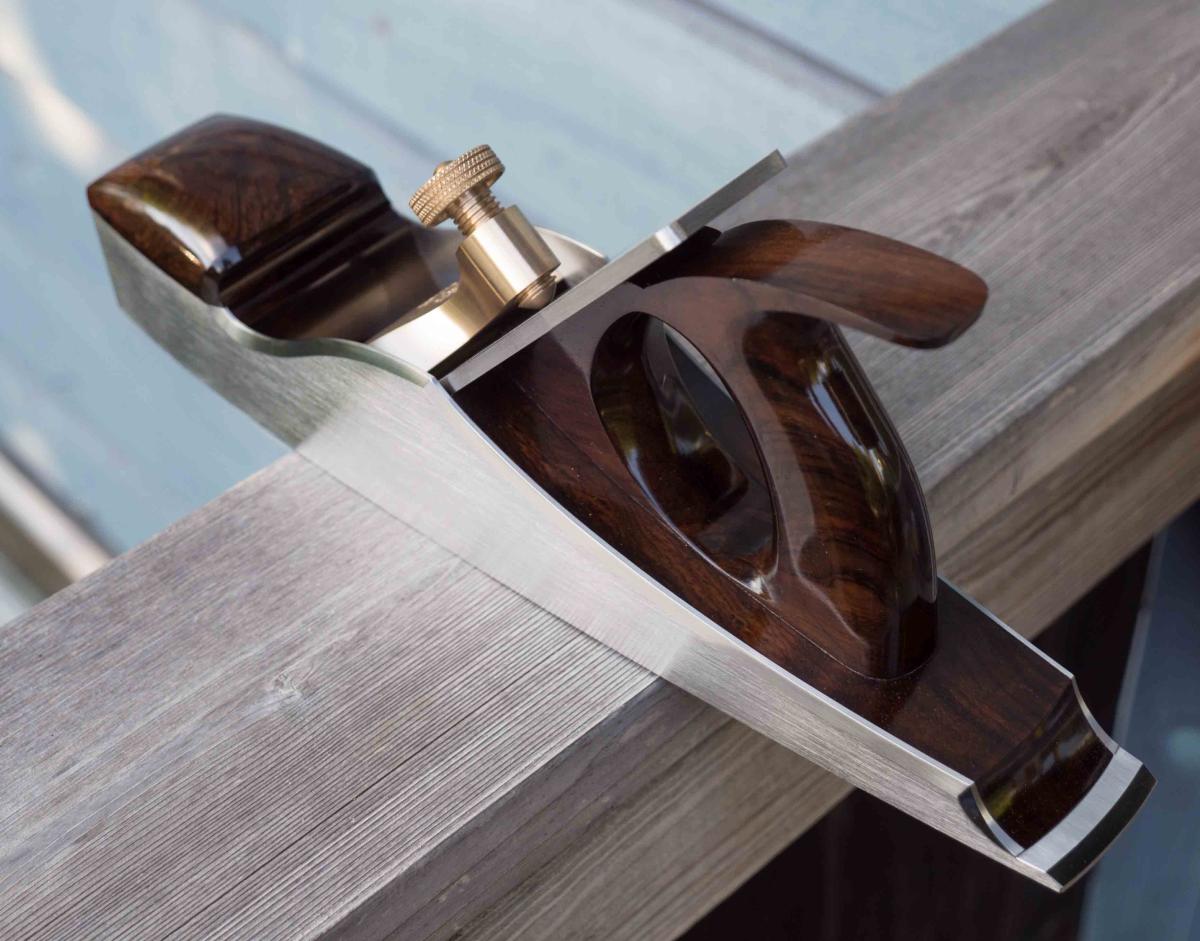
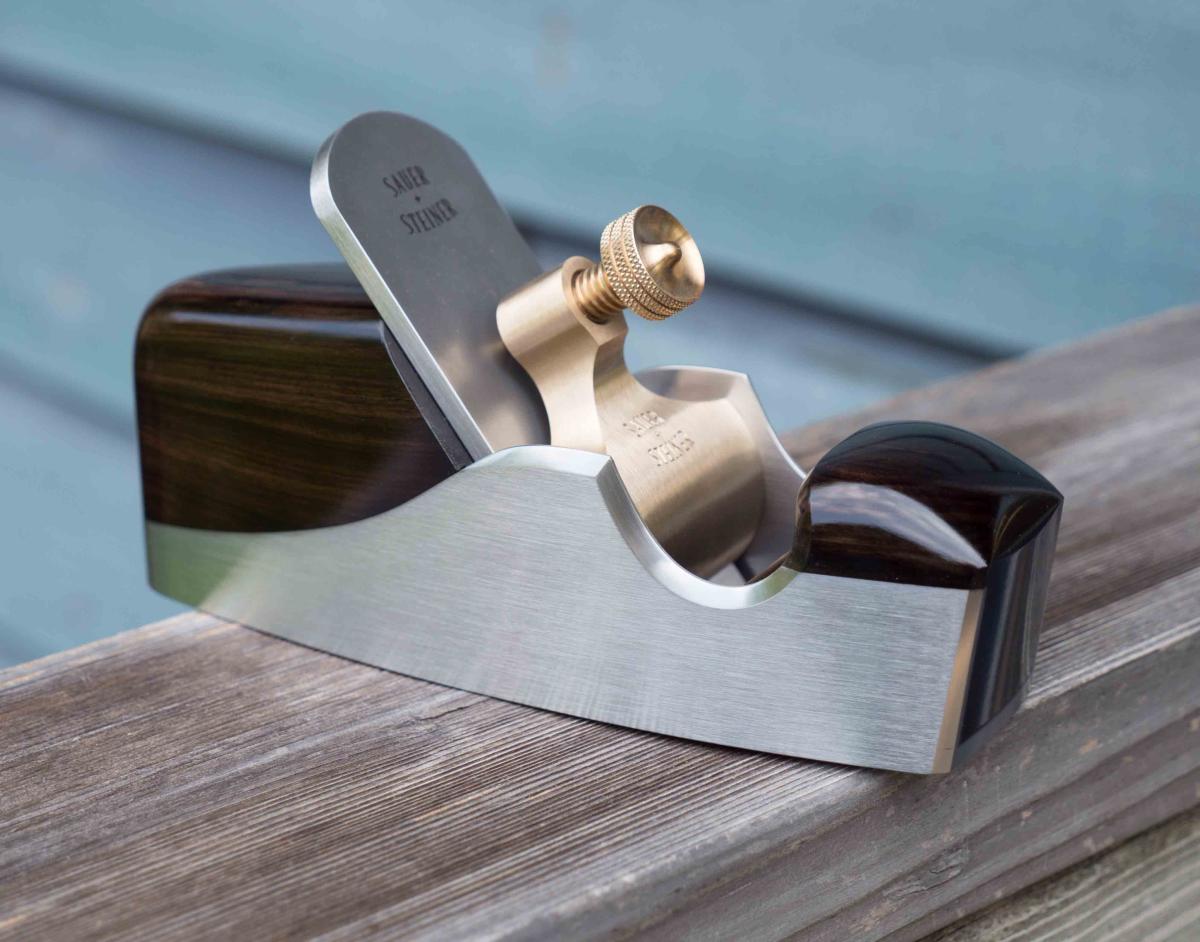
Here are some examples of Konrad's work:
Leo's bookcase done........
 |
| hmm....... |
I wasn't expecting this gap to fill in as much as it did with just paint. Made a command decision to see if I could close it up with paint alone. It will be a while before these will make the trip to North Carolina so I can check on it.
 |
| final check |
Used flashlight to cast raking light to highlight any boo boos. Found two on this shelf.
 |
| hmm........ |
The light highlighted them and I could see them without it too. Paint, especially a shiny one, defects pop out like blinking neon lights.
 |
| think I got all of them |
I applied wood putty to 8 spots. I wasn't expecting this because I thought I had steamed all the boo boos out already on this side. I guess the moving around I did with the bookcase wasn't as damage free as I thought.
 |
| done |
A couple of hours later I sanded the spots and slapped another coat of paint on them. Did one final eyeball and flashlight check and I was satisfied that I had not missed any. This was ready to get the back on.
 |
| nails first |
Used 1" brads to nail off the perimeter. If I make another one these I will make the rabbet bigger. The depth was good but the width was a wee bit shy of 5/16". I had to nail the brads angled on the sides due to gaps. If the width was 3/8" I could have nailed them straight.
 |
| screws second |
I put five #6x3/4" FH screws through the back into the back of the three shelves. This really stiffened the bookcase up a lot. I doubt a small block Chevy would make any of the shelves sag.
 |
| only one glamour pic |
Happy with how this came out. It was easier making a 2nd one. If I wasn't feeling so washed out this probably wouldn't have taken me as long as it did -12 days.
 |
| Leo's on the left, Miles's on the right |
They aren't exactly the same and I didn't try to make a clone. At a glance they look to be the same but there are subtle differences. The base cutouts aren't the same and there are small dimensions that you can't see with the eye. Most of them are less then a 1/4".
Another blah day. I had to set the bookcase down 3 times taking it from the shop to the boneyard. The shortness of breath is getting worse. I can longer go up the stairs from the shop without having to stop to catch my breath. It doesn't seem to pop out as I work in the shop. Don't know if I am subconsciously making allowances for that or not. For me the important thing is I can still work in the shop and make things.
accidental woodworker
Not Mussorgski
It was not the Pictures From An Exhibition but rather pictures from an exhibition of traditional wood finishing as last month I taught another iteration of my class at Joshua Farnsworth’s Wood and Shop classroom. Oddly, three days is barely enough time to scratch the surface of the topic while still changing the students’ mindsets pretty profoundly.
So I present, Pictures From An Exhibition of Historic Wood Finishing, featuring performers (students) from all over North America.


Pages
