
Hand Tool Headlines
The Woodworking Blogs Aggregator
“Glory to God in the highest heaven, and on earth peace to those on whom his favor rests.” - Luke 2:14
Be sure to visit the Hand Tool Headlines section - scores of my favorite woodworking blogs in one place.
Hand Tools
Dewalt 734 belt change pt pt II........
Things didn't go merrily, merrily down the lane today. Spent the AM at the DMV getting my license renewed. The clerks there must attend 6 months learning how to be arrogant and exasperating all the while smiling smugly. IMO the forms are confusing, and the instructions when available make it even more confusing to fill out. After filling the pie hole I drew up a new battle plan for replacing the belt.
 |
| my absolute best goofy looks |
Cleaning up the two pulleys was a royal PITA. Holding a flashlight to see WTF I was doing and trying to scrape the remnants of the old belt off took me almost two hours. The lighting SNAFU was the worse annoyance to deal with until it came time to put the new belt on. BTW the goofy looks didn't help one iota.
 |
| hmm....... |
I wanted to take this pulley guard off but I stripped out the screw. Made it awkward trying to get a pick and a steel wire brush on the small pulley. I could get the front 1/4" easy enough but the back had me cursing up a storm.
 |
| finally |
Managed to get the big pulley cleaned up. I turned it slowly and got all the little spots I had missed. It looked brandy new to me. The smaller, black pulley to top left was not being as cooperative.
 |
| it worked |
I got the acetone to clean up the big pulley and I wasn't expecting it to do anything with the belt residue. It softened and removed it. It worked on the black pulley but it wasn't as easy removing it. However, it did soften it sufficiently that I could get a pick at it and remove it.
I thought of drilling out the screw on the black pulley cover and went so far as to find my set of screw extractors. I only two, one for a tiny screw and one for a 1/4-20. Neither of them would have worked here. Briefly thought of drilling it out too but nixed it. I endured the tedious process of wiping it with acetone, picking out with a pick and knife, and then wiping up what I could. Wash, rinse, and repeat 25 bazillion times before the pulley was clean.
 |
| another hmm....... |
I couldn't see how you could one, get the belt behind this rod and two, then get it on the bigger pulley. To my thinking this rod has to go. Started with removing the plate at the bottom held on with two screws.
 |
| nope |
I got the plate at the bottom off but the rod wouldn't unscrew so I nixed doing that. I tried to get the belt onto to the big pulley and nada. I couldn't get it downward so I could get a piece of it onto the bottom of the pulley.
 |
| this sucked pond scum |
I had to remove this sprocket in order to unscrew the rod. Up to this point all the screws were imperial but not so on the bottom boys and girls. Here it was, lets switch over to metric. The two set screws holding the sprocket were 3mm held on with blue locktite.
 |
| off and out of the way |
The bottom plate on this is set in a groove on the rod which locks in the proper position of the rod. Nice touch that it doesn't need to be aligned or adjusted.
 |
| frustrating 30 minutes |
I tried everything I could think of to lever the belt onto the bottom pulley and nothing was working. I had soaked the belt in hot water from the tap for about 10 minutes. I don't think the water was hot enough because the belt hadn't seemed to stretch at all.
 |
| because I'm brain dead |
I also like pissing into a head wind and say it is raining. Let the belt soak in boiling water, off the fire, for ten minutes. This was no better and the first hot water experiment. The belt didn't even feel hot to the touch.
 |
| No Mas |
I called it day mostly because I was getting nowhere getting the belt on. Instead I went back on YouTube and looked up the belt vid again. I couldn't find the one I watched where the guy did the hot water trick but I did find one YouTube vid from 'ereplacement' that was an eye opener.
First off I found out that you can remove just the side panels without having to take off the top. Secondly and most important is you don't have to remove the threaded rod. He showed how to get the belt in position on the big pulley after getting it on the smaller one. Then he uses two screwdrivers levering against the rod and using the nut on the big pulley as the fulcrum point. Zippty Doo Dah and the belt was on.
I don't remember seeing this vid when I searched the other day. If I did I might have ignored it thinking it would be an advertisement for 'ereplacement'. I will try the belt replacement dance steps in the AM following this vid (which I bookmarked). Right now all I want to do to the planer is see how well it will survive me going postal on it with a 3lb sledge hammer.
accidental woodworker
Three-Tier Auger Bit Box
A couple months ago I came into possession of an old Russell Jennings auger bit box. Somewhere along its life, someone had altered the box by removing from the first two tiers the grooved shelves that held the auger bits safe from rattling around.
 |
| The old box |
 |
| The top tier with grooved shelf removed and ugly compartments installed |
 |
| Middle tier with grooved shelf removed |
 |
| Bottom tier with grooved shelf still intact |
This got me thinking about how to repair the box. A few years ago I made a different (but similar) type of box for a set of auger bits, so I was confident I could recreate the grooved shelves. But in the end I decided to make a whole new Russell Jennings style of box from scratch.
 |
| My version of the three-tiered box |
I don't know what wood the original boxes were made from, but mine is oak with poplar bit trays. The Russell Jennings boxes are made with 1/8" box joints at the four corners and no doubt they were made as a single box and then sawn apart to create the three tiers. Due to the narrow recycled oak I was using, I decided to make mine as three separate boxes, each joined at the corners with 1/4" box joint fingers.
Before making the boxes, I played around with making the grooved trays. It took some trial and error to get the layout right so that all the bits would fit in their respective trays, and so that the box would have the right dimensions. If I remember correctly, the box needed to be 4 1/8" front to back, with 3/8" thick sides, which left 3 3/8" width in which to fit a bunch of auger bits.
 |
| Middle tier laid out - these need not be perfect half circles |
 |
| Here's the middle tray partially grooved |
I think I made each layout curve about 1/16" greater in diameter than the bit that would fit in it. The grooves were cut starting with a plow plane. Then, depending on the size of the groove, I followed with either round planes or scrapers in a scratch stock . For the largest grooves in the bottom tray, I also used a gouge to chop away some waste.
 |
| Top tier almost done, plow plane and scratch stock in background |
 |
| Middle tier was done with plow plane and a small round plane |
 |
| Here's a preview of the three tiers |
 |
| Grooves in one of the tier's ends |
 |
| Forming a rabbet: saw close, then clean with chisels and rabbet plane |
 |
| The bottom tier was special with this rabbet ... |
 |
| ... and a rabbet on the underside so the tray's bottom would be in line with the box's bottom |
One more detail: the square tapered shank of auger bits is wider than the business end for the 1/4", 5/16" and 3/8" bits, so they don't sit right in the box unless the end where the shanks of those bits rest is relieved.
 |
| An old Russell Jennings box showing the relieved area |
 |
| Marking out |
 |
| After careful paring with chisels |
 |
| Now they play nice together |
The hardware is nothing special. I used cheap butt hinges and front clasps from Lee Valley. Most of the small brass screws I had were 1/2" long, so I had to cut them down to 3/8" so they wouldn't go through to the inside of the box. Screw holes were pre-drilled and the screws were waxed to ease them into the hard oak. The hinges were not mortised into the box but were surface-mounted, similar to the way some old Russell Jennings boxes were made.
 |
| Hinges on the back |
The front clasps were nailed on and I predrilled holes for the nails.
 |
| Installing the clasps |
 |
| Clasps on the front |
I gave the outsides of the box 3 coats of shellac and a coat of wax. The box is about 3/16" taller than the old boxes. I could have easily gotten the correct height in my box because my top tier tray was deeper than it needed to be. But overall, I'm happy with it.
Something unexpected: I got a free can of shellac on "freecycle" and it was cloudy. I've been mixing my own shellac for years and it's always clear. But I tested this shellac on a scrap and it hardened properly. Anybody have this issue with some cloudy shellac?
 |
| Cloudy shellac |
If I was a real maniac, I'd try to duplicate the label that R-J put on the inside of the lid of their auger bit boxes (see pic #2 above). I'll leave that for the real gung ho out there. All for now. I'll leave this with a couple of glamour shots.
 |
| The finished box |
 |
| And with bits on display |
The Bosnian, Ottoman-Influenced Arabian Style Bookshelf Part 5
The top moulding is made the same way as the base moulding. I ripped all the parts to finished width first, so every piece was already the right size before any mitres were cut. Then I cut a mitre on one end of two pieces, so they would meet to form a corner.

I took those two pieces to the top of the bookshelf, fitted the mitres together without glue and clamped them so they couldn’t shift. With the corner sitting tight, I looked down the length of the front piece to the opposite end, where it runs past the side of the bookshelf. At that end I held a pencil against the edge of the bookshelf and struck a line across the moulding. That line is exactly where the next mitre has to start, and I didn’t measure a thing to find it. Measuring is where mistakes creep in, and one wrong number means a ruined piece of timber. Letting the bookshelf tell you the length is far more reliable.

I cut the mitre on that pencil line, then fitted it back in place. For the last piece, I laid it on top of the mitre I had just cut, so the two overlapped, and scribed a line along the angled edge. That scribed line is the mitre for the final piece. I cut to it, again without measuring anything, and the three pieces came together in a U shape around the top of the case.


I let the moulding overhang by 1½” on the front and both sides. The back is cut flush with the back of the case. Then I glued and screwed it down. I could have plugged the screw holes, but the case is tall and nobody will ever see the top, so I left them as they were.


Boondock Sunrise (?)

When you live in heavily wooded hills like Shangri-la, the term “sunrise” can have different meanings. In the case of today’s post, it is the time when actual sunshine strikes the surroundings, or somewhere between 9AM and noon.

This tree exploded in chromatic brilliance once the sun was on it. Last week’s pic was from a grim, grey day that was followed that night with four inches of rain.
My oldest picture (very distant and blurry) of this tree was from 25 years ago and it was a sapling probably the size of my wrist. Now the trunk is the size of my waist.
Dewalt 734 belt change........
The weather forecast changed and now there was rain in the morning and cloudy skies in the PM. Based on that I decided to wait on changing the belt until tomorrow. The skies looked like they would open up at any moment and drop rain like a cow letting loose on a flat rock.
 |
| done |
Got the jig set so both aprons are inset an 1/8" from the outside edge. The first leg was 1 1/4" and this one is 1 3/16". The dowels didn't bypass each other so I had to adjust and play with them until the aprons seated fully on the legs gap free.
 |
| only a 16th |
I was surprised that I could see a difference between the two thicknesses of the legs. Once this one has the chamfers on it, it should look a little more thinner and slender.
Stopped here and did some grocery shopping and dropped off a package at FedEx. Decided that I would change the belt in the back hallway rather then wait until the next day.
 |
| ready to do battle |
Didn't know it here but I hadn't brought all the tools I would need. I ended doing the one thing I wanted to avoid at all costs and that was trotting up and down the stairs getting things I forgot. Getting the outer shell off the planer was painless and incredibly easy to do.
 |
| worth it |
I purposely made this little tray to hold screws etc etc. These things can go MIA in a heartbeat. As long as I don't knock it over I should have them come time to put it back together.
 |
| this sucks pond scum |
The old belt had melted on the bigger pulley. The smaller one (up to the left) had some melted crappola but not as much. I have to remove and clean this up before I can put on the new belt. It doesn't look like it is going to easy to do.
 |
| found it |
The block with the knives wasn't turning which was making cleaning the big pulley a ROYAL PITA. Now that I found this I won't have to flip the planer 180 so I could have access to the bottom of the pulley.
 |
| incoming headache |
I got some of the melted crap cleaned off and stopped. I went back to the shop and got my vacuum and more tools. That wore me out and I sat at my desk to rest and fell asleep. When I woke up I tried to get the belt on - just to give it a look see.
Getting the new belt on isn't going to easy. The belt has to stretch about a 1/4" to fit. The procedure says to install the new belt first on the top, smaller pulley and the bigger one next. The bigger pulley has a rod in front of it. No mention of any hints to help. The YouTube vids I watched, one of them soaked the belt in boiling water which helped him. I still have to clean the pulleys before I can have fun, fun, fun with the new belt.
accidental woodworker
console/entry table pt VII..........
Things are getting worse for me with my breathing issues. Leaving the shop and coming up stairs is exhausting for me. It now takes me about 15 minutes before I fully catch my breath and stop coughing. I'm learning to work around it by moving as slow as a glacier. That helps because if I do my normal balls to the wall walk I cough for a bazillion hours and get short of breath.
So I've been carefully planning before I go to the shop (going down is problem free still). I try to stay as long as I can before going topside. I try to make that as close to lunch time so I don't have to make any extra up/down dance steps. Once in the shop I can carry on albeit nowhere near at the pace I used to do. Regardless, I'm just happy to be able to make shavings and sawdust no matter what my body annoys me with.
 |
| cut list |
I didn't see any reason why I couldn't cut out the aprons, top, and bottom shelf now. I know how wide (front/back) my wife wants it but she made no mention of the length (R/L). The top is 9" wide and 30" long. The bottom shelf is 6 1/2" wide by 26" long. The aprons and the one stretcher are all 2" wide but different lengths.
 |
| ouch |
I couldn't find the wrench that came with this router. The only joy I take from that is that it is too big to sweep up with shavings and shitcan. I'm sure it will turn up in some totally unrelated black hole.
 |
| done |
End aprons, top and bottom shelf, and the bottom stretcher. I am not putting any long side aprons on the bottom of the table. That will keep the table light and airy looking.
 |
| hmm........ |
Rounded the ends of the top and the bottom shelf. It isn't much but it lightens up the top continuing the delicate look I'm going for. I'll hold off sawing the round off until the aprons are glued and set. Leaving it square will be easier to position them and do the layout for the table top clips.
 |
| done |
Got check marks on everything on the cut list. Once I get the legs done, finishing this will take no time at all.
 |
| tough going |
Initially I got winded quick but the more I did it the easier it went. It didn't go fast and I got all the aprons, the stretcher, and the top and shelf planned and smoothed on the edges. I'll the do the faces before I do the glue up.
This is all I got done today. There is nothing on the horizon yet as the next project and I had taken this one as far as I could for now. Tomorrow I'll saw out a piece of scrap 1 1/4" square because that is the size leg I decided on. I'll use that to set the length of the dowels and the offset for the aprons.
 |
| 2 for $18 |
These came as I was finishing up this blog post. The email had said friday but I'll take it. I checked the weather and tomorrow will be cloudy but no rain. I had watched YouTube on replacing the belt and none of the vids looked difficult. Taking the planer apart to replace the belt was what I thought it would be. None of the vids said that any alignment was needed and it was put back together in reverse order. That is a bonus.
accidental woodworker
Inches I like

I like my inches, they always made total sense to me and I think that that's because learned imperial measuring as a young child. Inches made me think, and I think the more in fractions of inches and then there is the foot distance and yard too. I picture distance in yards and miles. In my culture, imperial has been a common thing. I take it for granted as standard to me. I look at sixty-fourths of an inch and see an increment, a percentage of that inch that fits into it sixty-four times, but then a half-inch with thirty-two increments in it, or eight thirty-seconds of an inch in it, at quarter of an inch with sixteen in it or8/32nds of an inch in it. What's to fault that, anyway?
Sense comes in many ways. Remember, at aged fourteen, my headmaster told my parents, "Paul can never be educated." This man thought you could cane and strap education into children who didn't learn at the same rate or in the same way as all the other children did. He used a wide leather strap to drive his point home and strapped them to learn compliancy. But I knew feet and inches, could measure with these increments easily. Sense comes in many ways and experience makes theory concrete for minds that envisage in three-dimensional reasoning. Twelve inches to a foot made great sense to me as did a foot distance and a yard made up of three feet toe to heel in a length. Get over it!
Stanley's tapes in Europe carry the CE letters which stands for "Conformite Europeenne" which is French for European Conformity. Naturally, metric measurements will ensure exactly that: conformity to EU standards. The US has no need to conform to metric even when it benefits all and shows inclusivity.It seems a strange thing to me that the birth of the new world adopted imperial as it's standard measuring system. The USA measures a large percentage of its work in imperial feet and inches but less so using yards. The whole of the English imperial measurement system is not quite its officially adopted system but close to. Furthermore, the US uses its own United States Customary System (USCS) as its primary system of weights and measures used for everyday commerce, but the length of inches determining feet and yards remains the same as imperial measuring, translating into the exact same distance as the English or British inch which only older people like me still relate to in the everyday of life here in the UK. It's actually borderline. The majority of the UK in every sphere adopted metric in and around 1965. In the US, volumes and weights differ to the UK imperial units but of course the change over to metric in the UK started in 1965 and is now pretty near complete. The British Imperial system was imposed across the British Empire in 1824 to standardise it throughout the empire, hence the term Imperial Measurement. The UK transitioned to the metric system following a request from British industry who sought to adopt metric units for international trade competitiveness. This may have prefaced joining the EEC (the title prefacing the EU) but it would be 1973 before Britain was finalised as a member. I'm sure that with the evaporation of my generation we will see the evaporation and extinction of the imperial system in the next five years also.
Even understanding and adopting both system of measuring distances, working in inches still makes more sense to me than metric does, but that is purely because I learned to use imperial in my formative years and subsequent training in work, building on solid foundational knowledge. I can relate better to the inch and foot more readily than metric, though those using metric can rarely relate to that level of security. You see, owning the knowledge means I have no need to be threatened by it, and therefore I don't argue with inches at all for my daily work: I simply own them. They're quite fine to me, but that doesn't mean rejecting a metric system too. Once you learn complicated systems you can easily and readily adopt simpler ones, but you will more than likely never go the other way.
 The Kreg fence is not the best retrofit version to install because the table slot for blade installation and removal on many UK bandsaws is on the front rather than the side, so the channel guide is not designed for this slot location. A retrofit version could have been made easily, but the market demand might not be big enough. As a result, there is a break in the fence and alignment for a seam-free smooth move from left to right takes patience and some shop-savvy metalworking to get it just right. I have done this to three bandsaws now. You would think I would have learned after the first two but hey ho.
What still stuns me each time I go to my bandsaw is that a tape measure for modern-day equipment might well come only in imperial (or USCS) on a tape measure. I installed a US made Kreg fence on my newest bandsaw recently, and the tape that came with it had no metric measurements on it. Imagine such a thing in 2026. Such a simple thing seems to have escaped the brilliance of their refined engineering, and yet I will guarantee that the engineering of all the components were carried on machines governed by metric control.
 Going way back to the first retracting measuring tapes in the UK we had both measuring systems on the tapes. So in and around the mid-1960s we could work with both systems. How come 65 years later we have a tape being manufactured without metric?
Being born to inches and feet, understanding each one of then, I placed inches into feet and yards, then feet and yards into miles too, quite readily. 5280 feet end to end in every mile is a happy treasure I value. I will die in a casket I made using inches knowing inches gave me height and width before cutting the dovetailed corner and making the lid with three-eighth inch mortise and tenons for the lid corners. I love inches, understand them, think in them, imagine them in any number you give me to see visually in my brain and anything in three-dimensional sizing. Once you know them you use them and using them means you own them. I have earned the right to them.
 Lee Valley Veritas produced left- and right-handed tapes, so the numbers are upright for both parties but of course that didn't turn things around for a parallel metric side.
When I received the minor instruction guidance in designing the two White House credenzas, I was given four sizes: length, height and depth and then the radius for the curved wall they would stand against in the Cabinet Room on each side of the door leading to the Oval Office.
 We made ten book-matched face panels like this one so that not only were the sections to each panel book matched, but the two credenzas were wholly book-matched opposites too. This was taken at the tail end of 2008 and the first few days of 2009, my closing days of life in the US and Texas where I had lived since 1985.
These measurements came in Imperial inches and fractions thereof throughout, though some pedantics might say USCS inches (one and the same size), so not a millimetre anywhere in sight. The exchanges between my US colleagues and myself were in inches though mine were imperial all the way. No matter: we delivered.
 These two credenzas are the only mesquite pieces in the White House Permanent Collection. They grace the end of the Cabinet Room on either side of the door leading to the Oval Office, which I never got to go into. The pictures I have are really quite unique in that they are fresh-coloured but unstained mesquite and have doubled in darkness now so they match the depth of tone of the adjacent massive Richard Nixon conference table of the Cabinet Room.
Addendum: I work equally well in metric and imperial and quickly switch to either if discussing with metric-only users, which is now the majority here in the UK. I learned metric in 1967 in ten minutes. There's nothing to it at all. Especially is this so when you've mastered the reality of maths classes where you learned about pounds, shillings and pence where such was the day back then when we entertained 20 shillings to the pound, 12 pence to the shilling and denominations of farthings, halfpennies, pennies, three-penny bits, sixpences, shillings, half-crowns and crowns and ten shilling notes all inside a pound equalling twenty shillings.
console/entry table........
The legs for the table are in limbo for now. The belt for the planer is on order and this AM I got an email that it had shipped. A 2nd email said it would arrive on this friday. When I ordered it the write up said 2-4 day delivery, so maybe that is close? In the interim I decided to play with leg designs so I could eyeball the look of it.
 |
| first set of experiments |
I've been running different ideas through the brain bucket since my wife asked me to make it. Because it will be narrow and delicate looking, I didn't want just plain square legs. I don't have a lathe so any turning options ain't happening. I'm starting with two blanks 1 1/2" square.
 |
| first changes |
The 1 1/2" square size looked too clunky IMO. The leg on the right I ripped down to 1" square and I like that size. I don't have a warm and fuzzy about the leg cutout at the bottom. The real estate sitting on the ground is a little more than 1/8" by 1". It looks too thin. Note to self - 1" square is ok, the leg angle is history.
 |
| hmm....... |
This kills it for good. The angled cutout looks flimsy but I did get the depth of the dowels dialed in. That took me 3 tries before the aprons seated gap free.
 |
| worked |
I was worried that the size of the leg wouldn't be large enough for the dowels on adjacent faces to pass each other. They did, barely but neither set hit the other one.
Got one hiccup with the aprons. The set back is off - one side has it and the other doesn't. Taking the angled leg cutout into account screwed me all up when I drilled the holes for the dowels.
 |
| nope |
The idea I had was to make the angled cuts so they were on the outside and front inside faces. I'll kill all the suspense and fess up that I screwed it up. The 2nd cut itself was good but I had sawn them on the wrong faces. The cutout at the bottom was painfully small. It looks delicate but it also looks like someone walking by it would cause it to snap in two.
 |
| hmm...... |
I'm scratching angled leg cuts off the to do list. I'm not happy with how thin the bottom of the leg looks. On to the 2nd option rattling around the brain bucket.
 |
| too small |
Changed my mind on the size of the leg. I want a wee bit more separation between the sets of dowels and also to have more dowel sticking out. I think I'll eyeball what 1 1/8" and 1 3/16" square looks like before I decide. I think either one is still small enough to look delicate.
 |
| hmm...... |
I don't want the aprons to be flush with the front. I don't care about the inboard face position. I played around with the shims until I got a setback I liked. I'm leaving the dowel jig and the depth guide set up for this.
 |
| this is winning so far |
The 2nd option was to plane a chamfer on the outside 90° edge of each leg. I planed the first one free hand which was a bit awkward. I whipped out a 45 planing sled lickety split and it worked perfectly for planing the 2nd leg.
 |
| hmm....... |
I think I found the winning entry. A large chamfer on the outside 90 and smaller ones on the other 3. The other 3 are subject to change because the short side aprons haven't been factored in yet.
 |
| stopped chamfers |
The inside edge opposite the could go all the way up to top of the leg. The plan is to stop the chamfer a 1/2" below the bottom of the aprons. Again this is subject to change.
 |
| 2nd leg |
An alternate for the chamfer is a round over or maybe a round over with shoulders. I do like the look of the chamfers on all four legs. They make the leg look thinner and should make the larger legs look the same too.
accidental woodworker
Taking out an old post from the Old Postern
Hara-kiri on this cruck foot. The suspected dry rot is exposed. No problem; it's source of water has been removed and the socket is now dry. Contrary to common belief, dry rot needs a water source to grow. The pillow/corbel/cruck plate was a bit bent!


real big sigh........
 |
| ready, almost |
I left these on the workbench to make sure neither of them had any stupid wood tricks up their sleeves. Spoiler alert - they both behaved themselves.
 |
| checking for flat |
Put the boards together and they were flat against each other end to end. No humps and no playing Mr Helicopter. In all combinations the two of the lay together gap free 360.
 |
| the big sigh |
This board wasn't planed on this face, it still has the scallops from the router. I was tired yesterday and not really paying attention 100%. The last two times I ran the boards through the planer, there weren't any shavings being spit out. I assumed (wrongly) that the setting was too high and the board just went through underneath knives.
 |
| hmm...... |
I ran a board through and nada. The roller pushed it through but no shavings came with it. I took off the cover and I didn't find any interlocks so I turned it on and nada. The motor spun up but the cutter head didn't move. My first thought was a drive belt or maybe a gear was broke.
 |
| what's left of the drive belt |
Glad it is just this and not a stripped or broken gear. I checked the WWW for a replacement belt and the prices caused a hacking fit for a bazillion minutes. The OEM price averaged $80 but eBay prices were about $12-18. Those were a lot more reasonable. I also had checked the wrong Model #. I have a DeWalt #734 and I had checked prices on a DeWalt #735. The prices were better for my machine and I got a replacement belt on order.
This put a rather huge monkey wrench into the gears of making the console table. There aren't any tool repair centers within a reasonable distance from my house so I'll be the mechanic replacing it. It looks to be a fairly simple job but I'm not sure how much of this I'll have to disassemble to replace the belt. And if there will be any alignment(s) associated with replacing the belt. I'll be spending some quality time on You Tube tonight.
accidental woodworker

A Simple Way to Convert an 8 String Classical Guitar Tuning into a Brahms Guitar Tuning!
For those of you who don’t know what a Brahms guitar is, it is a classical guitar with eight strings, a cello end pin and the guitarist holds the guitar like a cello. Please visit my page on the Brahms guitar, Paul Galbraith’s website or Redmond O’Toole’s Instagram account for more details of this wonderful style of guitar.
About twice a year I receive emails from guitarists asking me if I will make them a Brahms, I tell them “yes, I can” and then they ask what I charge to make one for them. I tell them that the base price for my classical guitars is $8,000 and a Brahms guitar starts at $8,500 - that is when they lose interest. A lot of work goes into making a Brahms guitar: I triple laminate the sides; I hand cut all the fret slots, the fretboard is fanned, this guitar actually has eight different string lengths(!); the neck is wider than a standard classical; I have to make a special bridge, which is angled to matched the different string lengths; installing the cello endpin; etc., etc.
Recently, a guitarist asked me if I could make a Brahms guitar for them, and if I could send one to them to try out, just to make sure they would want one. I do not have a Brahms guitar on hand. I told them that a client of mine has one for sale, they should contact that client to discuss the playing technique used for playing a Brahms guitar and the possibility of buying the guitar.
The next week I contacted the guitarist and asked them why they wanted to play a Brahms guitar. Their answer was what I expected, the Brahms guitar offers more musical possibilities than a six string classical guitar. Then I suggested to them what a guitarist can do to experience a Brahms guitar without having to buy one.
WARNING! What I am about to suggest is to be done at your own risk! This is just a suggestion! I am not responsible for any damage done to any guitar! This suggestion is a way to try out the tuning of a Brahms guitar! DO NOT drill a hole in the guitar for a cello end pin! Hold the guitar as you would a standard classical guitar! If you do change strings, protect the guitar while you do the work! Please read this ENTIRE post before attempting!
If you really are interested in trying a Brahms guitar without a cello endpin, find someone who is willing to loan you a standard eight string classical guitar, or better yet, find someone with an eight string guitar that is interested in trying out the Brahms tuning. I also suggest that you read about the history of the development of the Brahms guitar before you attempt changing strings.
A Brahms guitar is usually tuned B1 E2 A2 D3 G3 B3 E4 A4. A standard eight string guitar is usually tuned A1 B1 E2 A2 D3 G3 B3 E4. All you need to do to convert that eight string guitar tuning over to a Brahms tuning is to remove the eighth string completely from the guitar. Once you do that, shift the remaining strings over towards the bass side, so that the seventh string now becomes the eighth string, the sixth string becomes the seventh string, the fifth string becomes the sixth string, so on and so forth until there is no longer a first string on the guitar. Then you need to find a first string that can be tuned to A4 without breaking.
I suggest buying a set of Aquila Bionylon High A Tuning Classical Guitar Strings.
Here is Aquila Strings description of the set:
High A tuning: A D G c e a, regular guitar intervals, but the 1st string is an above normal e.
We are proud to introduce the Bionylon® the first eco-friendly synthetic string in the world. These special sets also offered in Low A, High G and Low E tuning all designed for a guitar of 64-66 cm scale can give a guitar quartet, all using normal 6 string classical guitars, the range of an orchestra.
These strings get good reviews at the various on line guitar string dealers.
I suggest that you take that high “a” string and use it as the first string on the guitar. Eight string classical guitars are usually built to withstand the add tension of two extra strings, if in doubt about this you should contact your local luthier or qualified repair person. If you are uncomfortable in changing these strings take the guitar to your local luthier or qualified repair person and pay them to do the work!
Once you add that high “a” string, slowly tune all the strings, perhaps you should start with A435 to see how the guitar will react. To try out the tuning, hold the guitar as you normally would, DO NOT DRILL THE GUITAR FOR A CELLO ENDPIN! If you like the tuning and want a custom Brahms guitar, contact me or any luthier about making one for you!
Again, I must state that this procedure is just a suggestion, do not proceed with this if you are uncomfortable with the idea.
I first learned about the Brahms guitar in 1994, shortly after it was premiered by Paul Galbraith, I was immediately impressed by expanded range of the guitar. I shared the article with a fellow guitarist and he said, “Now, that’s best idea I’ve seen in a long time! Every guitarist should have one!

”
If you have any questions or comments about this idea, please email them to me at
highcountrylutherie@gmail.com
I will not answer any comments posted to this post.
better day.......
Today started a whole lot better than yesterday. No coughing fits going on continuously for a bazillion hours. The shortness of breath is still kicking my arse but the coughing has toned down a ton. That was a welcomed relief. I didn't do anything in the AM but sit and veg out. I wanted to make sure that it would keep going on as is.
I went to Gregg's for fish 'n chips and I when I got back home I started working on getting the boards planed to final thickness. It took me a long time and I spent four times as much resting then I did doing any planing.
 |
| 80 pounds - 36 kilos |
I had to do everything one at a time. The only things I doubled up carrying out were the extension cord and my hearing muffs. The boards, the back hall bench, and the planer I brought out one at a time. In between each trip I had to sit and rest to catch my breath. On a bright note, I didn't have to suffer through spasms of coughing. Definitely looking that yesterday was a bad day.
 |
| planer was last |
I will have to do these dance steps 3 more times. One to bring this all back into the house and then twice more tomorrow when I plane the individual legs.
 |
| hmm...... |
I usually put the planer in the middle of the driveway (to the right). That is a distant memory now. That is now too far to carry the planer to. This was manageable but I think this is something that I won't be doing again.
 |
| done |
I am not sweeping up the shavings. It was breezy and the pile on the left was already 1/2 blown away. Besides the wind owes me a favor.
This was all I got done today. I got all the stuff back into the house and brought the boards down to the shop. Overall I was kind of happy with how things went this PM. The shortness of breath sucked but after resting for 10-15 minutes all was well in Disneyland again. Tomorrow I'll try to do get the remainder of the donkey work done.
accidental woodworker
day off.......
I can't remember the last time I didn't go to the shop during the day and made sawdust. I had gone to the shop in the AM to get my ear muffs. At that time I had fully intended to haul the lunchbox planer outside. That didn't happen boys and girls. I spent 99% of the day seated at my desk watching You Tube listening to pod casts.
I had a terrible night sleeping and woke up for the final time a little after 0300. Every time I moved or rolled over I would have a coughing fit. I must have drifted off again because I didn't roll out of the rack until after 0700. Things didn't get any better once I went upright.
I went through one coughing fit after another for half an hour. The coughing sucks pond scum but now I was being rewarded with the pleasure of losing my breath with each fit. I let things settle down and after not coughing for over an hour, decided to haul the lunchbox planer out to the driveway. Within a couple of seconds of walking about, the coughing fits started again.
There was no way I would be able to haul my heavy arse planer out to the driveway today. That much exertion would probably bring on a massive coughing attack. Decided then and there to take the day off and veg out at my desk.
Tomorrow is supposed to be mostly sunny so at least the weather is cooperating. Now I just have to get my body agree with what I want to do.
accidental woodworker
Make the Infamous Tusk Tenon Joint with Hand Tools
The Bosnian, Ottoman-Influenced Arabian Style Bookshelf Part 4
It has been a while since I wrote about the bookshelf build, so I’m picking it up from where I left off.
In the last part, the bookshelf had been brought together, glued and clamped, and everything was square. I now need to add two final elements: a base moulding and a top moulding. The base moulding will help stabilise the bookshelf, while the top moulding will add character and finish to the piece.
Before making the base moulding, I need to construct a cleat which will be attached to the bottom of the bookshelf. I use ¾” thick stock for this. The cleat is glued and nailed in place, flush with the front of the bookshelf. Its purpose is to provide a solid gluing surface for the front section of the base moulding.
I cut the cleat to size, apply glue and clamp it in position. To speed up the process, I use cut nails to permanently attach the cleat. This means I don’t have to rely solely on the glue to hold it in place, and I don’t have to leave it clamped while waiting for the glue to dry.
When using cut nails, I take a little care to prevent the stock from splitting. I drill a pilot hole part way into the wood rather than drilling the full length of the nail. I also position the nail so that it follows the direction of the grain before driving it in.


To make the base moulding, I start with a long board approximately 20% longer than I actually need. I then rip the board to the required width. The moulding consists of three pieces which will form a U-shape around the bottom of the case. I don’t measure the individual pieces. As Christopher Schwarz says, measuring is your enemy. Instead, I fit each piece directly to the bookshelf.
I start with one of the side pieces and place it against the case. I then use a pencil to mark where the board meets the front corner of the case. I take it to the mitre and cut the 45° end directly to the line I have just marked. I then repeat the same process for the other pieces, fitting and marking each one against the case rather than relying on measurements. The front piece is mitred at both ends, and the two side pieces are mitred at the front end only.

Once I’m satisfied that all three pieces fit correctly, I apply glue to the cleat and the case where the moulding sits, then clamp it in place. I leave it overnight so the glue can dry properly.
The following day, I plane a 45° bevel along the edge of the moulding. Looking back, this is something I should have done earlier, while the moulding was still one long piece. It would have been easier to plane the bevel before cutting the board into the three sections.


That completes the base moulding.
In the next part, I’ll be making and attaching the top moulding.

more router sled work.......
 |
| quick check |
Wonky rocking board is on the left and it still is rock free on the workbench. The other board that I got twist/rocking free is now rocking.
 |
| I tried |
There appeared to be a hump and I tried to plane it away. I knocked back some of it but not all. Rather then chase my tail on this I decided to put this board into the jig and flatten it that way.
 |
| hard going |
My shortness of breath ramped up this AM big time. Trying to plane the hump off took a lot of calories and a lot of rest stops to catch my breath. Made something that should have taken a few minutes take a bazillion minutes
 |
| secured |
Used six blocks to keep the board in place. I had to shim three of the corners to eliminate any rocking. Ready to commence the dance steps again.
 |
| Lie Nielsen pure beeswax |
The router was stuttering on the rails. I waxed the rails and the base of the router. The stutter stepping went away and I only had to use the wax once.
 |
| see them |
The board has what I'm calling scallops across the length. They are similar to plane tracks (when the iron isn't parallel to the sole).
 |
| much joy in Mudville today |
The board is rock free. It was an ordeal to plane the face I routed. The shortness of breath was getting in the way much more today than in previous days. It was like someone flipped a switch that kicked in the turbo. Both boards are ready to be fed into the lunchbox planer.
 |
| hmm...... |
There is a noticeable difference in the two boards now that the flattening is done. the thinner one on the right was the wacky, wonky rocking machine. From eyeballing it I like the thickness of it for the legs. It will probably be a bit thinner before I am finishing running through the lunchbox.
The plan was to get the lunchbox planer out in the driveway and plane these two to thickness. Then rip out the four legs and plane them equal in thickness. That didn't happen boys and girls. I had zero energy left after bringing the boards up from the shop to the back hallway. I'll try doing this in the AM if the weather permits.
I didn't get any time in the PM session. I had some errands to run and getting gas was one of them. $57 to fill up the truck that was between a 1/2 and 3/4 empty. I checked on Maria and the frame wasn't ready and then I went grocery shopping. I had a tough time on the walking portions of these stops. I hope that today was just hiccup in the time line I have left.
Going down to the shop doesn't upset things but coming back up the stairs does. I have two sets of stairs to navigate and the first one I have to stop and rest to catch my breath. The 2nd set has only 3 and I'm now getting short of breath going up them. For the most of the day any movement on my part, turning, moving my arms, blinking would make me short of breath and usually followed up by repeated fits of coughing. Not a pleasant day sports fans.
I spent most of the PM glued to my desk chair but I did jump into the rain locker for a shower. This was first for me, I got short of breath 3 times showering. I still take a navy shower - get wet, soap up, rinse off, and repeat once. It has me thinking about how much longer I can keep making sawdust. Not to mention if I will be able to tackle the Welsh stick chair.
accidental woodworker
Presenting Gragg at Winterthur
Every Spring, Winterthur Museum hosts a Furniture Symposium, and I have been invited (again). I will present a demonstration on the making of Gragg’s Elastic Chairs during this year’s event, April 23&24, 2027. (I say “again” because I was invited to present five years ago but was then disinvited when I declined to comply with their Fauci Flu protocols.)
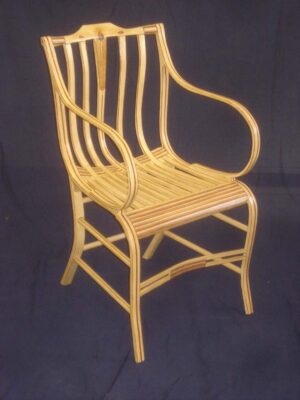
I think my presentation/demonstration will be about 75-90(?) minutes, which should be quite the adventure. You can follow the event developments at winterthur.org. Just go to the “Calendar” page.
I hope to see you there.
Once I get my teaching and presentation schedule finalized for 2027 I will post it here.
This Too is Manhattan (A Hike Through Central Park)
 A Victorian style rustic fence over a stream
I grew up near Central Park, but I am less familiar with its northernmost parts. Last Saturday had fabulous weather - a great time to explore the park. The north end of the park was intentionally designed to be an area of hills, hikes, and nature. Since the park's opening, a large public pool and some ball fields have been added, but this part of the park is very much substantially the way Calvert Vaux and Frederick Law Olmsted, the park's designers, envisioned it.
 The Conservatory Garden
We started at the Conservatory Garden on Fifth Avenue and 105th Street. The Conservatory Garden is a staggeringly pretty formal European garden. In the spring and summer you'll see multiple wedding parties getting photographed, but at this time of year you'll find folks who enjoy the peace and beauty. Then we walked, mostly uphill, to two waterfalls tucked away in the woods. The north end of the park is very hilly. And by hilly I mean OMG up and down, up and down, all the time. The hills are bad enough so the bicycle loop that goes around the park has a shortcut at 102nd Street if you don't think you can make the hills on the full circle that goes to 110th street. It's bad: I've done it.
If this part of the park has a style, it would be "Victorian Rustic." It has just enough organization so the rock formations allow you to step up to the waterfall, but not so much organization that you feel you're at a tourist attraction.
Like many centrally located urban parks, Central Park is incredibly heavily used. There are rowers, hikers, picnickers, people playing sports of all kinds. There is a roller disco dance area and bird watchers everywhere. There was a formal birdwatching activity for kids - in fact you can see a person dressed as a cardinal in the corner of one of the photos. And it's all free, one of the great goods of the city.
The park was built in the 1850s, the first landscaped park in the US. It was designed to serve its residents, who needed a place to cool down in the steamy summer heat and relax in nature, and also showcase the city as a major world class city with an urban jewel park as other cities had.
There was a lot of opposition to the park, but as speculators and another opportunists realized, there was also tons of money to be made. Central Park was built with a fair amount of corruption thrown in. Whole neigborhoods were condemned and torn down. Thousands of people were hired to shape the park. Mountains were blasted, valleys were dug, and the park came into being. And this is the point of this blog. What astounds me about Central Park is that the city government, complete with all its corruption, managed to build such an incredible public good. These days when I read in the papers about politicians overriding the will of the people to build things like data centers and tear down environmental protection, in return for donations, I think to myself, at least back then some of the corruption was for a public good. Now it's just money.
Here are some pictures of my trek in the north of the park. Bear in mind that Central Park is only three avenue blocks (5th - 8th) wide, so you're never really far from "civilization" (a good bagel). Traffic though the park is hidden from view by several deep transverses. The brilliance of the park's design, with its winding paths and architectural features, makes you forget that you are at most 1200 feet from a densely populated streetscape.
If you like the rustic furniture, you might find "Rustic Carpentry" a welcome addition to your library.
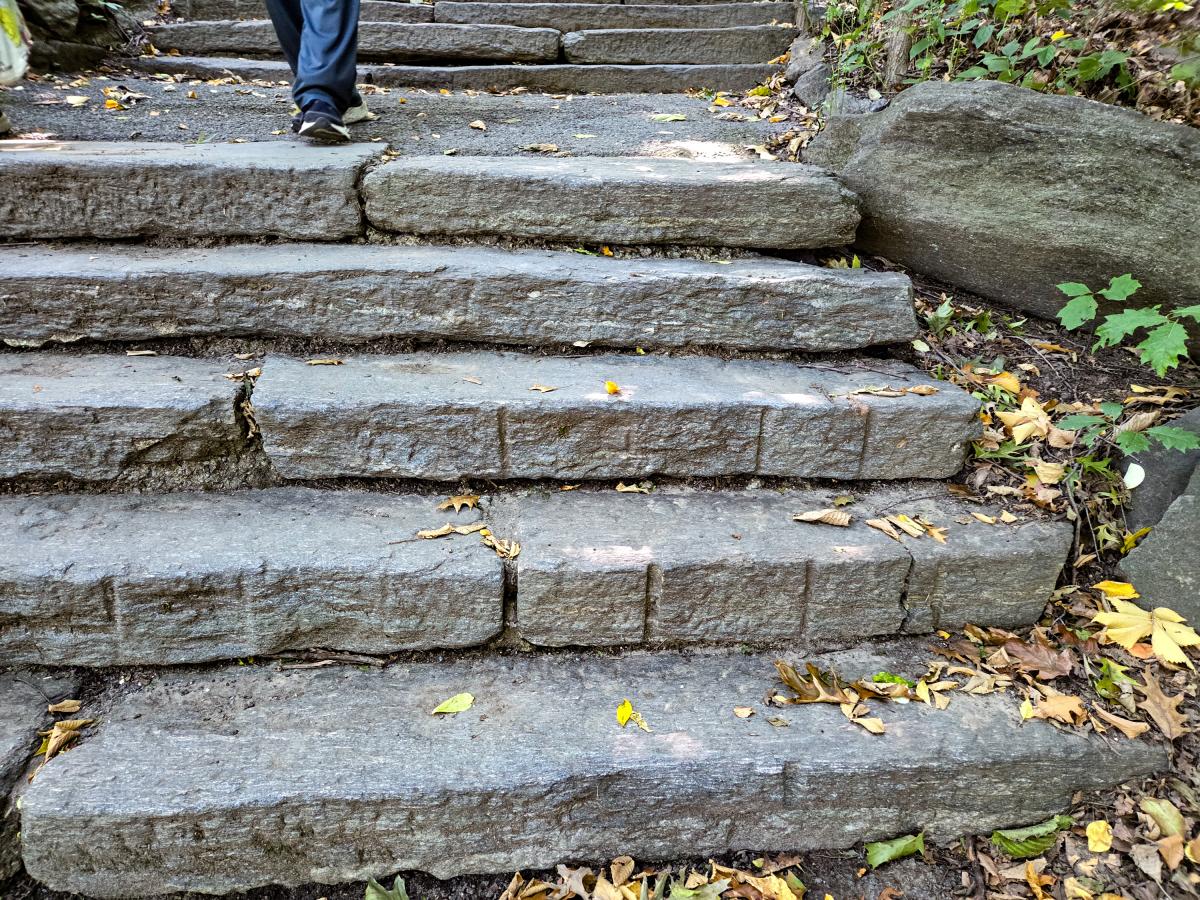 An original stone staircase
 One of the waterfalls; note the cardinal in the corner
 A babbling brook
 Reading and watching the ducks
 Birdwatchers sitting on a rustic chair
 Very low res picture of ducks
 View from a path
 The Reservoir
router planing sled pt II...........
 |
| done |
No tackiness on the tote or the tray. I'll bring this up to the living room and let the shellac fully cure out.
 |
| router sled rails |
I couldn't double these up due to the 90° lip on it. These are stiff enough I think that it will be ok with one.
 |
| rails done |
I thought of moving this outside bearer to the outside edge of the back wall but I didn't want to drill any new holes in the rails. Four #12 screws hold each rail to the bearers.
 |
| ready to try it |
I wanted the router to be 90° so the flats on the router base would butt against the upright walls of the rails but had to do it this way. The other way I would have had to cut the rails because they were almost touching in the middle. I didn't want to drill in the rails and I also didn't want to jigsaw a cutout for the router bit.
 |
| hmm..... |
I checked the height of the bit and the two router sled bearers were too tall. I sawed 1 1/4" off both of them. With the router full down the bottom of the collet is about a 1/4" above the board. I will have plenty of room for adjustment once the router bit is installed.
 |
| I was ready |
Got the board secured on all four sides. I got shims under the high corners. The board was secured with zero movement anywhere I checked for it.
 |
| hmm...... |
I had to road test. Made the initial first run with no hiccups. I was concerned with getting a chattering cut due to the router not moving smoothly on the rails.
 |
| tapered cut |
This is want I was expecting although I wasn't entirely sure of which way the taper would go or how deep. I hadn't planned on doing anymore than this but changed lanes. It took me less than 15 minutes to do the whole board going L to R.
There were some ridges because the rails did deflect a wee bit. None of the ridges were higher then a 32nd. Some I went back and removed but I left most of them. They would very easy to clean up with the 5 1/2.
 |
| done |
Surprised that the router debris was rather subdued. On the board the deepest cut looked to be a strong 1/8". I was prepared to make a 2nd run but it wasn't needed. Vacuumed up the wood dust and decided to do the other board next.
 |
| 2nd board |
This one I didn't have any headaches getting it flattened and twist free. Just for peace of mind I ran the router over it. I set the bit so that it was barely taking a skim cut.
 |
| simley face on |
From the near end to where my finger is, is the only place the router cut. And it was only on the right side edge, not across the width of the board. The board lay flat on the workbench before I loaded it into the sled and did the same after I took it out.
 |
| the wacky rocking board |
It is laying dead nuts flat on the bench with zero rocking when checked on the four corners.
 |
| laying gap free |
The face of the board looked similar to one that had been band sawn. Except the marks on this board were scallops. I ran the 5 1/2 over it smoothing it a wee bit. Next step is to run these two through the lunchbox planer. Hopefully that will be tomorrow if the weather holds.
 |
| sapele wood |
This board has the same wacky rocking as the problem child board had. I will get one face of this flattened on the jig. It was too late to do that today so maybe tomorrow.
 |
| hmm...... |
I had bought this bit over 15 years ago and only can remember using it once or twice. It has a diameter of 1 1/4" and I had no hiccups/headaches using it to flatten these two boards. I don't have to cool my heels waiting for the 2" bit from Grizzly to arrive.
 |
| yikes |
I planed off a 1/2" trying to get the wacky rocking board twist free. That was more then what I thought I had turned into shavings. Still more then enough for the size legs I want.
accidental woodworker
Pages
