
Hand Tool Headlines
The Woodworking Blogs Aggregator
“Glory to God in the highest heaven, and on earth peace to those on whom his favor rests.” - Luke 2:14
Be sure to visit the Hand Tool Headlines section - scores of my favorite woodworking blogs in one place.
Hand Tools
Leo's bookcase pt III.......
 |
| hmm........ |
First thing in the AM I checked the squareness of the carcass. I had squared it up yesterday and left it as is overnight to cook. The left side, top/bottom, was square. The right side was a wee bit off. Not much and visually I can't see it.
 |
| the top secured |
The top was glued down in spite of me having doubts it would be. I had used hide glue for this and the top was down tight to the sides. I used four Miller dowels on each side.
 |
| need to remove this to the line |
I didn't notch the sides to fit in the top stopped dadoes, instead I dead ended the sides into the ends of the dado. I purposely left it long so the sides would be tight against the ends. I had thought of sawing it off before I glued and nixed it. Decided it was better to leave it long and then plane it off. It is/was only an 1/8".
 |
| checking |
I still have to rout a rabbet for the back so this needs to be straight and flat from side to side.
 |
| hmm....... |
Got it straight and flat but not square. I had to plane it by going from the right to the left which screwed up me eyeballing square. Corrected that boo boo but around the center was a brown knot where the grain swirled. So that spot is ragged and torn out and I'll have to smooth it out. The router bearing will just follow it and rag out the rabbet.
 |
| shelves |
I sanded the shelves with 150 grit on both faces. I will apply primer next and 150 should be good enough for that. I had also sanded the inside faces of the carcass before gluing it up.
 |
| first one fitted |
The left end fit snug but the right end I had to plane and check the fit 4 four times before I could seat the shelf in the dadoes.
 |
| hmm....... |
I have yet to see a defect like this before. It isn't a pitch pocket and it is unusual looking. Wonder what caused it? Regardless this is on the back edge and will be removed when I saw the shelf to width.
 |
| took a while |
Got all three fitted and it took a while. Got a good fit and I might help things out by putting Miller Dowels in the ends for just is case. Can't remember if I had done this for Miles's bookcase.
 |
| dry fitted |
Clamping the bookcase improved the square a little - didn't remove it but it helped. With the shelves clamped I marked the front edge for the notch.
 |
| notches |
It is only a 1/4" and it will be inset from the front edge of the bookcase about 1/8".
 |
| needs a frame |
This is the drawing that daughter #2 wants me to make a frame for. She wants it to be the same as the frame I made for the bumblebee orchid pic. Not a problem and I might whack this out before I get back to the bookcase.
Didn't get much done today. I had wanted to get the shelves glued and cooking but it didn't happen. Yesterday I felt queasy for most of the day and so tired I could barely keep my eyelids open. I hit the rack before 2100 and didn't roll out until a little after 0600.
Felt a little better this AM but only marginally. The queasiness was almost gone but I still felt tired. I was dragging in the shop taking seemingly forever to do things in hours that took minutes. I actually nodded out after lunch too. I haven't taken a nap in the afternoon since I don't know when.
I'm still coughing and having fits but they are shorter in duration and not as frequent. The chemo cocktail side effect is helping there and I appreciate it. I hope it keeps at it until my last cocktail on the 21st.
accidental woodworker
Leo's bookcase pt II..............
 |
| hmm....... |
Whacking out the shelves and it wore me out. I got short of breath on all three before I had sawed 1/2 way across. Got it done and marched on smartly.
 |
| the top |
I barely had to plane a frog hair off on the joint line. I had fussed a wee bit when I glued this up getting the joint line flush.
 |
| brown knots |
This is the top and I went back and forth on whether or not to put it aside and make a new one. I soaked the knots on both faces and after it had set it all of them felt smooth to the touch.
 |
| prepping the shelves |
I planed a reference edge and squared one end. I will saw it to length and width after the carcass is glued and cooked.
 |
| stopped dadoes |
Router work is in the on deck circle.
 |
| ouch |
I did a horrible job knifing the dadoes on this side. This is the worse one of the three. The furthermost line to the right is the one I need. It was a comedy of errors doing this. The square wasn't tight to the edge and the blade slipped as I knifed. I would like to say it was the knife wandering off into La La Land but it wasn't. Spoiler alert I dodged the bullet on this.
 |
| hmm........ |
I had soaked the errant knife lines with super glue before I chopped the wall. I took my time on that and went super duper slow and the wall ended up intact end to end. The opposite wall won't be a problem at all.
 |
| happy face on |
All three shelves are self supporting, even the one with a bazillion knife lines.
 |
| feel better about it |
The knife lines I soaked with super glue felt smooth. I couldn't feel any ridges or bumps. It was flush feeling from the wall going to the left.
 |
| done |
All the dadoes are done and to depth. I had two more to do for the top and then I would totally done.
 |
| marking the top |
Clamped the spacer and got the overhang R/L the same on the top. Made my knife nicks and put the top on the workbench to chop the dadoes..
 |
| not quite |
The left side slipped down perfectly but the right side is throwing a hissy fit. I tried tightening the clamps and that did nothing. After I took them off the top dropped down onto this side. The dadoes came out clean but the fit is loose. I'll secure the top to the sides with Miller Dowels.
 |
| Mr 18" Starrett |
The combo square says that the inside of the carcass is square. All four corners said I'm 90. The diagonals were less then a 16th off. I was expecting this to fight because the top wasn't really secured because of their sloppy fit.
 |
| ok |
Made good progress on the bookcase these past two days and I should be done with the woodworking and slapping paint on it this weekend hopefully.
accidental woodworking
Chisels Too Tough to Square?

In 2021 I published my guide for getting the two bevels on narrow plough plane blades dead on 30-degrees and 25-degress and 90-degress dead across too. You read that post here if you're interested. There is also a video on YT here too. Chisels are different because they always taper from the cutting edge to the handle and chisel makers use different ratios.
If, like so many, you have struggled to get your narrow or thin chisels with a pristine square and accurate angle on the bevel you are the same as almost everyone. I developed this style of honing guide for my narrow plough plane irons described above but this one I developed for thin chisels-it's slightly different, I think it will be the best honing guide for narrow chisels you will ever use bar none. It's also just out as a standalone YT video on my channel here. Please subscribe and Enjoy!
 My guide for narrow plough plane blades published in 2021, but this blog version is slightly different.
Lots of people struggle to get the same levels of accuracy on narrow chisels and the looks frustrate them. Obviously, it makes very little difference to the chisel's functionality unless it's a long way out. Long term, I will always suggest you develop your freehand skills for sharpening because speed in the zone is important. This guide should take about ten minutes to make, no more and that's because it's quick and simple to make.
 The taper between some chisels will vary, and you might need to make alternative guides or wedges if you have different makers or even the same makers with different tapers.
Any wood will do, I used a poplar scrap. One piece for the main guide at 6-8" long 1" by 7/8", but that's more just what I had to size rather than critical. The second piece, for the wedge, is 4 1/2" by 1/2" square.

Somewhere near the mid-section, strike a crisp cut line at 30-degree using a sliding bevel with a sharp knife. This line goes across the one-inch face.
 I know, I see it, I'm half a degree over...
The taper on your wedge can be whatever you want but the shallower the wedge the better the retentive friction quality. My wedge starts out 110 long and tapers from 4mmto 10mm before cutting to length later.

Place the chisel and the wedge against your 30-degree knife line and mark the second angle with a pencil. Four of my MHG chisels are the same taper, so one guide will suit all four small chisels I need it for. I have found this method and guide works well up to say 1/2" chisels if you want to alter the sizes of your guide.

Square the extremes of the two lines on the adjacent faces on both sides of the workpiece.

Set a marking gauge to 7/16", shallower than the width of the wedge, and mark a depth line on both sides to cut down to.

Saw down the two angled lines as tightly as you can and then as close to depth lines as possible. These walls need to be dead square as the chisel and wedge will be aligned and pressed firmly to them.

Chisel out the waste, working from both sides and after first removing the bulk of the waste, work down to the final gauge line.

If you have a router plane, then use that to establish the seating level, otherwise straight off the chisel will work fine enough.

Slide the wedge and chisel snugly in the recess.

Take a straightedge and mark the angle, making the wedge short of the bottom as shown.

Saw the angled end of the wedge.

The wedge is wider than the depth of the rebate. Clamp the two in the vise with the top face of the wedge aligned with 30-degree wall and plane to the sole of the holder.
Your holder is ready for use.
How To Use Your Guide + Useful Tips and Options Too
We have a couple of options. You can load the whole holder assembly 'upside down' in the vise, squeezing the wedge and holder in the jaws as shown below...
 A good flat file will establish or initiate the first bevel rapidly.
...or you use the holder to hold the chisel on the surfaces of the diamond honing plates or other abrasive like wet and dry. A 10" flat file usually works provided the chisel steel is not super hard. It's an option to use the vise hold for the whole assembly as shown which allows you to use the flat file to establish the first level of abrading.
 Even on a 1/16" (2mm) chisel I get pristine results. This picture shows the initial filed bevel before honing to finer levels.
I prefer using the diamond plates so I can work through the three grit levels. In my case, they go to 1,200 starting at 250-grit, then 650-. You can polish out with abrasive compound on a wooden strop with no leather and trailing the cutting edge so it doesn't dig in if you want, that can take you up to 10,000 in a heartbeat but on such narrow blades it's really not necessary.

I have diamond surfaced paddles and they work great. The wet-n-dry option of paper abrasive is less durable for long-term use.
 Coarse filed bevels come out truly square and dead on 30-degrees. This filed bevel cuts excellently, but it's still preferable to got to finer levels of abrading, and it takes only half a dozen rubs to get a highly polished finish so may as well go the whole hog.
Also, I never use the double-bevel or so-called micro- or secondary-bevel method. I use the single macro bevel of near 30-degrees or a macro-camber on wide cutting irons and chisels. However, for those that want a secondary bevel, just load the chisel against the steeper bevel, tighten the wedge and give the chisel edge a couple of rubs on the fine plate only and the result is as show below.
 If you do want a micro-bevel you can.
Once you have established the coarse bevel level, you can tap the chisel to send it through an extra fraction for more honing as shown here.

To remove the chisel and wedge, shock them loose by striking the end of the holder a couple of times.

Using the end of a steel rule to press the blade against the bottom of the recess works well.

Inking in the 30-degree angle saves confusion as to which angle is which when installing the chisel.

A cross-pein hammer is advantages for tightening wedges
 See how the cross-pein aspect slips in nicely to the end of the wedge for tightening.
 The Bosnian, Ottoman-Influenced Arabian Style Bookshelf Part 3
It’s 4am and again I wake to the sound of the alarm clock ringing, that same flat, monotonous drone. My body knows the drill before my brain does. My eyes open wide and fast, and instantly, without giving time for anything to process, I’m up and walking briskly towards the alarm to shut it off, the floor tiles are cold under my feet the whole way there. It’s too easy to reach over and shut the alarm off from the pillow, so I keep it far enough from the bed that I have to get up to silence it. If I lay there thinking should I get up or sleep another five minutes, I’d be snoring and falling straight back into a second, deeper sleep within minutes. When you wake properly, on your feet, that’s when you really feel how tired you are. It’s another cold morning, and the tiles are cold enough under my feet to wake me the rest of the way as I walk towards the shower.
I shower, get dressed and pour myself a hot cuppa, wrapping both hands around the mug the way I always do. I’m greeted again with those familiar morning songs from my feathered friends as they prepare for their day, a few calls, then more answering back. I often contemplate how they go out with empty bellies and come back with full ones by the end of the day, which reminds me a fair bit of us.
I enter my workshop and I’m greeted with that familiar aroma of freshly cut and old, well acclimated timber, the two smells sitting together in a way I’ve stopped noticing most mornings but catch again on a day like this one. It’s going to be an exciting day, I’m putting the bookshelf together for the first time. My son’s excited too, he comes into the workshop to get updates on the progress, hovering near the bench with that look he gets. I tell him he’d be more excited if he waited until the very end.
I look at my work. I run my eyes over the carving one more time, checking for anything I might have missed, any spot I left too shallow or a leaf I never quite finished rounding.

When I’m satisfied all is good, I do a dry fit up. It’s always a good idea to do a dry fit up before the actual glue up, a rehearsal, a chance to see if everything will actually sit together the way it’s meant to before there’s glue involved and no going back. I try to fit the first top shelf and, aargh, as expected, I’ve made the dadoes too tight. I now have to plane the shelves down to fit. I start by planing only a small section near the end of each shelf, wanting to keep the thickness on most of the material, taking the shaving off in thin, careful passes so I don’t overshoot and end up with a sloppy fit instead of a tight one. After planing only two boards down, everything fits snugly and the bookcase comes together with a bit of gentle persuasion but no real fight. I’m confident the case is ready to glue. I gently pry it apart again, careful not to break anything in the process, and set the pieces out in order. I have my white glue ready and my clamps laid out within reach. I’m now ready to glue this case together.
I shake the glue bottle well. Sometimes I pour the glue onto a scrap piece and mix it by stirring, since it’s important to mix the glue properly, something I picked up from watching Japanese craftsmen. I squeeze the bottle gently, controlling the bead as it runs out onto the mating surface, and I’m met with that distinct smell of the glue I’ve relied on for the last two years or more. Before that I only used hide glue. I take a brush and spread the glue evenly through the dado, making sure to reach every part of it. Some people like to spread glue on both pieces. When I’m satisfied it’s done properly, I insert the shelf that corresponds to the number I marked on the dado, since that dado was cut to suit only that one shelf. I pick up a large 20oz rubber mallet, the kind you’d find in an automotive repair shop, and hammer the end in, working quickly along the row, hammering each shelf until it’s fully seated, the mallet giving off a heavy, dull thud each time it lands.
I spread glue as fast as I can through the rest of the dadoes on the other timber, then pick the whole thing up, a low grunt escaping me as my back muscles start to strain under the weight. I line up all the dadoes to the shelves, tap each one part way home with the side of my fist, then hammer them fully in. I grab the clamps, working quickly, I don’t want the glue setting on me, even though I’ve got longer working time with white glue than I ever had with hide glue. I position the clamps carefully, checking their alignment, making sure they sit straight and not crooked, so I don’t end up pulling any twist into the case as they draw down. I hear the familiar creak of the joints as I tighten the clamps and everything seats fully into the dadoes. There’s some bowing along the side boards, but the clamps take care of that as they close in. The worst of it is over, and I let out a breath, the bookshelf finally starting to look like a bookshelf and not just a pile of parts held together by hope. I check for square with a tape measure, comparing the diagonal from corner to corner against its opposite, since a case is only square when both diagonals match. Both come back the same. I let out one more breath, and a smile spreads across my ageing, weathered face. Everything is square, and the job’s a good’un, but the day is young, far from over. Then again, it is over for now, there’s nothing more I can do until the glue’s fully cured. Just as well. I could use a break from it all.


Disclaimer: I changed the title to encompass all three traditions. We all know Konjic carving is specifically Bosnian, grew out of Ottoman influence, and carries genuine Islamic geometric and arabesque motifs. It makes sense why the title includes all three.
5 Easy Steps to Install a Wooden Heavy Duty Workbench Vise
Leo's bookcase........
The bowling alley project is dead in the water. I thought I had some maple left over from a step ladder I made but I didn't. I had one 5/4 board that was too thin and not long enough. So I pivoted and started on the bookcase for grandson #2. I do have a couple of projects in the queue from daughter #2 but I'm waiting on her to send them my way.
 |
| Kreg pocket hole jig box |
This is done. I got the last coat of shellac on it (4th) and it has a check mark in the done column. I will leave the lid propped up for a couple of days to let the shellac set and harden.
 |
| 3 flat boards to start with |
The first two I dug out were cupped and not suitable for the sides, top, and bottom. I will try to use one of them for the base. Unfortunately I don't have any clear boards left. All of them are peppered with small brown knots.
 |
| prepping |
Planing my reference edges and faces first. From them I'll saw them to width and length.
 |
| need a dutchman |
This is going to be a painted project but paint will not stick to a pitch pocket. I thought it was shallow but I was wrong. BTW this doesn't extend out to the opposite face.
 |
| done |
I used a 3/8" thick dutchman and it sucked up a 1/4". I didn't knife it carefully enough because I have a gap on the inboard edge I'll have to deal with. This will be at the back of the bookcase too.
 |
| the top |
1x12 pine is only 11 1/4" wide and I need a board that is 11 3/4". I don't like gluing skinny width boards to wider ones. I glued on a 3" board and I'll saw it to the final width by taking it off the wider board.
 |
| filling the gap |
I packed the gap with super glue and pine sawdust. I will check it in the AM and give it a second helping if needed.
 |
| brown knot work |
Brown knots can and will shrink and possibly fall out. I soaked all the knots with super glue and then used the putty knife to push it down into and around all the knots (on both sides). I thought of covering them with dutchmen but nixed it. The superglue and paint should hid them all.
 |
| almost |
The bottom of the bookcase is dovetailed and the top of the sides are in a housed dado in the top. I am use to four corner dovetails I laid out tails on both ends of this side. I caught it when I checked that the layout triangles on the sides and the bottom agreed.
 |
| barely |
I had to move the Moxon to the left because the workbench foot was in the way. If this hadn't worked I would have piled some boards on the bench and clamped the Moxon down on them. I have a couple of stools in the shop that I could have stood on to saw the tails and pins.
 |
| hmm....... |
Not going together off the saw. I made the pins a wee bit too fat. Did the same for the left side too.
 |
| rasped them 3 times |
I didn't have much to trim and I prefer to use a rasp for taking off a few thin frog hairs. I find the pins keep their angles and squareness better than I can do with a chisel. It took 3 dance steps of rasp and check before the sides mated with the bottom.
 |
| spacer |
Got the sides seated and squared off the bottom. I sawed this piece of 1/2" plywood to the distance between the two inside faces. I will clamp this to the inside at the top when I knife the sides to the top housing dado.
 |
| shelf layout |
I am trying to make this a clone of the first bookcase which I think is Miles's. I'm not shooting for an exact match but a visual one. When I made Miles's bookcase I had made a me-steak when I chopped the housing dadoes. Chopped on the wrong side of the knife line changing the spacing. I'm keeping the mistake spacing for Leo's bookcase.
 |
| double triple checking |
Making sure that the dadoes line up and they do. I have made some bone headed me-steaks laying these out in the past. No such hiccups today but I still have to chop the dadoes starting in the AM.
 |
| wow |
I had come back to the shop a little after 1200 not intending to stay long. I had looked at the clock and was surprised by how late it was. I got into the flow of things and time just slipped by me. No hiccups with the chemo cocktail I had yesterday. I felt good today and I wasn't coughing much neither. I hope tomorrow will be a good shop day too.
accidental woodworker
honey can you is done..........
I had my 3rd chemo cocktail today with my final one scheduled for the 22nd. So far I still haven't experienced any of the scary side effects. Fingers crossed that holds true for the last two. One thing I'm looking forward to is today and tomorrow is the chemo has knocked down my coughing (and fits) significantly on the previous two infusions. So far today I've coughed but have yet to have a 5 minute fit of it.
I left before 0800 to have blood work before my appointment. I didn't get back to the barn until a little after 1200. It made for a long day and the delay was with the blood work. The doc didn't get the results until after 1000. I guess I'm lucky with only one more to go. The other patient in my room was going into his 8th month of chemo. Needless to say I didn't get a lot of time in the shop.
 |
| nope |
I had intended to return to the shop after dinner last night but didn't make it. I was bone weary tired and kept my butt cheeks molded to my desk chair. There isn't anyone holding a gun to my head to get this done.
 |
| first glamour pic |
This done for all intents and purposes. The top needs one more coat of shellac but you don't know that just from looking at this pic. Got the cup pull install with no hiccups.
 |
| cup pull |
This oil rubbed bronze is running neck and neck with polished brass. IMO I thought brass wouldn't look good against all the white of this poplar. I got the cup pull from Lee Valley and no screws come with the pull. I used black oxide, oval head #6 screws I got from Blacksmith Bolt and Rivet Supply. The color match between the two of the is perfect.
 |
| side glamour pic |
My wife likes this because the wood is white but mostly because there isn't any pronounced grain on the legs and slats. The shelves not only have grain they have green streaks in them (which I like). I had to put something in this that I liked too. This is going to North Carolina to live in daughter #2's house.
 |
| half lapped shouldered dovetail |
I like how this looks. There is just enough color difference to highlight it a wee bit. Even the plug fits and doesn't stand out (at the bottom left corner of the drawer).
If I make another one of these it will have adjustable shelves. That is the only thing I would change. This fixed shelf looks ok but I like the ability to change the shelf spacing based on what you want to put on it. The reverse of that happens with this arrangement.
 |
| hmm........ |
This is the large half pin after sawing off some of the height. I don't like skinny half pins because I don't think that they are strong enough but this size is over kill. It is almost the size of the tail.
 |
| got around to it |
I leave this chisel on the workbench and use it for the odd things that I don't want to use my #1 set of chisels. Its only draw back is this chisel will not hold an edge for long and the bevel edge chips just looking at it. But right off the stones it works flawlessly.
 |
| hmm...... |
The hinge holes don't line up. I had left the hinges on when I applied the shellac and that wasn't the correct thing to do. I couldn't get the holes/hinges aligned in any orientation of the lid. The big me-steak was the right hinge went south on the express.
 |
| ouch |
The right hinge warped, bent, cupped, and bowed all at once. I guess I abused it too much clamping it in the vise to drill the pilot holes. I shitcanned the both of them and I'll be using two new ones.
 |
| next project? |
I've had these bowling pins for 6-7 years. I had started to make it once and abandoned it. Thinking of making it for the grandsons. Not sure if they will use it though. Miles is into anything trains and Leo is a baseball nut. But this will take a couple of shop days to do and give me a chance to think of what next to make.
 |
| makes me sad to look at |
I really like the look of these marking gauges. It has been years since I used any of them. I had stopped using them because the head/fence couldn't be secured. I went nutso using them before I realized the head was slipping and moving as I marked with them. I tried all three again hoping the summer had swelled them but no joy there.
All three slipped and moved just like the three bears. The baby one moved too easily. The mama bear one moved with a little pressure. Papa bear almost worked but I couldn't mark a line all around the end of a board. You can't use a marking gauge that won't hold its head when set.
 |
| nope |
accidental woodworker
Arabian Style Bookshelf Part 2
The alarm goes off at 4am.
My eyes snap open and for a moment the room is completely still. Like a soldier waking to the sharp sound of a bugle, I’m out of bed and heading for the shower before I’ve properly thought about it. The floor is cold under my feet the whole way there. There is no hesitation. I’ve been doing this long enough that my body seems to know what comes next before I do.
Early morning is my favourite part of the day. There is something special about being awake while the rest of the world is still asleep. The house is quiet, the streets are quiet. My workshop patiently waits for me in silence, somewhere out there in the dark.
Outside, I can hear the birds beginning their morning songs, a few thin notes at first, then more of them answering each other. To me, it is better than music. I stand there listening while the kettle rattles and starts to hiss, steam curling up past my face when I pour it. I wrap both hands around the mug to kick start the day, feeling the heat move into my fingers, then step outside and breathe in the cool morning air before heading into the workshop.
As soon as I open the workshop door, the fresh morning air begins to mix with the aroma of timber, that particular smell of sawdust and shavings that’s sat in there overnight, faintly sweet, a bit like standing inside a freshly cut tree. It’s still dark outside. There is something about walking into a workshop at that hour, when the rest of the world is asleep, with nothing but the smell of wood and the task ahead. That’s the part of the day I look forward to most.
I know there is a long road ahead of me, and I don’t want to waste the day.
Most cabinetmaking shops start around 6:30 in the morning. But in a hand tool woodworking world, that’s too late unless you’re retired. Every board has to be prepared by hand. Every joint has to be cut, grooved and planed to fit precisely. There is no machine waiting to do the work for you.
My motto is simple: every detail takes as long as it takes.
So I start early.
Usually I’m in the workshop somewhere around 4:30 in the morning, and I’ll keep working until around 5pm. Seven days a week is not unusual when I have a project like this in front of me. There is a certain rhythm to it. The early morning, the quiet workshop, the sound of hand tools in use, steel on wood, the small grunt of effort you don’t even notice you’re making anymore. Long hours await me as I work my way through one part of the bookcase after another.
Today, however, the work is going to be a little different.
I’m going to carve both sides of the bookcase.
I had spent some time previously looking at antique bookshelves and noticed something interesting. The sides were generally quite plain. The decorative carving was usually concentrated on the front, and even then it was often quite restrained, a flower perhaps, with a few petals and some foliage worked around it. Nothing too elaborate.
That makes sense when you think about how these pieces were made. Carving is slow work. The more detail you add, the more hours disappear into it. Most antique bookcases didn’t need much more than that.
But this isn’t an ordinary bookcase. This one is being made for my son.
I stood at the bench with that thought for a while before I picked up a tool, one hand flat on the cold, unplaned side panel, feeling the grain run under my palm. I’m not making this piece to satisfy a customer, or to get it finished as quickly as possible. I’m making it because I want him to have something that was made by his father, something that can sit in his home for decades, and maybe get passed on again after that, still carrying a little piece of the person who made it. So although the antique examples might have left the sides plain, I decided that mine would not be. I was going to carve them. And this is where the real work begins.
My son and wife had recently returned from a trip through Bosnia and Herzegovina. They’d travelled all over the country, but there was one place in particular I’d asked them to visit for me: Konjic, a small town on the Neretva River, tucked in among mountains and dense green forest. I didn’t care about the scenery. I wanted to see the woodcarving the town is known for.
Konjic has a long tradition of hand carved furniture, with patterns that are immediately recognisable. Geometric shapes combined with stylised flowers, leaves and interwoven forms, filling panels and borders with a rhythm that almost makes the wood look woven. Triangles become diamonds, diamonds become stars, and simple cuts repeated over and over create patterns far more intricate than any one cut would suggest. They found the museum where some of the old furniture is kept, and were surprised to learn the tradition is still alive, some of it modernised, but a lot of the old patterns still being carved the same way they always were.
When they got home, my son showed me the photos he’d taken, dozens of them, patterns from every panel and border he could find. I sat at the computer that evening, the room dark except for the screen, and went through them one by one until I’d found the ones I wanted.
Once I’d settled on the patterns, there was only one thing left to do. I opened QCAD and started drawing, the mouse clicking under my hand while lines built up on the screen, curve by curve, until the photographs had disappeared and I was looking at clean geometric lines I could print out and transfer to the timber. When I carve, I don’t redraw the pattern onto the wood. I glue the printed drawing straight onto the board. There’s little point spending an hour transferring every line by hand when the drawing’s already accurate on the computer. The paper becomes my carving pattern, and from there the real work begins.

I start by gluing the paper to the timber with spray adhesive, the smell of it sharp in the air for a second before it fades, working it down carefully from the centre out with the flat of my hand so there’s no wrinkle or bubble trapped underneath. The paper goes slightly tacky and cool under my fingers as it sets. When it’s smooth, I stand back for a second and look at the pattern sitting there on the raw wood, waiting, and then I pick up the V tool.
The V tool is the one that outlines the design, the irregular curves of the floral pattern, the veins running through each leaf. I set the edge against the paper, rest the corner of my palm on the timber for control, and swing the mallet. Each blow is slow and steady, cut deep, because this will be a relief carving and the depth I put in now is the depth I’ll have to work with later. The mallet makes a flat, dull knock against the chisel handle, over and over, a small jolt travelling up through my wrist each time, and by the time I’ve worked my way around the first flower there’s a fine skin of pale shavings gathering at my feet and a faint ring in my ears from the knocking.
Once the outline’s cut, I switch to a #7, 20mm fishtail gouge and start establishing the background, cutting away the timber around the design so the flowers and leaves begin to stand proud of the surface. Curls of wood peel off with each pass and drift down onto the bench, catching the light from the window as the morning brightens outside. It doesn’t have to be that particular gouge. Any size or shape that suits the carving in front of you will do. The main thing is you take your time and let the shape tell you where to cut next, rather than forcing a shape onto the wood that isn’t there yet.
With the background roughed out, I round over the arrises and start shaping the leaves and flowers as best I know how, running my thumb along each edge as I go to feel where it’s still sharp and where it’s started to soften into a curve. There’s no formula for this part, no measurement to follow. You look at what’s in front of you and use your judgement, a little more taken off here, a curve eased there, until the petals start to look like they’re actually resting against each other instead of just sitting flat. By the middle of the afternoon my forearm has a low, steady ache running through it and there’s a warm patch on my palm where the mallet’s handle sits, but it’s the kind of ache that tells you the work is going somewhere.
The last thing is the background itself. I texture it with short, close strokes, so the surface around the carving catches the light differently to the smooth, shaped timber of the flowers and leaves. Run a finger across it and you can feel the difference before you can see it, rough against smooth. Without that contrast the whole design goes flat and the eye can’t find its way through it.
When it’s finished, I brush mineral turps over the paper, the smell of it sharp and clean, and watch it curl and lift away on its own, no scraping, no risk of scuffing the carved surface the way I’ve seen people do it on YouTube. A wipe with a paper towel clears whatever adhesive is left behind, the wood underneath pale and slightly damp where the turps has been. One thing worth knowing: turps won’t stop the finish from taking later, but if you’re going to glue that area afterwards, either keep the turps off it or let it dry fully first, otherwise it can interfere with the glue. Denatured alcohol is what I reach for instead, when I need to clean an area before gluing, since it won’t touch the spray adhesive enough to lift the paper but it will clean a surface without leaving anything behind.


Now that both sides are carved, I’m ready to glue the bookcase together.
I know you’re itching to know how long it all took, and I’ll be honest with you because there’s nothing shameful about taking your time when you’re making something by hand. Everything took about a week for this first stage. That included planing both sides, though I only needed to flatten one face of each board completely, since that was the face where the dadoes were cut. Then there was chopping out the dadoes, followed by carving both sides.
A full week of work. I stand back at the end of it with my hands still smelling faintly of turps and timber, shoulders loose for the first time all day, and picture him running a hand along that carved edge one day without knowing exactly how many hours went into it, just knowing his old man made it.
I’d say the job’s a good’un.
It’s now ready for the glue up.
Guitars Currently Available has been Updated!
I updated my Guitars Currently Available page!
I added "Violante", guitar #50 to the list which will be available later this year! I will post updates on this guitar as I finish it!

The Lorenzo Frignani #221 guitar is now listed on Reverb!

Guitar #50, "Violante", Has a New Top!


The back and sides are gorgeous, they are Santos rosewood!


kreg jig box.......
 |
| cooked |
I resisted the urge to come back and play with this after filling the supper pie hole. When I sawed off some excess the half pin it left was a wide half pin. Due to that I wanted the box to cook overnight in the clamps to strengthen those corners.
 |
| sigh |
Made another boo boo, brain fart me-steak. Sawed the groove wrong again. Didn't I just do this a couple of days ago? I'm not going to fill this.
 |
| sigh, again, and again |
I made this boo boo when setting the fence on the tablesaw. I'll fill this one in because it is on the outside face. At least I caught it before I got to the other end.
 |
| the lid |
Got lucky that I found two scraps of New Zealand pine to make the lid. It isn't my preferred way as I like one board lids but this is a shop box. A two board lid will keep out the dust just as good as a single board lid.
 |
| two options |
The bottom is overkill and too large for this lid. The top one is doable.
 |
| nope |
This hinge isn't swaged (not a deal killer) but this does kill it. There is no countersink for the screws. The screws when tightened down would be proud of the hinge leaves. That means the hinge will not fully close even with a generous mortise for the hinge.
 |
| right one is the winner |
I wanted to use the left one but the screws in the box and the lid would have been too close to the edges. BTW these are both 90° stop hinges which makes them borderline acceptable.
 |
| needed some work |
The hinge is sized for a #3 screw but all my #3 screws are flat heads and this needs a round head. Drilled it out for a #4 RH.
 |
| pilot holes |
Used a numbered drill for the pilot hole. My smallest fractional bit was too small. This is about all I use this eggbeater for. It excels at it and the only annoyance is the chuck needs help to open and close.
 |
| box prep |
Planed the four sides leveling and flushing the pins/tails. Filled in a couple of gaps and once it has set I'll sand it.
 |
| hmm...... |
I had to reset this hinge. The barrel was below the top of the box. The hinge on the opposite side has its barrel sitting less then a frog hair above the top. As is the lid would have protested when opened/closed.
 |
| it works |
Used a scrap to check the swing the of the hinges. I used tape and the truncated lid swung freely. Both hinge barrels are inline now.
 |
| 3 hours later |
Sizing the lid. I barely had enough overhang R/L but squeaked by. I ended up with the R/L with a couple of frog hairs overhanging with the front of the lid being flush with the front face.
 |
| done |
Whacked out a quick finger grabbie thing. I had thought of putting a catch but nixed it. No need for it IMO. This is ok for giving a place to open the lid with thumb or finger.
 |
| last step |
Used the sanding sticks to smooth the end grain ends. Next batter was slapping some shellac on it.
 |
| 3 coats |
I steel wooled between each coat. I'll do that for each coat I put on from here. I also ran my fingers across the top to make sure it was still flat and smooth. 2 more coats and this should be getting a check mark in the done column.
accidental woodworker
What I Love

What I like the most about my craft is the days are laden full with work I want to do. I have put in more days than probably, possibly all of you and I still go willingly to work to make something I've designed, picked out my rough-sawn wood for and do not use a machine or a machine process to make with. Imagine, sixty-one years of six-day weeks making every day from wood. I carry this DNA of designing, engineering and making inside me. It's inside you too, most definitely. It's got a name. Identifying it is essential. Its name is 'calling'.
Our humanity is designed to make in the sense that the word design comes from the word designate. Break it down more, and you will find in there the word de= out or from + sign= derived from. Look too to author as in designing something we wrote into being by design. That's the reason I say that we carry within our DNA the ability to own ideas and develop them into multidimensionality. Only humans can capably do this.

So, following hundreds if not thousands of years of mapping out our ideas in drawn from our knowledge of craft, of growing, harvesting, curing, preserving and cooking, such like this, is indeed, in the deeds that we do, hard-wired to trace our design paths by taking the raw and unprocessed ideas into process mode to process it by the logic of our amazing humanity.

When I'm making, I find myself wrapped in a world of intelligent making, a high-demand world of critical thinking, processing, high-level interacting with the raw I process with my hands and mind. There is no passing wood into the mouth of an insatiable machine. My hands take on the full meaning of making and the felt textures speak volumes in my decisions for cutting and processing with a chisel, a spokeshave and a plane of one kind or another. Because I am born to make all kinds of things using my hands, I chose to do just that and never fought it but wholly volunteered into it.

In the same way birds migrate by crossing mighty oceans, deserts and continents so too I follow a call I can scarcely describe. I would that we could all return to our true callings, that vocare that spoke to our inmost being for our trade and working to the days when we knew who we were and what we had to do because the magnetic fields, scents and sights spoke deeply unto deep. Shop work as in vocational training is but a hundred years old and an Americanism that adopted the idea whereas vocation calling is ancient and had both spiritual and physical implications relating to the deep essence of knowing in a deep way what we were to actually do with our lives.

This morning I woke to a live brain and was ready to take on the challenge. Over the days before, I processed design intuitives, patterns worked out to follow that I must volunteer into to ensure the dead-on accuracy of a fully fitted lid. The lid anchor point is unchangeable and non-adjustable.
It's quite hard for me not to find joy even in the difficult things. Whether that is in the actual process or at the final outcome I am never sure. My chemical neurotransmitter feeds on the dopamine to ensure my joy every time, uniting brain and physical sentience every time I work things like this out. Passing it on to you and others heightens my awareness that what I give was also given in my vocational calling.
I love that a mind opens in our working
That we return to our roots of making
Answer the simplicity of dreams to make
and lift the tools by hand to create
what's yet to come from our fingers, fingertips
hand, arm and upper body pressures.
A Gift for My Son. Handcrafting an Antique-Style Arabian Bookshelf
I haven’t written an article for a build project since the days of the magazine. Where’s Matt when I need him? Well, here goes.
The first thing I’d like to get off my chest is that I really don’t know the correct name for this style of bookshelf. I’ve seen them in antique shops and furniture stores described as Indian, Moroccan and Egyptian. So who is right? I have no idea. Perhaps someone reading this can enlighten me. What I do know is that my boy likes them and wanted one, and I like them too, so that was good enough reason for me to build one.
I devoured the internet looking for a style I could reproduce and, to be honest, Pinterest is still one of my go-to websites when I’m looking for gorgeous clocks and furniture. It didn’t take long to find what I was looking for. Once I had found a design I liked, I showed it to my boy and, after getting his approval, I wasted no time getting to work. There is something satisfying about having an idea in your head, finding a piece that comes close to what you imagined and then deciding, right, let’s build it.
You might be wondering about the drawing. Surely I would draw the whole thing up in CAD before cutting any timber? Well, not this time. All I needed to get started was a printed photograph of the bookshelf I wanted to use for inspiration. I’m not trying to reproduce an existing antique piece exactly, so I don’t need its original measurements. I’m building this bookshelf for my son, which means I can make it to suit his needs, the space he has available and, just as importantly, the material I have sitting in my workshop. The photograph gives me the design and proportions I like, while the actual dimensions are mine to decide.
I pulled out a couple of durian boards from the workshop. I think durian is going to work particularly well for this project because of the character of the timber and the appearance it will have once it has been worked and carved. I measured the boards and started working out the dimensions from there. I decided on a finished height of 65 inches (1650mm) and a width of 8 inches (200mm), with the shelves being 7/8 inch (22mm) thick. I deliberately went a little heavier than the modern industry standard of 3/4 inch (19mm). I like the additional substance, and for a piece that is intended to have an antique appearance, I don’t think the extra thickness will look out of place.
The trouble is that my boards are 1 1/4 inches (32mm) thick, so I have a considerable amount of hand planing ahead of me to bring them down to 7/8 inch (19mm). This is one of those jobs where a bandsaw would really shine. When I owned a bandsaw, I would resaw the stock as close as possible to the finished thickness and then plane it smooth to the required dimension. That removed a tremendous amount of unnecessary timber before I even picked up a handplane. Without a bandsaw, however, I’m back to removing all that material with muscle, a plane and a fair amount of patience.
I’ve started writing down how long some of these jobs actually take in the workshop, because it is very easy to underestimate the amount of time involved in preparing timber by hand. It took several hours just to thickness the boards and flatten one side. Once I had one true surface, I didn’t waste time trying to make the other side look as though it had come out of a thicknesser. I only needed to plane the surface that would eventually become the show face, and that is where I concentrated my effort.
This is one of those areas where traditional hand-tool woodworking differs considerably from the way timber is normally prepared today. In modern woodworking, we tend to surface all four sides of a board so that everything is flat, smooth and consistent. Machines make this relatively quick and easy, so there is little reason not to do it. When working entirely with hand tools, however, every surface you prepare is time and effort. I don’t see the point in spending hours making a hidden surface perfectly flat and smooth when it doesn’t need to be.
In the old world of hand-tool woodworking, you true the side that matters and then surface plane the show face with a smoother. The show face doesn’t necessarily have to be perfectly flat and machine smooth either. It needs to be good enough for the job it has to perform. In this case, that surface is particularly important because it is going to become the face of the bookshelf and will eventually receive the carving. That’s where my attention belongs. There is little sense in spending half a day making a surface that will never be seen as perfect as the one that will become the centrepiece of the finished piece. I don’t have any photographs of the boards after they were planed because, at the time, I had no intention of writing about this build. You’ll have to take my word for it and picture the process in your head. I also don’t have any photographs of me chopping out the dadoes, so I’ll explain what I did as clearly as I can. I’m sure most of you already know how to chop a dado, but there is a little trick I use that makes getting the opposite end accurately positioned much easier.
I set out five dadoes, spacing them as equally as I could along the board. I knifed one side of each dado but deliberately didn’t mark the opposite side yet. I then chopped down to roughly 1/4 inch (6mm) on the first line. Once I had established that wall, I took the shelf that would eventually fit into that dado and placed one end against the wall I had just chopped. I could then use the shelf itself to mark exactly where the opposite wall needed to be. I marked that with a knife, scribed the line and then proceeded to chop out the rest of the dado. This way I wasn’t relying on measurements and hoping that the shelf would fit. The actual shelf became my reference, so I knew the dado was being made specifically for that piece.
With the boundaries established, I used a chisel bevel side down to remove as much of the waste as I could. Once I had removed the bulk of the material, I brought the dado down to its prescribed depth with my router plane. When it was finished, I numbered both the board and the dado so I would know exactly which shelf belonged in which position. This might seem unnecessary, but it is an important part of working this way.
In a machine woodworking environment, the idea is generally that one shelf should fit every dado. The machinery allows you to produce a consistent dado and consistent shelves to very close tolerances. In the hand-tool world, no two boards are identical. Each dado corresponds to the particular shelf it was made for. The fit is established individually, and once everything is numbered, there is no confusion about where each piece belongs. It is a different way of thinking about furniture making, and one that I actually enjoy.
At the top of the board I made a 1/4 inch (6mm) groove, and on the top section I made a rabbet, or rebate, with a corresponding 1/4 inch (6mm) tongue. This gives the top a positive location rather than simply having it sit on the end of the board. Once I had completed the first dado, I worked my way through the remaining four, using the same process for each one. By the end of the day, the dadoes were finished, the parts were numbered and the job was a good’un”.
There was a price to pay for all that work, though. I had spent the entire day hand planing timber and then chopping out the dadoes, and it put a massive strain on my back and neck. By the end of it I was in so much pain that I could barely walk. You would think that might have been enough to keep me out of the workshop the following day, but that’s not how it works when you love what you do. The next morning I was up bright and early at 4am, ready to get back into the workshop.
I’ve always said that if you want the nation working, give people jobs they love to do. Nobody will want to take a sick day, and nobody will be unemployed. I suppose my back might disagree with that statement, but when you’re doing something you genuinely enjoy, getting up at four in the morning to do it doesn’t feel like work.
BTW I do have photos for everything else.
honey can you pt XVII.........
 |
| finish done |
I can't see a color difference between the blonde shellac and the super blonde underneath it. I'm happy with the build and the shine. I'll check it in the AM for drips, runs, and holidays.
 |
| shelf bottoms |
I put two coats of the blonde shellac on the bottom. The build was iffy after one and the shine wasn't there. With two coats the build and shine is now good enough for the bottoms.
 |
| Kreg jig box |
Can't do anything else on the honey can you so I'll be whacking out the box for the pocket hole jig.
 |
| hmm...... |
I must have dropped this because one corner was dinged and below its mate (more than the half pin). I sawed off 1/8" to remove it and square this end again. I had plenty of room because I had about 3/8" of wiggle room to play with.
 |
| it was lunchtime |
The tails were done and I got the pins sawn. In the PM session I chopped them and fitted the box together. I have been thinking lately about sawing out the waste on the tails and pins with a coping saw. I am seeing this step on You Tube more and more.
 |
| oops |
The box is too big. I am ok on the length and depth but the height is way OTL (out to lunch). I thought I had sawn the box to width already. I thought wrong boys and girls.
 |
| hmm...... |
There is over 2" of dead space which is too much. About 1/2" of the dead space will be eaten by the bottom but it still leaves too much.
 |
| better |
I dry fitted the box and flushed the bottom with the #4. Then I sawed off about an inch leaving a little less then an inch of dead space. This is acceptable and I'm going with the height as is.
 |
| divider |
The router is small but it works but it has its annoying quirks. Both the height adjuster and the lock loosen with use. The divider separates the screws from the pocket hole jig doo dads.
 |
| everything fits |
I was going to saw the top off but I changed lanes on that. Instead I will hinge an applied top. I glued the box and divider and set it aside to cook until the AM.
 |
| yikes |
Before I killed the lights I ran my fingers over the top and I thought I was dragging them across a washboard. I tried initially using 120 grit to smooth things but that did diddly squat. It gummed up from the shellac and I had to drop down to 80 grit before the top felt smooth. I sanded it back up to 180. I'll get shellac on it starting in the AM.
accidental woodworker
honey can you pt XVI.........
Slow shop day. Nothing exciting happening and I spent most of the day molding my butt cheeks to my desk chair watching You Tube. The honey can you is essentially done. I need to slap a few coats of shellac on the carcass, install the top, the shelves, and the cup pull for the drawer. I had ordered that from Lee Valley and it is coming sometime on Monday. I'll put off the glamour pics until then.
 |
| came at lunch time |
It looks like any other blonde shellac I have bought. Smells the same and the flakes don't look any different. I was kind of expecting something from the bottom of the barrel full of bug parts and tree debris. And it weighed a little more than 1.1 pounds. Mixed up a batch to have it ready to go for tomorrow.
 |
| hmm........ |
This shellac whizzed up into the finest powder I have seen. The batch from two days ago was powdery but it was coarser then this batch. Based on the finest of it I expected it to dissolve immediately.
 |
| dissolved rapidly |
I mixed up a 2 pound cut - 6ozs of flakes and 3 cups of alcohol plus a wee bit more to fill it to the top. Initially the flakes dissolved easily with a little bit of clumping. The clumping went away with extra stirring and clumped a wee bit more when I stopped and checked it again 15 minutes later.
The batch I mixed two days ago dissolved immediately and stayed that way. An hour after first mixing it there were no more clumps and it looked ready to slap on the project.
 |
| no difference |
This batch wasn't as thin as the two day old batch (which was 99.9% gone). After waiting 2 hours I put a coat on the shelves, top, and drawer front. I couldn't feel or see any difference in its application then I did with the previous batch. It dried to the touch within five minutes and I think I'm calling it done. I think this coat is the 4th one and that is adequate for the undersides.
 |
| almost done |
The slats have 6(?) coats on them I think. Three spray coats and 3-4 brushed coats. I used up the previous batch getting the last of it on the carcass. I like the build and shine so far but I am going to slap on at least one more coat of the 2lb cut shellac. (that depends on how it looks on the undersides) I am going to wait until the AM to do that. It will give the previous shellac time to set up.
accidental woodworker
"Get a Grip!"
Hand Holds On Bench Planes

I wonder if we truly understand the hold we have on bench planes, the subtle grips, the slips and slides left and right and then the difference between skews and slides and a combination of both in a sliding skew. Because something has a handle doesn't mean we have to use it. I wouldn't look to a carpenter for sound advice, I've seen too many men's vans over the years depicting a viselike bulldogging grip with two fists whole finger-wrapped around the handles and tote to believe they know very much about planing wood. Perhaps it's because there's a cord attached to their version of a plane and to them, shavings come away in tiny chips spit from the so-called power tool in the millions. In the hand tool world, it's a clutch of long and wide ribbons that spill noiselessly to our feet. Two completely different worlds, thankfully.
Most often it's a dull plane iron that forces a man to use a power grip to get the plane enter and then cut. I have yet to pick up any sharp plane or edge tool that belonged to another in a previous history of ownership that was sharp or anywhere near it. Most people overwork an edge because they are reluctant to take time out to sharpen it. We usually sharpen up long after we should have done.When George hovered over my woodworking at the workbench, me fifteen years old and a complete novice, he'd nudge my elbow, speak softly or loudly but always with a tone that said, 'Listen and obey' then, depending on my response,"Get a grip!" The firmness in a voice of true authority speaks volumes and my hand hold on my plane searched for the as yet unknown version yet to be revealed. At first, I simply assumed he was saying 'more force' or 'grip harder', but I soon learned after various initiation sessions that he was saying the grip needs adjusting.
 Who said you only push a Western bench plane? When the frame on the bench is to big turn, and you cannot get behind the plane because of distance, pulling the plane into the cut might well be the only way to effect a cut.
George was the gentle giant in my teen years of apprenticing. He was big on teaching and training and never let anything slide when it came to hand tools. In general, we worked in 20 different woods and I learned that each different wood type had its own idiosyncrasies with almost no two being the same. Planing wood meant handling a plane accurately according to task and sentience. No one speaks in these terms and though George didn't either, the unspoken worth of silent words spoken by action spoke volumes; I learned from a cough and an 'um' or the heavy industrial-grade clearing of a throat.
 I posed this picture to show my general soft grip and hand and finger positioning. See how the hand grip on the rear tote with my dominant hand wraps only three fingers with the forefinger pointing and registered to the side of the plane frog. The front hand is semi firm and relies on the two fingers opposed by a firm thumb. I would say that 90% of my plane work follows this pattern though I hesitate to give it a value. The finger pointing on the tote handle gives verticality and direction to the plane.
Grip is everything in handling any hand plane, but instruction comes best through an experienced woodworker at the bench. I am talking about a man-maker with decades in his hands at the bench rather than a college graduate teacher who scarcely if ever made for a living. My hand holds may change fifty times in pursuit of a smooth surface. The subtle shifts drive for more than just shoving the plane at the wood. That slightest of skews, a square-on equalling out of balanced pressure to get the fullest width, the lifting of the [lane heel and the lightest circular motion here and there that changes the dynamic majorly with so minimal an effort. Of course, that means far too many to remember and recall in the saddle. I always told my students in hands-on classes to take time to experiment even on their projects. Mostly they were too diffident and especially if the plane strokes they were using worked. Why fix what ain't broke isn't really a good maxim if you want to gain mastery for future use. I recall one time planing a wide board absolutely across the grain at ninety degrees to the long axis of the plank and how many woodworking carpentry and joinery 'experts' told me in comments how very wrong that was. With wood grain, there may well be one right way for that plane stroke, you just have to find out which one will give the result you want. It might be one out of the 50, and I wouldn't limit that number to 50 either. A slice cut is not a skew cut, but there are skewed slice cuts mid-stroke over complex grains that deliver smoothness. I had that in my newest and latest two boxes where you might have thought it would be the curly-grained woods causing an issue when it was the straight-grained elm every time.
 The inside view of my hand hold on the tote shows the three wrapped finger...
 ...while the outside picture of the hand shows where my pointing finger rests in place beneath the cutting iron assembly and the side of the frog. But then notice the not so subtle change in my left hand because my right, dominant hand is my power hand.
Planing the ends of my dovetail pins, smoothness came readily going across the grain rather than with it. Several circular motions planes up my end grain even on small sections. I learned that from George too when I was a boy, and he was only just a man of 25. We tried different techniques and strokes that defied books. Ever noticed how old books rarely if ever spoke of such techniques. They only ever showed rigid hand holds with no versatility. Looking at what I know about woodworking today, I realise how little value they offered to novices
 I planed the nubs of the pins down but have yet to tackle that small tear out by the vertical ripples. A little tear out isn't daunting to me as it might have been back 1960s starting out.
Of course, what's right for met might be right for others, but what is often lacking is experienced makers talking about alternatives. Also, though many experienced makers might have been working wood for years and decades, very few of them, perhaps one percent, will use any hand tools for any significant time in a day. This sad reality holds them back. Would I ever use a power router to rout out for a hinge flap? Of course not. Would I level the nubs of my dovetail pins or tails with a belt sander or power planer, hand held or static? I wouldn't. It gets too complicated and absolutely unnecessary in my world of non mass-making. I have the job done in a heartbeat with a sharp plane and a few choice planing techniques.

Would I use a random orbit sander on my work? Or a belt sander? I have no problem with these two creatures. An RA sander loaded with a newish 280-grit disc will leave the very smoothest finish. The advantages of planing is creating the dead flat and true plane. The RA with a fine grit paper doesn't take the surface down more than a small thou of an inch and so retains the flatness you get from a planed surface. Going through various grits from coarse to fine creates problems on fine work..
Rasslin’ A Super Slinky
Last week my brother and I laid the new 2″ HDPE penstock (pipe) for my microhydroturbine system to power the barn (and the cabin if necessary). Last winter absolutely trashed the existing pipeline of Schedule 40 PVC.

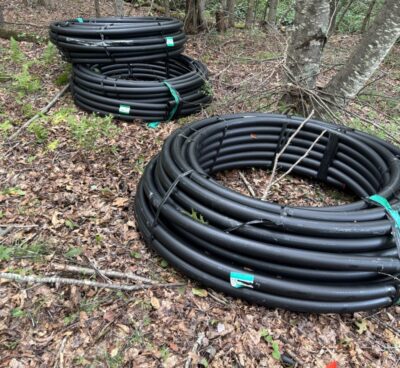
The 2″ HDPE came in giant ~6-foot coils, each of which weighed several hundred pounds. Once these were unraveled we had a rasslin’ match that looked like a monster movie with giant snakes. If you’ve never handled large dimension HDPE it is unbelievably tough and strong, slippery and cantankerous. Not to mention ridiculously expensive compared to Sch40 PVC, but I am expecting it to be worth the added investment. I got 15 years from the Sch40 PVC so this should outlast my time in Shangri-la.


Even two stout redneck brothers were no match for the Super Slinky. We wound up lashing the end to a long rope, feeding the rope along the path we wanted the pipeline to follow, and then pulling it up the ravine with my beloved little 4WD S10. The pipe was more than a match for two ~septuagenarians but was no match for 210 h.p. x 4500 lbs.

Here are the old and new, side by side. This level of damage to the old penstock was present in about 75% of the 1000+-foot length.

We finally connected the new pipeline into the system and had water flowing! I discovered that even at the bottom there was a crack in the PVC joints, so that needs to get replaced as soon as I can find the time. It’s working, now, but who knows for how long?

The work is not done by any means. I’ll let the new HDPE pipeline relax and lose its coilification to the greatest degree possible, then work the line from top to bottom leveling and lashing it. Reducing the up and down of the lay is critical to making the flow have as little turbulence as possible. If all goes well I will be able to run the system year round. Here’s hopin’.
honey can you pt XV.........
 |
| first one |
Last night after dinner I went back to the shop and put on the first coat of shellac on the shelves, the top, and the drawer. Doing the tops of them first followed by the bottoms. I hate this part of a project. I don't enjoy applying finish and certainly not the wait time between applications. Not to mention I can't do much of anything else while I do these dance steps.
 |
| got 3rd coat on |
This one pound coat isn't building and it is going to take more than 3-4 coats before it shines like I like it.
 |
| hmm...... |
I hadn't forgot this box for the Kreg pocket hole jig. I got the layout for the tails done but I don't have any room to get the Moxon vise on the workbench.
 |
| in the workshop |
The humidity is/was high today. I didn't want to bring it up to the driveway and chance having the shellac blush on me.
 |
| first coat |
The vertical slats look darker than the legs and rails. It was a little awkward applying the shellac to the interior - there wasn't a lot of room to spray.
 |
| PM session |
Got 5 coats on the shelves, the top, and the drawer front. I got four coats on the interior of the drawer and I'll put four on the bottom of the drawer.
 |
| hmm........ |
Got two spray coats and I rubbed them down with 4-0 steel wool. Applied the 3rd coat and I didn't have a warm and fuzzy with how much spray shellac I had left.
 |
| its dead Jim |
The can went dry spraying the on the 4th coat. I only got one side of one of the vertical slats before it gave up.
 |
| hmm........ |
Used about 2/3 of the batch I mixed up yesterday. I hadn't expected to use so much of it just on the shelves and the top. I still have the bottoms of them get shellac on. I got a pound on order but it won't be here until next week. FYI - the cost of 1 pound of dewaxed super blonde, with S/H, was $87. That is about $20 or so more than my last order.
I had bought it from shellac dot net and the price of the same shellac on 4 other sites were all within a few dollars of the shellac dot net price. I then checked on Amazon and dewaxed super blonde was the same price. However I found blonde shellac, 1.1 lbs, for $30. I don't know if it is dewaxed or not but I'll have it tomorrow. Fingers crossed that I will have enough of the current batch to finish this project.
accidental woodworker
The Last Page
I started blogging here 16 years ago today. Now I have decided to bring the Literary Workshop blog to a close. This is the 400th post on the blog, and I expect it to be the last one.
When I started the Literary Workshop Blog back in August 2010, I was just a couple years out of graduate school and had only a couple kids. A whole lot has changed since then.
When I started the blog, I didn’t set out to build an audience or promote a business or anything like that. Here’s how it happened: I used to post regularly on a woodworking forum called WoodNet, but the posts on that forum lasted only a year before being deleted. As an avid hand-tool woodworker, I enjoyed showing off my projects and trading woodworking advice with other traditional woodworkers. So I started this blog as an archive of the longer posts and projects I had put on that forum. Eventually the blog took on a life of its own. Internet forums declined in popularity, and I continued to learn about hand tools, make furniture, and discover traditional woodworking techniques. I’m a compulsive writer, so describing these things came easily to me. Part of the fun of starting a new project has often been planning the blog post(s) and photos that would feature it.
So what has changed in the last 16 years?
First, today’s media ecosystem is different. When I began the Literary Workshop Blog, most of the high-quality information on hand tools was still on forums and blogs, as well as in a few select magazines and books. If you wanted to work wood with hand tools, the information wasn’t going to find you. You had to read up on it. Now in 2026, the online space is flooded with short-form how-to videos, and once social media algorithms figure out that you’re interested in hand-tool woodworking, it will keep delivering that content to you automatically. The sheer amount of video content available is overwhelming. And a surprising amount really is fairly high in quality. That means there’s less demand for written content than their used to be. But I’m a writer, and I’m just not interested in creating video content. And even if you’re more of a reader than a video watcher (like I am), you can get very high quality content on hand tool woodworking from several good sources, like Lost Art Press and Mortise & Tenon Magazine.
I also maintain this blog at the pleasure of the WordPress platform, which I don’t control. Tomorrow the owners could decide to delete everything I’ve written over the past 16 years. If I were going to keep writing seriously about woodworking, I would want to publish it in a more stable, permanent form: a book. But I’ve written books, and I know what kind of time and expertise such a project takes. There are much better woodworkers than I am writing books right now, and I’m very grateful for them. I have neither the time nor the desire to compete with them for a publisher’s attention.
I’m also concerned about the rise of AI large language models (LLMs) like ChatGPT, Claude, and Gemini, which have taken advantage of all the free information on the internet and are able to synthesize it for users, often without regard to the credibility of the content, let alone the identity of the people (like me) who labored to produce that content. I am not interested in providing even more free content to feed those AI beasts.
But more importantly, my free time has become more limited of late. Writing about a project takes a significant amount of time, and the more time I devote to the writing, the less time I have for the woodworking itself. That’s one reason why I’ve gone from posting a couple times a month (at my peak) to posting just a few times a year.

If you’ve never tried to write up a project for a magazine article or a blog post (or done a video shoot of it), it’s hard to imagine how much extra time it takes to do the content creation on top of the actual woodworking. I estimate that writing a high-quality series of blog posts about a project can add a good 50% to the total time the project takes. If the project is really involved, doing the content creation can easily double the time. So if it was a 12-hour project, but I want to document each step and write up a series build-along posts, it’s now an 18-hour project, at least.
These days, I don’t have a lot of time for woodworking itself. Most of my kids are teenagers, and I’m always running them to practice or rehearsal, or attending a game or a show they’re in. And my oldest now has kids of her own, so my wife and I are having fun doing the grandparent thing. I’m also in a leadership position in my local church, which is an honor but also a big time-commitment. And my current job doesn’t allow me to step away from work during school breaks like my previous job did. All in all, it’s a good phase of life! But I have fewer stretches of uninterrupted time in which I can get a project done. Woodworking is still important to me, so if I’m going to spend any time woodworking at all, I can’t also be committed to writing about it.
Besides, I feel like I’ve said pretty much everything I wanted to say about woodworking and related topics over the years. The really important things I’ve learned and shared here can be summed up pretty easily:
- Make things you need. You get started by figuring out what you need, learning some skills, and trying to make it work with the tools and materials you have most readily available.
- Read widely. You can learn things about your craft from the most unlikely of authors.
- Sharpen your tools. Sharp fixes everything.
- Simplicity is a virtue. You can do so much with a small kit of essential tools.
- Use what you have. Most jobs don’t require new tools. You may already have something that will get the job done.
- Keep your eye out for good material. There is a lot of good stuff out there if you know what you’re looking for.
- Be picky about what you keep. There’s a lot of junk that’s not worth taking home or holding on to.
- Quality matters. Spend the money to get the good tool, and spend the time to make the joint fit just right.
- Specialize. There are so many sub-fields in woodworking, and nobody can learn them all. Pick just a few and get really good at them. Skills in one sub-field will transfer over to another.
- Build relationships, not just projects. It’s good to bring people into your process and to share what you have with others.
- Selling your work will change everything about your craft. You may or may not like the changes.
- Learn by imitation and experimentation. Find excellent models to imitate.
I do want to say thank-you to you, my readers, especially those of you who have taken the time to post encouraging comments on posts, or to ask follow-up questions. The writing comes easier when I know there will be at least a few people reading. And if you find yourself wanting to read more of my writing, you can always go back to the very beginning of this blog and start reading from there! A lot of the pictures are now gone from my earlier posts, but many of the really important photos remain.
If you run across a post you like, but you find broken links and/or missing photos, please post a comment letting me know. If I have time (and if the photos still exist), I’ll try to update the post with the missing material. And if you want to interact with me about woodworking, I am willing to reply to new comments on old posts, at least for the time being.
Eventually, though, I will close down users’ ability to comment on posts and turn this blog into a true time-capsule. I have no idea how long it will remain accessible to other people. I suppose it could still be floating in a digital archive a century from now. Maybe in a couple hundred years some historian or anthropologist will stumble upon one of my posts and discover something really interesting about the Hand-Tool Woodworking Revival of the early twenty-first century. Or maybe some distant descendant of mine will get interested in genealogy and discover more about his or her ancestors than anybody really needed to know. Or maybe a freak solar flare will obliterate this whole blog before the end of the year. There’s no telling how long anybody’s writing is really going to last.
Even though I won’t be writing new blog posts anymore, I’m not really going away. I’ll still be right here, doing the things that I’ve always written about: reading books, building furniture with hand tools, making spoons and spatulas, and spending quality time with my wife and kids.

Farewell!
Stephen J. Schuler
Springfield, Ohio
Priority of machines to get for woodworking (part 7)
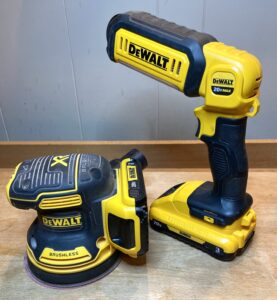
Pages
